
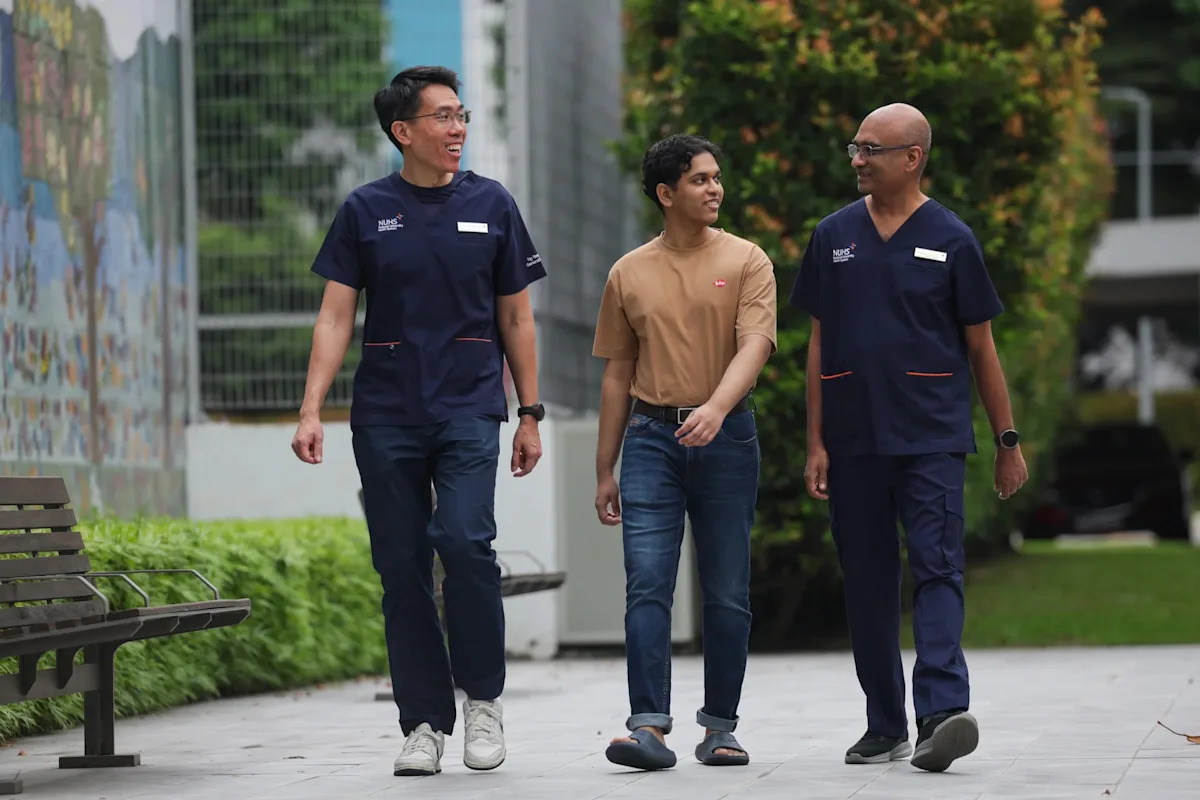
SINGAPORE – Going for a slow walk was impossible for part-time administrative officer Muhammed Arshad Assainar just two years ago.
He could not even put his right foot on the ground, let alone wear his right shoe and sock.
“Even having a blanket touch my right foot at night would make me jump and writhe in pain,” the 22-year-old told The Straits Times.
Arshad’s ordeal started after he tripped and landed his full weight on his right leg.
“Initially, it wasn’t painful, so I thought it was fine. Then the pain and the swelling progressively got worse and I was hospitalised on Sept 30, 2024, for about two weeks.
“That was when the doctors ran tests: X-ray, MRI and bone scans. It was then that I was diagnosed with CRPS (complex regional pain syndrome),” he said.
It is a rare and debilitating condition that typically affects the hand, arm, foot or leg after injury or trauma. The pain is more severe and lasts longer than what would normally be expected from the original injury.
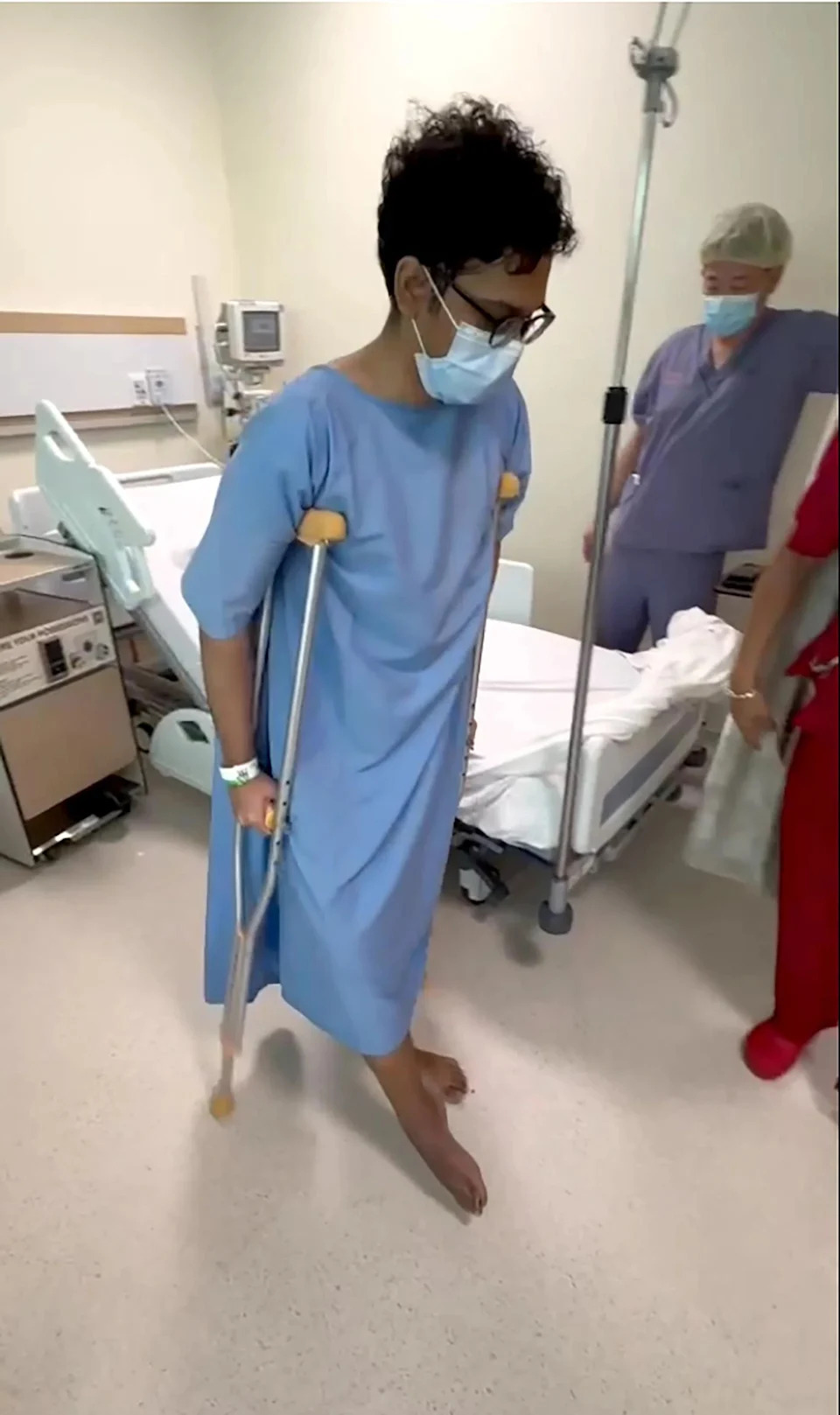
Before a two-stage spinal cord stimulation procedure, Muhammed Arshad Assainar, 22, could not let anything come into contact with his right leg.
(PHOTO: NG TENG FONG GENERAL HOSPITAL)
The exact reason why some people develop CRPS while others with similar injuries do not remains unknown. However, experts believe it happens when the body’s nervous system experiences a malfunction, becoming overly sensitive and creating exaggerated, prolonged pain and inflammatory responses.
“We do not have Singapore-specific data, but globally there are five in every 100,000 cases (of injury) and only a fifth ends up with severe resistance to treatment,” said anaesthetist Harinda Goonesekera from Ng Teng Fong General Hospital.
He added that if the patient does not respond to medication, “a more invasive approach like surgery will be considered”.
Arshad was initially treated in the orthopaedic department with his condition managed with physiotherapy. He was eventually sent to the pain management clinic but did not respond to medication that managed the nervous system.
“His pain was so intense and persistent that it was beginning to affect his mood. At this point, he was feeling desperate and was also feeling depressed,” Harinda said.
Arshad told ST: “Initially, I was still on crutches, and in just a few months, I was wheelchair-bound. I didn’t know why this was happening to me. I felt it was very unfair and why it had to be me… I felt like a burden to my family, so I entertained bad thoughts… It was pointless to go on.”
Using electrical pulses to control pain
Harinda said that in the United States, some patients had chosen a controversial move – amputating their limbs to get rid of the pain.
For Arshad, however, hope came in the form of a matchbox-sized pulse generator.
“We told (him) about a new procedure where a surgically implanted device is used to send electrical pulses to specific areas of the spine to help control pain,” Harinda said.
The doctors recommended this procedure because Arshad’s condition had not responded to treatment and could worsen over time.
Ng Teng Fong General Hospital’s head of neurosurgery Low Shiong Wen said the device, called a pulse generator, is not a cure but a jamming system.
“It will treat the over-amplification of pain at the spinal cord level by jamming the signals (sent to the brain) and stopping the patient from perceiving the pain, hence improving his quality of life,” said Low, who is also chairman of the hospital’s Medical Board.
Arshad went through a two-stage spinal cord stimulation procedure – which Low described as a “test-drive” – in May 2025 to determine whether the procedure would work for him, and the implantation of the pulse generator a month later.
“The test-drive was done under local anaesthesia. The leads, or two very thin wires, were placed into his spine at the spinal cord membrane. At the appropriate level, stimulation was introduced to moderate or mask the pain,” said Low.
The ends of the wires were connected to an external generator worn on a belt, and Arshad tested the device for about a week to see how well it masked his pain.
In typical cases, when the patient gets relief from the pain, the surgery is carried out to implant the pulse generator within the body, Low added.
It is implanted under the skin in the abdomen region.
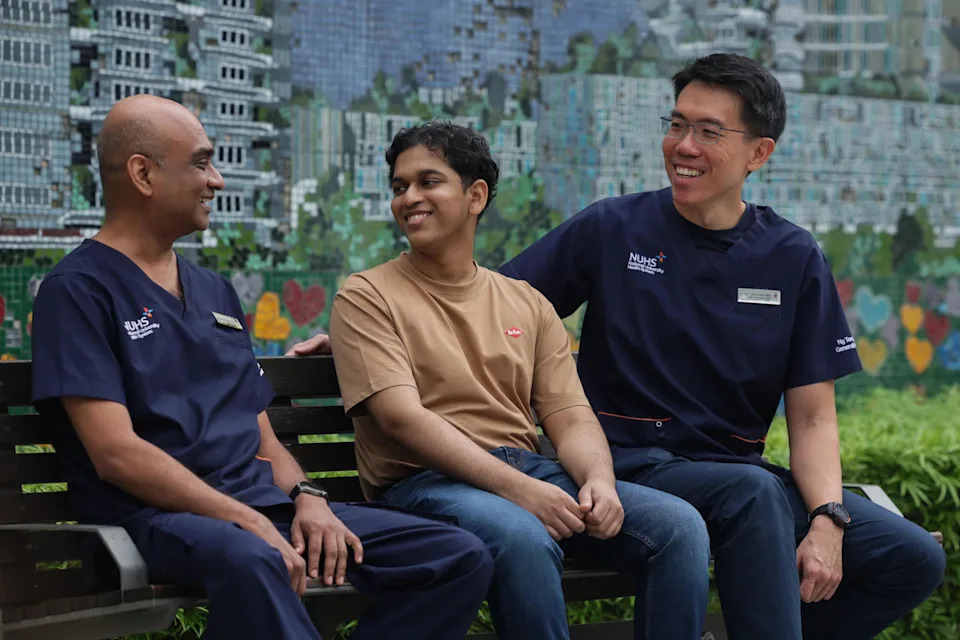
Arshad with anaesthetist Harinda Goonesekera (left) and neurosurgeon Low Shiong Wen (right).
(ST PHOTO: GIN TAY)
If the device fails, the battery runs out, or the wires that were in contact with the spinal cord shift position, disrupting the jamming system, then the patient would have to go through surgery again “to replace the hardware”, he added.
Harinda said the batteries in the older models of the pulse generator needed to be replaced every three years.
“But with today’s technology, the batteries can be recharged wirelessly, much like the magnetic charger of our mobile phones,” he added.
Arshad responded so well to the procedure that his pain reduced “almost immediately”.
Despite the good results, he still needed physiotherapy to rebuild muscles that had wasted away from disuse.
“After a few months and frequent physiotherapy sessions, I am able to put my right foot down and walk again,” he said.
Although Arshad is not pain-free, his condition has improved significantly.
“(I have) way less pain. I can basically do day-to-day tasks now without struggling, compared with how I did in the past year… I have learned to appreciate life a little more,” he said.
Source: The Straits Times © SPH Media Limited. Permission required for reproduction