
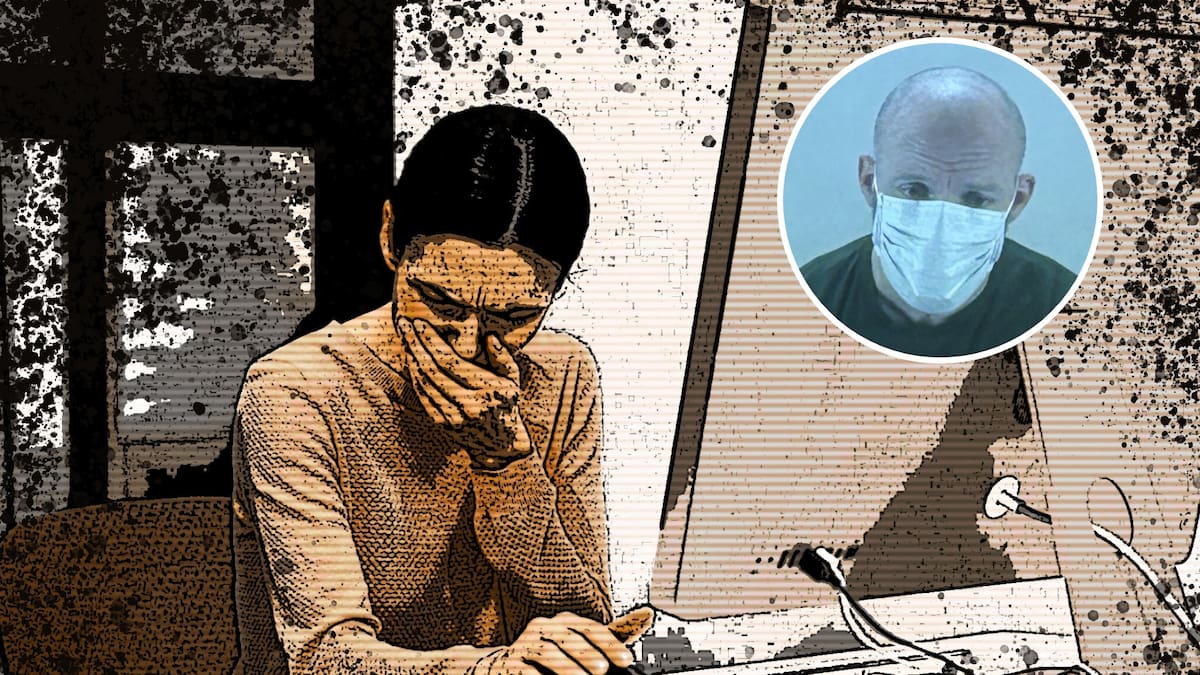
On the outside of the bag, someone had scribbled: “I think you should watch these; you’re in one of them.”
Not being very tech-savvy, the woman gave the bag to her son, who brought the files up on a computer.
Video clips of women filled the screen.
Police analysis would later show that over a period of about two years, Jason Curtis had filmed five women, some in their own homes.
The woman found her video and watched, horrified, as for more than 23 minutes she was dragged around like a doll by Curtis, a man she’d thought of as a friend.
This week, Curtis was sentenced for his crimes, including rape, indecent assault, multiple counts of unlawful sexual connection and making intimate visual recordings.
He was convicted following the woman’s testimony and that of a second victim after a jury trial last year.
Police said a third victim was identified but didn’t want to proceed with a police complaint, while the last two victims have never been identified.
Despite the verdicts, the court heard the now 43-year-old, who appeared at the sentencing by AVL from Rimutaka Prison, continues to deny the offending.
He accuses the victims of perjury, claiming one made it up to deflect from her own alleged offending. As the court heard this, Curtis nodded, the only reaction he showed during the hearing.
He accused the police of planting and destroying evidence, despite expert evidence at trial that none of the videos had been doctored.
‘It was a video of you raping me’
In her victim impact statement, which was read out for her in the Wellington District Court, the woman described how Curtis took her trust and shattered her world.
“The fact you drugged and then raped me is horrific enough. But to find out what you had done exactly by watching those videos you took left me mortified.
“What I was watching was actually happening in real life and not some movie. Worse, it was actually me in the video, and it was a video of you raping me.
“I was clearly unconscious and not in any state to have consented to having sex with you, nor would I have, and yet you still carried on raping me,” the statement said.
As she watched the video, she described feeling a range of emotions: “Rage, anger, frustration, hopelessness, and vulnerability.”
In the video, she sees herself lying face down: “I look dead.” Curtis appears in the shot and starts moving her into different positions, “doing God knows what”.
She says that at one point, she starts moaning, tries to close her legs, and kicks Curtis away before drifting back into unconsciousness, and the abuse continues.
At another point, he slips on a leather mask and is covered in a blanket. At the end of the video, the woman stumbles to the door.
“You just raped me,” she says, “you can clearly hear me say it”, before she leaves the room.
But her ordeal wasn’t over. Curtis followed her to the bathroom, carrying the camera, and assaulted her again as the filming continued.
Late the next morning, she awoke naked on his bed, with no idea of how she got there and no memory of what had happened.
Jason Curtis showed little emotion during his sentencing.
‘You violated them over extended periods’
At sentencing, Judge Brett Crowley also outlined the offending against Curtis’ two other victims, who were also sexually violated and filmed.
The judge said it was clear from watching the footage that the women weren’t conscious or were barely conscious, with Curtis not attempting to hide the camera and taking his time when setting it up.
“You rendered the women unconscious or, at the very least, unable to exercise their own autonomy. You violated them over extended periods.”
The court heard he’d also concealed a camera in the bathroom, filming one of his victims as she showered, which she was completely unaware of.
The judge noted there was only one incident that wasn’t filmed: an indecent assault in a car, which, despite the lack of footage, the jury found him guilty of.
How the hell did I get here?
Earlier that week, the woman had gone for a walk in the forest with Curtis.
It was a hot day, and returning to his house, she’d asked if she could have a shower, thinking nothing of it.
As she was showering, Curtis put his arm around the curtain, handing her a small can of pre-mix and telling her to drink it.
“I’m thinking it was a bit weird to start with, but you know, fair enough.”
He’d been insistent, waiting for her to finish it before leaving the bathroom with the empty can.
The last thing she remembers is walking out of the bathroom and across the lounge with a towel wrapped around her.
She awoke late the next morning, lying naked on his bed, thinking, ‘How the hell did I get here, let alone lying there nude?’
“His bedroom was right by the back door; anyone could walk in, and trust me, people came and went from that place all day, every day.”
Embarrassed, she collected her clothes and got dressed.
Meanwhile, Curtis was behaving as if nothing had happened.
As she sat on the couch, trying to piece together the missing hours, a mutual friend walked through the door, looked at her, and asked: “Are you all right?”
When she told him what had happened, he got her out of the house and took her to a doctor for a blood test.
The toxicology results, when they came, showed a high level of opiates. It was only then that she recalled the drink in the shower.
But still, she had no idea what had happened until she retrieved the paper bag from her letterbox.
She also recalls the horror of having to tell her friend, another of Curtis’ victims. Footage showed her unconscious on the couch, while Curtis was setting up his camera.
“Out of the whole ordeal, that was the worst: seeing her crumble in front of me like that.
“Watching the videos is one thing, but seeing someone crumble that you saw just walk in the door as happy as anything, to have her crumble in front of you, it was horrible.
“But she would never have known if I hadn’t told her. Never have known. And to me, that’s wrong.”
Yet her initial response was to do nothing; hide with embarrassment and get on with her life.
But it was her son who prompted her to take action, reminding her how she’d feel if Curtis continued to do the same thing to other women she knew.
She took the bag to the police.
Eight years waiting for justice
That was just the start of another ordeal. It would take eight years from the time charges were laid to sentencing.
In 2018, Curtis was initially charged with seven offences.
As the investigation continued, a further 18 charges were laid in 2019.
For the first six years, Curtis regularly drove down her street, slowing down to look up at her house.
It was only in the past two years, when his bail conditions were altered, that he was made to take a detour and avoid the local shops, where they risked bumping into each other.
But it was clear at sentencing that although the case was affected by the pandemic, the judge believed Curtis was largely responsible for dragging out proceedings, telling two report writers that he planned to delay the trial for as long as possible so that it couldn’t proceed.
“That was your strategy from the outset.
“And you very nearly succeeded. The [second] victim refused to attend court at the beginning of the trial, saying she had simply become worn out at the repeated disappointment of being told of a trial date, only for it to be abandoned.”
Curtis’ first trial was scheduled for 2020, but it was adjourned at his lawyer’s request. Despite talk of resolution and sentencing indications, nothing eventuated.
Over the next couple of years, more trial dates were set, only to be vacated, while lawyers came and went. There were questions about his fitness to plead, a communications assistant was appointed, and two section 38 reports were ordered, which concluded that Curtis was fit to stand trial.
Holding cells in the Wellington District Court were allegedly damaged by Jason Curtis at the start of his trial last year. Photo / Ministry of Justice
At the start of his trial, Curtis allegedly damaged his holding cell, disrupting not only his trial but also others that were running in the courthouse that day. The Ministry of Justice has released photos of the damage, saying the repairs cost $1,662.19.
Curtis also yelled at the Crown prosecutor during her opening address, causing a brief adjournment.
He then tried to claim he was suffering from persecutory delusions. But the judge noted that the court liaison nurse, who examined him, reached similar conclusions to the section 38 report writers.
“These delusions appeared to be a mindful choice on your part, rather than something you were suffering from,” the judge said, noting that once it was clear the trial was going ahead, “all evidence of any delusional thinking vanished.”
In the lead-up to trial, Curtis tried to sack his lawyer, eventually dismissing him at the end of the Crown case. To her surprise, he then called his mother to give evidence, in an attempt to introduce inadmissible evidence.
A sustained course of serious sexual violation: Judge
At trial, Curtis was found guilty of 23 charges, including 15 of making an intimate visual recording, five charges of unlawful sexual connection and charges of rape, indecent assault and possession of utensils for supply.
For this, the Crown suggested a starting point of 22 years’ jail, while the defence submitted that 17.5 years was more appropriate.
At sentencing, Judge Crowley noted the aggravating features of the case included the fact that all three victims were entirely vulnerable and were under the influence of drugs administered by Curtis.
He also referred to the clear planning, premeditation, and the scale of the offending.
In determining the starting point, the judge referred to the case of the Jaz brothers, who were at the centre of Christchurch’s Mama Hooch bar sexual assault and drink spiking case.
Acknowledging that the Christchurch case involved more victims, the judge and the Crown prosecutor, Sally Carter, agreed that this case involved a significant breach of trust, as all the victims knew Curtis well.
During the hearing, there was discussion about what had prompted a man with no previous convictions to offend as he had.
The Crown said it was clear from the reports that Curtis has mental health issues, although without a clear link to the offending, Carter submitted it wasn’t possible to warrant a discount.
In court, it was acknowledged that the death of Curtis’ father appeared to have prompted a man whose character references described him as being well regarded in the community to then behave in an “almost out-of-control” way.
Curtis tried to seek credit for his lack of previous convictions and the years he’d spent on bail, without a single breach. Judge Crowley said this had to be tempered against Curtis’ deliberate delay tactics.
The judge agreed to allow a 5% discount for Curtis’ lack of previous convictions and 5% for the other issues identified in the reports.
That 10% discount resulted in an end sentence of 18 years’ jail.
The question then was whether to impose a minimum period of imprisonment (MPI), which the Crown had sought.
Judge Crowley said an MPI was necessary to denounce Curtis’ conduct and protect the community, setting it at 50%, so Curtis must serve at least nine years in jail.
“This was a sustained course of serious sexual violation,” the judge said.
You don’t deserve to breathe the air of freedom
In her statement, the woman who received the SD card in the mail said the offending had eroded her trust in people generally.
“People go to hand me a drink, and I automatically decline based on the events that took place that night and the thought that they have spiked my drink too.
“The lack of trust and the constant doubting that I have now for anyone is a result of what you have done to me that night.”
She asked the judge to see Curtis for the “sadistic rapist” he is and sentence him for the “heinous crimes” he has committed, so that he “never gets the chance to ever do it again”.
“To never see your face again would be too soon; you don’t deserve to breathe the air of freedom.”
After the sentence was handed down, the woman told NZME, it was “fantastic”.
“It’s well deserved, and I’m glad a predator like that is off the streets.”
She has no idea who put the envelope in her letterbox, but speculates it was someone who knew Curtis well, knew what he was up to and wanted him stopped.
Victims showed enormous resilience, courage and tenacity
In a statement, Detective Senior Sergeant Martin Todd said police welcomed the sentence imposed by the court, which reflected the seriousness of this offending.
“We hope the sentence helps bring some relief to the victims, who we want to acknowledge for their resilience, courage and tenacity throughout this investigation.
“The offending by Curtis has understandably affected them deeply and has had a significant impact on their lives.
“I am very pleased that we were able to secure the convictions against Curtis so they can see him held to account for his actions.”
Todd also commended the investigation team, whose continued work on the case, even after the initial charges were filed, led to additional charges being laid.
“This demonstrates the conviction and determination the team had to secure an outcome for the victims in this case – and to demonstrate to other offenders that we take cases like this extremely seriously.
“No matter how long ago the offending was, we will investigate and do whatever we can to get justice for victims.”
Catherine Hutton is an Open Justice reporter, based in Wellington. She has worked as a journalist at the Waikato Times and RNZ. Most recently, she was working as a media adviser at the Ministry of Justice.