
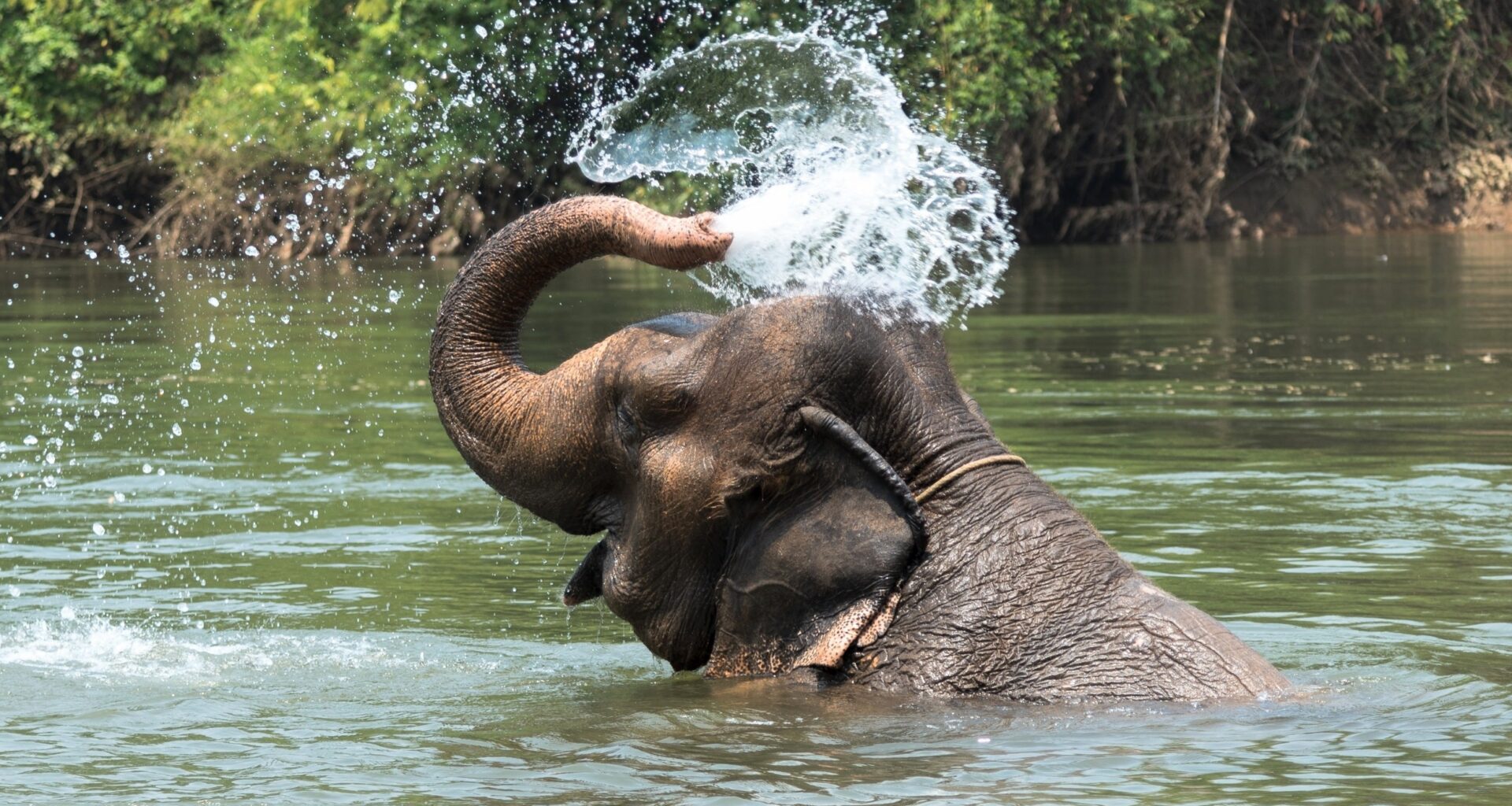
An elephant’s trunk is one of the most versatile tools in nature. It can drag a fallen tree trunk, strip leaves from a branch, or gently peel a banana without crushing the fruit.
Scientists have spent years studying the muscles that make those feats possible, revealing how a boneless structure can be both incredibly strong and remarkably precise.

A new study points to another piece of the puzzle.
Researchers found that the trunk’s skin is divided into two distinct regions, each specialized for a different job: one built for protection, the other for touch.
A trunk’s two jobs
The trunk does two things that fight each other. It must be tough enough to shove branches aside and haul weight, yet gentle enough to handle something fragile without crushing it.
Lucia Beccai, a robotics researcher at the Italian Institute of Technology (IIT) in Genoa, Italy, wanted to know how one skin does both.
Her team studied the trunk of an Asian elephant (Elephas maximus) that died naturally at a Swiss zoo in 2020.
To map the skin, they tested dozens of samples from along the trunk for stiffness and studied the tissue under microscopes. The picture that emerged split the trunk in two.
Protection where it matters
Earlier work had mapped the deep folds along the top of the trunk and the finer wrinkles below. That paper described the surface, not how those features change the way the skin performs.
The top skin is the tougher one. Compared with the underside, it is more than three times stiffer, holding firm before it gives. It is thicker and rougher, too.
Up top is where the trunk meets the world, scraping against bark and rough ground.
That stiff outer layer takes the hits and spreads the load, acting as a shield that protects the softer tissue underneath.
Built for delicate gripping
Flip to the underside and the skin changes character. It is far softer and far looser. It molds around whatever the trunk grabs, spreading its contact for a steadier grip.
This is the surface an elephant uses for its most delicate work.
One study showed elephants peeling bananas with the trunk tip and lifting small items with surprising care.
Softness alone does not explain the trunk’s reputation for touch.
The real surprise lay just beneath this underside skin, in a layer the team had not expected to tell the story.
The hidden touch boosters
Just under the underside skin sit rows of dome-shaped bumps called dermal papillae, small mounds of tissue that push up toward the surface.
The top skin barely has them. On the underside, they are large and densely packed.
When the team modeled how these bumps respond to touch, the simulations predicted something useful.
A dome gathers pressure spread across the surface and funnels it to a small point at its base.
That point is exactly where the touch-sensing nerve endings sit. A faint brush on the surface, funneled downward, could reach those nerves as a strong, clear signal.
The model is a prediction, not a measurement from a living trunk. Still, it offers the first physical explanation for the trunk’s fine touch.
A smarter way to feel
What makes this clever is the route to better touch. Not better nerves. The skin changes its own form so that ordinary nerves get a louder signal.
That trick is not unique to elephants. Human fingertips use a similar arrangement of tiny ridges and bumps to sharpen their own sensitivity, as a separate study of skin mechanics has described.
Anatomists guessed more than a century ago that the trunk’s skin shared in its sense of touch, but could not show the mechanics.
This study offers a likely answer, tying the trunk’s famed tactile sensing to one feature of its skin.
Helping build better robots
These findings hand engineers a design they can copy. Machines that grip and feel face the same challenge as the trunk, needing a surface that is both tough and sensitive, a problem that has long dogged soft robotics.
One lesson is to stop building grippers from a single material.
A robot hand could wear a hard, scuff-resistant skin where it meets rough surfaces and a soft, grippy one where it handles delicate objects, both printed into a single part.
The other lesson is to design the space around a sensor, not just drop one in.
By molding dome-shaped features above a touch sensor, engineers could amplify a faint signal while keeping the fragile component protected beneath the surface.
More elephants to study
For now, the work rests on a single trunk from one animal, which the team treats as a detailed case study rather than the final word.
Comparing more trunks, including African elephants alongside Asian elephants, would test how widely the pattern holds.
What the study makes clear is that the elephant trunk’s strength and delicacy come from a single skin divided into a hard, protective top and a soft, sensitive underside.
The bumps beneath help explain its fine touch, something long suspected but never demonstrated.
The bigger payoff lies in what engineers can now build. A gripper modeled on the trunk could protect its sensors while still detecting a gentle touch, making it useful for robots that handle delicate goods or work close to the human body.
The study is published in the journal PNAS Nexus.
—–
Like what you read? Subscribe to our newsletter for engaging articles, exclusive content, and the latest updates.
Check us out on EarthSnap, a free app brought to you by Eric Ralls and Earth.com.
—–