
Motion sensor transmits
real-time data
Motion sensor transmits
real-time data
Motion sensor transmits
real-time data
An illustration of the 2026 World Cup ball, the Trionda, which is being used on the pitch during current World Cup matches.
World Cup 2026
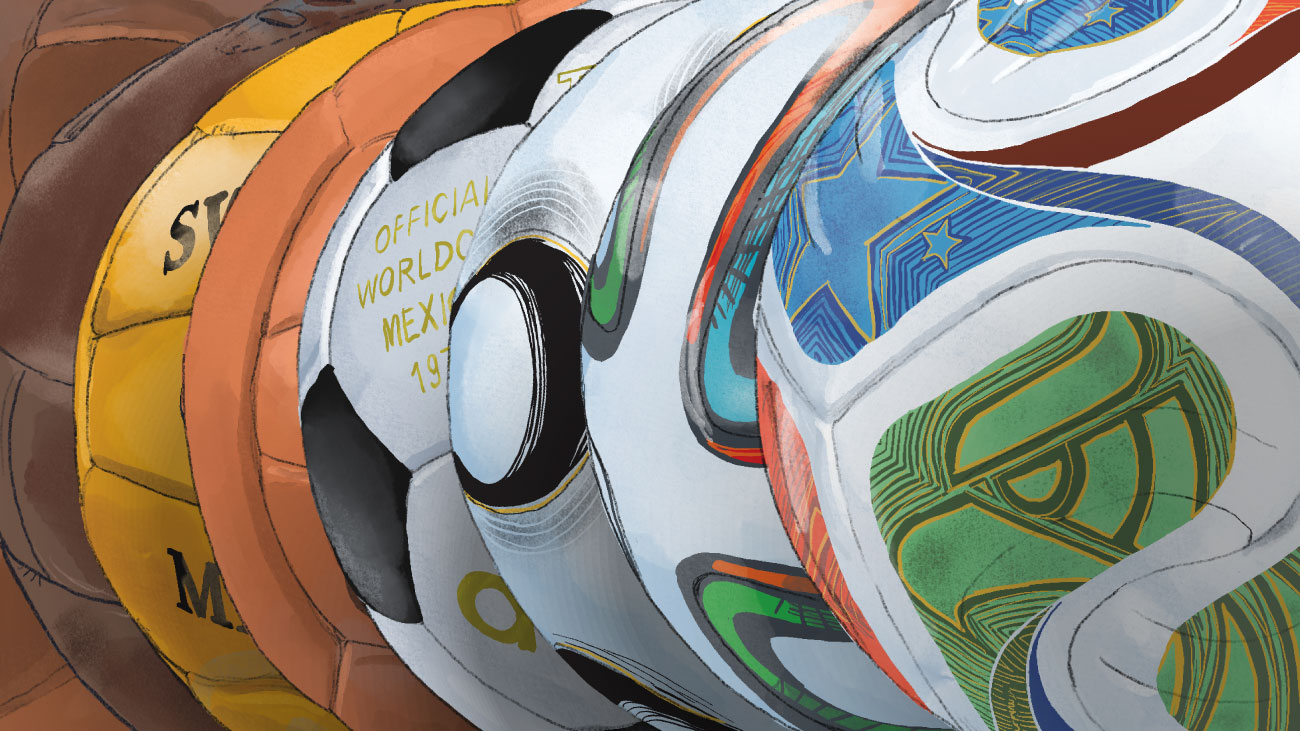
The evolution of the World Cup ball
Published June 22, 2026 03:00 PM GMT+8
Technology inside the World Cup ball took centre stage on June 14, when it helped award a disputed goal in Sweden’s 5-1 win over Tunisia. Officials used waveform data, similar to cricket’s Snickometer, to detect a slight contact with the ball, allowing the goal.
The incident highlighted how far the World Cup ball has come, from stitched leather models to sensor-equipped designs that can influence match-defining calls.
Here is a look at how the ball has changed over time.
The lace and leather era
Early decades were defined by hand-stitched leather balls, sometimes with external laces and inconsistent standards, often produced by host nations. These balls absorbed water, became heavier in wet conditions and varied in quality.
A dispute over the match ball marked the inaugural World Cup final in Uruguay in 1930.
Unable to agree, the teams used one ball per half. Argentina led 2–1 at halftime with their favoured Tiento, but Uruguay dominated after the break with their preferred T-model to win 4–2.
Thick leather laces
Seal the opening used to insert the inner bladder
Thick leather laces
Seal the opening used to insert the inner bladder
Thick leather laces
Seal the opening used to insert the inner bladder
Thick leather laces
Seal the opening used to
insert the inner bladder
Secondary annotation @14px
Tertiary annotation @12px
Illustration of the 1930 World Cup balls used in Uruguay. Leather models with thick leather laces sealing the bladder opening.
At the 1934 World Cup in Italy, the Italian-made Federale 102 was constructed from 13 hand-stitched leather panels. The bladder opening was stitched with cotton threads rather than leather, making heading less painful.
Cotten laces
Softer and less painful than leather
Cotten laces
Softer and less painful than leather
Cotten laces
Softer and less painful than leather
Cotten laces
Softer and less painful
than leather
Secondary annotation @14px
Tertiary annotation @12px
Illustration of two pre‑war World Cup balls: Italy’s 1934 Federale 102 with softer cotton laces, and the Allen ball used in France 1938 matches.
The Allen ball used at the 1938 World Cup in France was produced in Paris and broadly followed the same construction.
The Superball Duplo T, used at the 1950 World Cup in Brazil, was the first World Cup ball without laces. Air was introduced via a valve, producing a more uniform, round and sealed surface.
At Switzerland 1954, the Swiss World Champion used greased yellow leather to improve visibility. In a rain-soaked final in Berne, it still absorbed water and grew heavier as West Germany beat Hungary 3–2.
Secondary annotation @14px
Tertiary annotation @12px
Illustration of three mid‑century World Cup balls: Brazil 1950 Superball Duplo T, Switzerland 1954 Swiss World Champion, and Sweden 1958 Top Star.
FIFA introduced a selection process for the 1958 World Cup in Sweden, with more than 100 unbranded balls tested. The 24-panel Top Star was chosen. Used mainly in white, including in the final, it saw Brazil beat hosts Sweden with a young Pelé in the squad.
The Mr Crack ball, used in the 1962 World Cup in Chile, featured rounder panels than its predecessors. It was the first World Cup ball fitted with a latex valve, which slowed air loss and helped it retain its shape for longer.
At the 1966 World Cup in England, the Challenge 4-Star was made by British firm Slazenger, better known for tennis and golf equipment.
Secondary annotation @14px
Tertiary annotation @12px
Illustration of two World Cup balls: Chile 1962 Mr Crack in bright yellow with printed branding and hexagonal panels, and England 1966 Slazenger Challenge 4‑Star in orange with stitched panels and bold black lettering.
The white version was used for most matches, but the orange ball became iconic after the final between England and West Germany, when Geoff Hurst scored the first World Cup final hat-trick in England’s 4–2 extra-time win.
Adidas and the Telstar revolution
A major breakthrough came in 1970, when Adidas became the official supplier and introduced the Telstar, one of the most recognisable designs in sport.
Secondary annotation @14px
Tertiary annotation @12px
Illustration of two Adidas Telstar World Cup balls: Mexico 1970 with the original black‑and‑white panel design and adidas logo, and West Germany 1974 Telstar Durlast with branding on the same patterned panels.
Its black-and-white pattern improved visibility on television and became football’s defining image.
The ball took its name from a communications satellite that enabled the first live international TV broadcasts.
At the 1978 World Cup in Argentina, the Tango, named after the country’s national dance, introduced curved triads. The design was carried through to the next five World Cups.
For the following tournament, the Tango España kept the same look while nodding to Spain.
Secondary annotation @14px
Tertiary annotation @12px
Illustration of two Tango World Cup balls: Argentina 1978 Tango Durlast with curved triad patterns, and Spain 1982 Tango España with the same design, updated with polyurethane and coated seams.
A synthetic Transition
The shift to fully synthetic materials began, improving durability and water resistance. Balls became lighter and more consistent.
The Azteca was the first World Cup ball constructed entirely from synthetic material to minimise water absorption and increase durability.
For 1990, the Etrusco Unico followed adidas tradition, with triad panels featuring three open-mouthed lion heads, a motif from the ancient Etruscan civilisation of central and northern Italy.
Triads decorated with planets, stars and rockets
Triads match colours of French tricolore, featuring three cockerels, a French national symbol
Triads decorated with planets, stars and rockets
Triads match colours of French tricolore, featuring three cockerels, a French national symbol
Triads decorated with planets, stars and rockets
Triads match colours of French tricolore, featuring three cockerels, a French national symbol
Triads decorated with planets, stars and rockets
Triads match colours of French tricolore, featuring three cockerels, a French national symbol
Secondary annotation @14px
Tertiary annotation @12px
Illustration of four adidas World Cup balls: Mexico 1986 Azteca with Aztec‑inspired triad patterns, Italy 1990 Etrusco Unico with decorative motifs, USA 1994 Questra with planets, stars and rockets, and France 1998 Tricolore with blue, white and red accents and stylised cockerels.
The Questra maintained the familiar panel construction but its visual identity was shaped by the host nation United States’ exploration of space.
At the 1998 World Cup in France, the Tricolore was the manufacturer’s first multi-coloured match ball.
Brazilian striker Ronaldo jokes with team mate Roberto Carlos (L) while holding Tricolore soccer balls in training at the 1998 World Cup. REUTERS/Michael Urban
At the 2002 World Cup in South Korea and Japan, the hexagonal and pentagonal panel structure remained, but the Fevernova broke from the long-running triad design, introducing four trigonal graphics instead.
Secondary annotation @14px
Tertiary annotation @12px
Secondary annotation @14px
Tertiary annotation @12px
Illustration of the adidas Fevernova World Cup match ball for the 2002 South Korea/Japan World Cup, featuring a gold base with red and green trigonal graphics overlaid.
Engineering and aerodynamics
Technological innovation accelerated, focusing on aerodynamics and precision.
The Teamgeist, used at the 2006 World Cup in Germany and meaning “team spirit”, marked a structural shift in World Cup balls, replacing stitched hexagons and pentagons with 14 thermally bonded propeller-shaped panels, bringing it within one percent of a perfect sphere.
The swirling coloured lines reference traditional Brazilian wish bracelets.
Black and white referenced host nation Germany’s traditional colours, with gold lines providing a visual link to the World Cup trophy.
Black and white referenced host nation Germany’s traditional colours, with gold lines providing a visual link to the World Cup trophy.
The swirling coloured lines reference traditional Brazilian wish bracelets.
Black and white referenced host nation Germany’s traditional colours, with gold lines providing a visual link to the World Cup trophy.
The swirling coloured lines reference traditional Brazilian wish bracelets.
Black and white referenced host nation Germany’s traditional colours, with gold lines providing a visual link to the World Cup trophy.
The swirling coloured lines reference traditional Brazilian wish bracelets.
Secondary annotation @14px
Tertiary annotation @12px
Illustration of three adidas World Cup balls: Germany 2006 Teamgeist with black, white and gold curved panels, South Africa 2010 Jabulani with multicoloured textured panels, and Brazil 2014 Brazuca with interlocking shapes and swirling coloured lines referencing traditional Brazilian wish bracelets.
South Africa 2010’s Jabulani, meaning “to celebrate” in Zulu, carried 11 colours representing the 11 players in a football team. Its eight thermally bonded 3D panels were moulded into a perfect sphere with an innovative textured surface for improved grip.
For the Brazil 2014 World Cup, the Brazuca underwent extensive pre‑tournament testing, involving more than 600 professional players, 30 scientific teams and lab evaluation. The name was chosen by public vote, with over a million participants.
Secondary annotation @14px
Tertiary annotation @12px
Illustration of two adidas World Cup balls: Russia 2018 Telstar 18 with pixelated black panels, and Qatar 2022 Al Rihla with angular panels and red, blue and yellow graphics inspired by Qatari culture.
At the 2018 World Cup in Russia, the Telstar 18 revived the name and look of Adidas’ first World Cup ball. It also marked a technological shift, with an embedded microchip enabling smartphone interaction.
The Al Rihla followed in Qatar in 2022, designed to travel faster in flight than any previous tournament ball, with colours inspired by Qatari culture and the national flag.
It was the first World Cup ball to use adidas’ connected-ball technology, helping officials make faster, more accurate decisions, including on tight offside calls.
Secondary annotation @14px
Tertiary annotation @12px
Illustration of the 2026 World Cup ball Trionda for Canada, Mexico and the USA, featuring a white base with four flowing panels and red, green and blue graphics incorporating icons such as a maple leaf, eagle and star.
At the current World Cup, the Trionda features red, green and blue colours in tribute to hosts Canada, Mexico and the United States, with a maple leaf, eagle and star.
Its four-panel design has deep seams for flight stability and embossed detailing to improve grip. A motion sensor sends real-time data to match officials to aid faster decisions.
At this World Cup, the ball has become part of the technology shaping the game.
Simon Scarr and Kenneth Ferris