

When Don Archibald walked away from a comfortable career at a major bank to launch his own company, it wasn’t because he had discovered some foolproof path to riches.
In fact, the founder of Calgary-based Cypress Energy jokes that part of the reason was that nobody would hire him for the job he actually wanted.
“I had to create my own job,” he said. “I made myself president.”
Over the next three decades, Archibald did exactly that—building and leading multiple companies, sitting on corporate and non-profit boards, and establishing himself as one of Alberta’s most respected independent business leaders.
Yet when asked what entrepreneurship means, he rarely mentions money.
“I think you need to be motivated by the idea that you actually want to create something,” Archibald said.
That idea sits at the heart of this year’s Hunter Prize, a national competition seeking solutions to one of Canada’s most pressing economic challenges: declining entrepreneurship.
Supported by the Hunter Family Foundation, the competition offers up to $50,000 in prizes for innovative, practical, and fiscally responsible ideas to help reverse the trend.
At first glance, this so-called “wicked problem” seems like a niche concern for economists.
It isn’t. Entrepreneurship is ultimately about who gets to build the future.

“A country that cannot build its own future, through free people daring together to create what others need, will eventually rent that future from someone else,” said Jeff Adamson, founder of Neo Financial and SkipTheDishes, and one of this year’s Hunter Prize judges.
Problem-solving mindset
This future-focused perspective surfaced repeatedly in The Hub’s conversations with people who have spent their entire lives building companies from scratch.
For Derrick Hunter, president and CEO of Bluesky Equities—whose family helped establish both the Hunter Prize and the University of Calgary’s Hunter Hub for Entrepreneurial Thinking—entrepreneurship is the bedrock of all economic opportunity.
“Entrepreneurism isn’t an art or a science,” he said. “It is a practice, and it applies to us all. It is about identifying opportunities in situations of imperfect information and having the conviction to act.”
For Hunter, entrepreneurship is simply practical problem-solving.
“My mother is an artist, and she was the first one to say that if you’re an artist, you’re an entrepreneur, right? If you’re going to sell your paintings, you better be able to hustle and better be able to understand the market and how to get your brand out there and how to proceed if you’re going to build a following.”
That ability to notice a problem and do something about it is crucial. It requires both conviction and a leap of faith.
“Entrepreneurship is optimism put into action,” said Shelley Kuipers, co-founder of The 51, Canada’s largest women-led financial platform and venture firm.
“It’s the courage to build something that doesn’t exist yet, and the persistence to keep building when the outcome is uncertain,” she said.

i
Women walk in the financial district in Toronto, September 29, 2021. Evan Buhler/The Canadian Press.
More than a few have described the experience as terrifying yet liberating.
“It was like somebody gave me freedom,” Archibald said. “I would live and die by the decisions I made.”
Canada’s builder problem
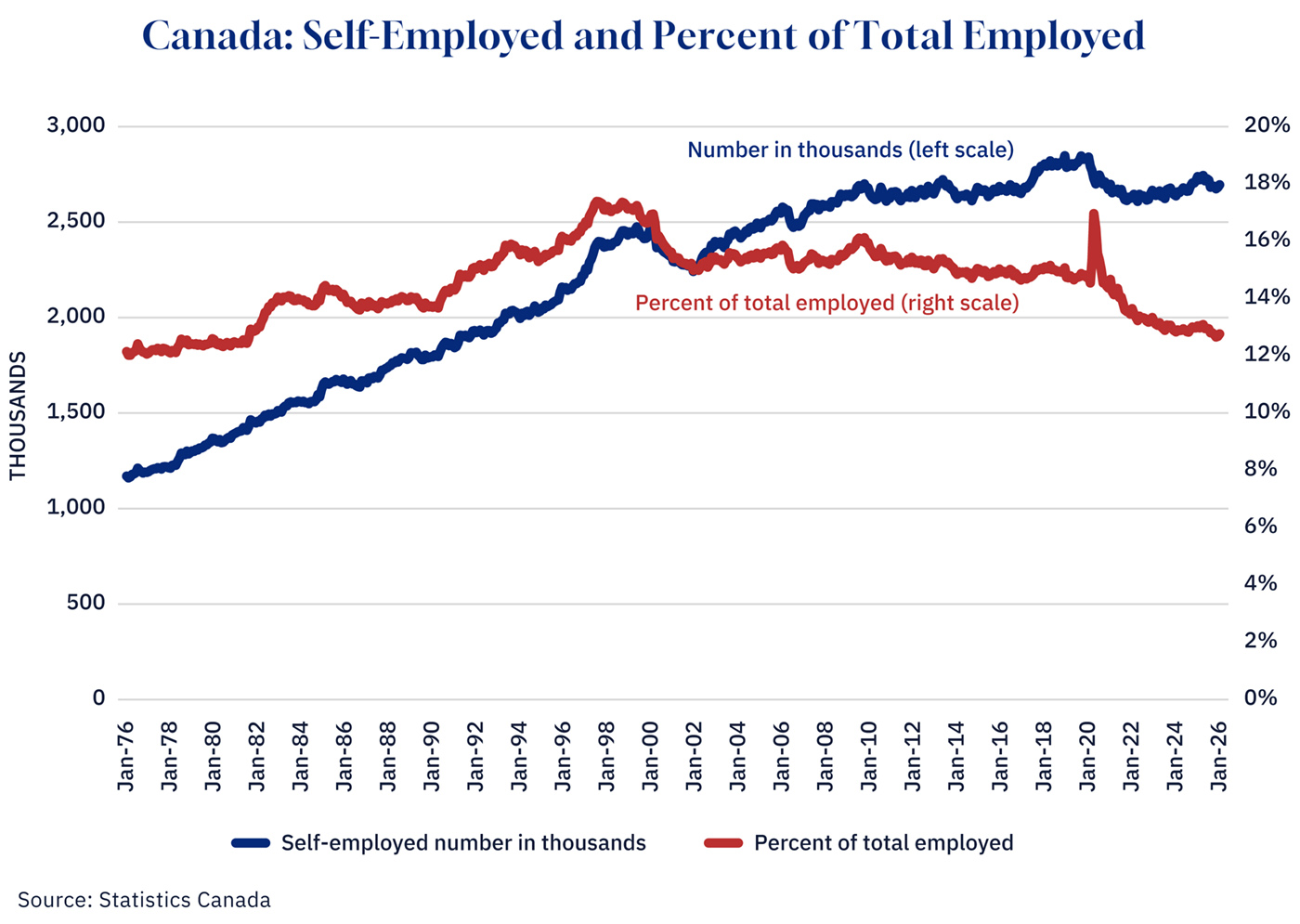
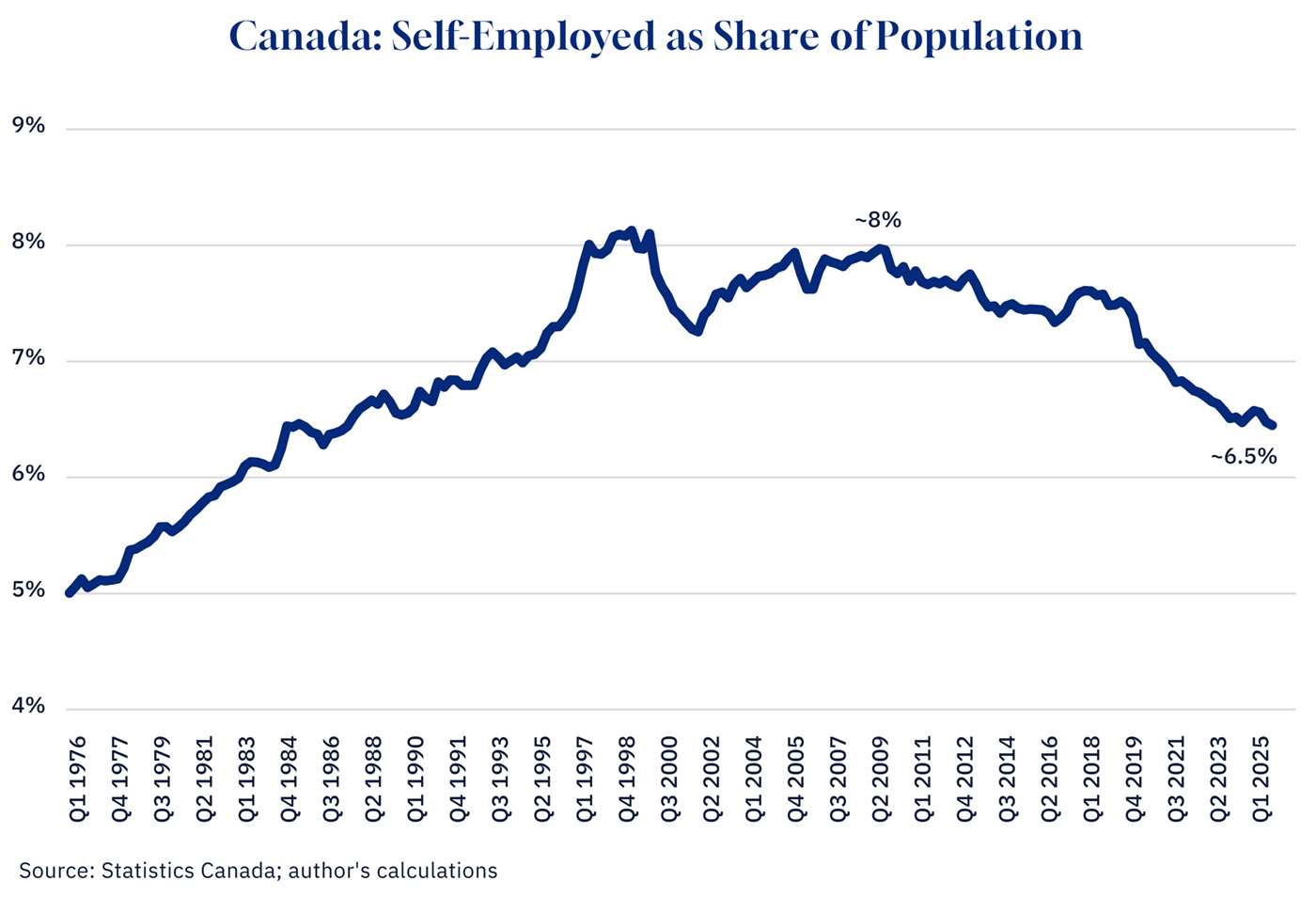
Canada is producing fewer builders than it used to. The share of self-employed Canadians has slipped from 17 percent to just under 13 percent. More alarming is the data on self-employed Canadians who actually hire employees—the very group that drives corporate growth—which has plummeted by more than half since 2000.
The same pattern appears in business formation. Statistics Canada data show Canada’s business entry rate fell from 15 percent in 2008 to 12 percent in 2023.
While the country continues to generate successful companies, many of the companies Canadians associate with success—even relatively recent ones such as Shopify and Lululemon—are now decades old.
In a recent episode of Alberta Edge, Adamson noted that many of Canada’s most recognizable brands were founded so long ago that they predate modern technology.
“Royal Bank was pre-electricity, I think,” he said. “When they started up. It was still during the fur trade when a lot of these companies first started up.”
Adamson’s point may have been tongue-in-cheek, but not by much.
The institution that would eventually become RBC was founded in Halifax in 1864 to serve Atlantic Canada’s fishing, shipping, timber, and trade industries—nearly two decades before another entrepreneur came along and built Canada’s first water generator in Ottawa, which still powers the capital today.
As The Hub has documented, the median age of Canada’s 15 largest public companies was an astonishing 122 years in 2021. In the U.S., it was just 45 years.
“The challenge isn’t that we know how to build great companies,” Adamson said. “It’s why did we slow down doing that?”
In his view, the country has shifted its focus from creating new wealth to managing what already exists. The numbers, as Hub contributor Charles Lammam chronicles, are troubling.
Graphic credit: Janice Nelson
“In a lot of ways, I think we started treating Canada almost like an inheritance to be managed and not a project to be built,” Adamson said.
Why it matters
Entrepreneurship is one of the primary ways a society renews itself.
Startups challenge stagnant incumbents, bring new ideas to market, create jobs, and solve the hyper-specific problems that massive institutions tend to ignore.
Many of the modern conveniences Canadians now take for granted—from online commerce to agricultural innovations and energy technologies—started as a risky, unproven idea that someone decided to pursue anyway.
That willingness to embrace the unknown is more critical than ever as Canada faces a rapidly shifting economic landscape shaped by AI, changing demographics, global competition, and sluggish productivity growth.
Ask any young person how they feel about the future, and their answer is revealing. Many no longer assume life will be easier than it was for their parents.
Solutions to these challenges won’t come solely from government mandates or corporate boardrooms. They will come from individuals willing to experiment with something different. This requires an enabling environment and a culture that rewards risk-taking.
It’s why this year’s Hunter Prize focuses on building “a new entrepreneurship agenda that makes it easier to start, build, finance, and scale firms.”
The goal is to encourage more people to spot opportunities, tackle problems, and build things of value.
For Archibald, that remains the enduring appeal of entrepreneurship.
“When you create a business, you create almost like a living entity,” he said. “If you do it properly, everybody feels like they have a hand in creating something worthwhile.”
The danger of Canada’s entrepreneurial slowdown isn’t just a lack of new startups. A country that stops producing builders eventually stops producing opportunities—leaving the next generation to simply live off the achievements of the past.
The Hunter Prize submission period is open until August 2, 2026.

Falice Chin is The Hub’s Alberta Bureau Chief. She has worked as a reporter, editor, podcast producer, and newsroom leader across Canada…
Read more
Canada is producing fewer entrepreneurs than it once did, raising concerns about the country’s ability to generate new businesses, jobs and economic growth. Through conversations with business leaders, including Don Archibald, Jeff Adamson, Derrick Hunter, and Shelley Kuipers, this article explores why entrepreneurship matters beyond wealth creation. Their argument is that entrepreneurs are ultimately builders—people willing to identify problems, take risks and create something new.