
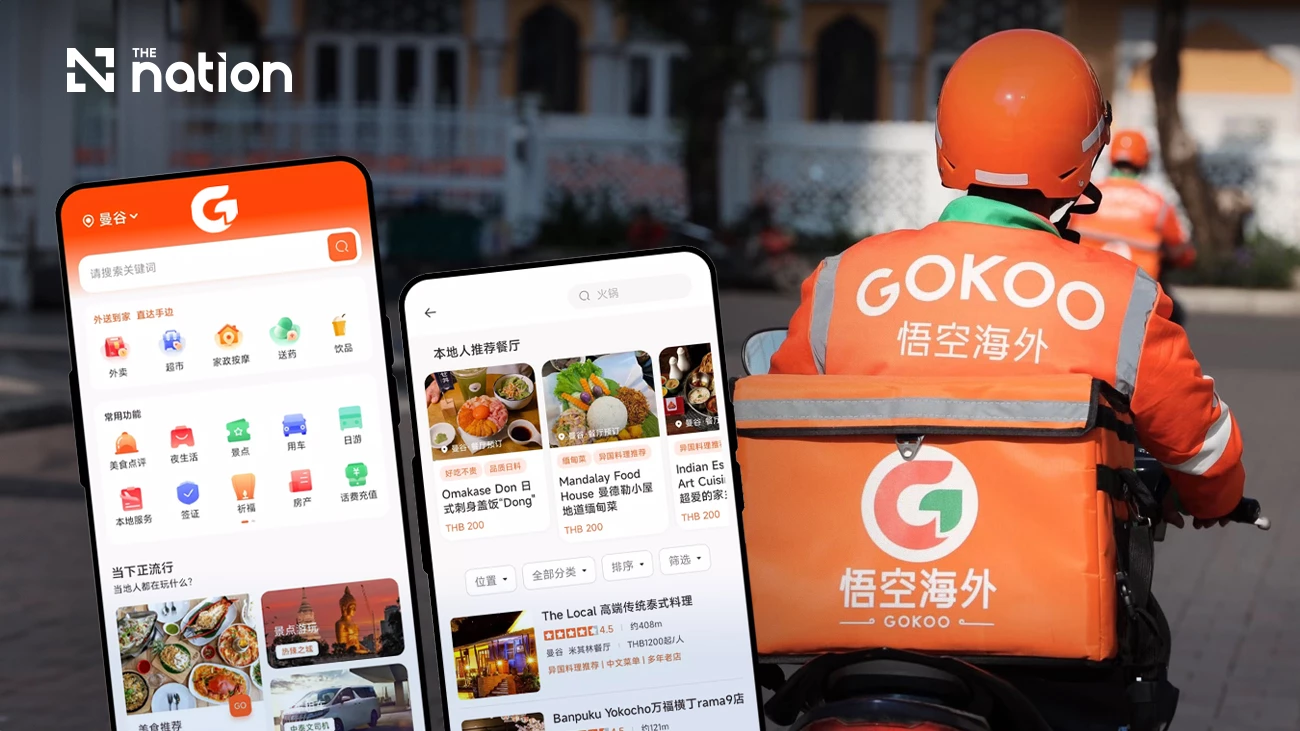
GOKOO grows beyond food delivery
GOKOO is the platform drawing the most attention. It operates in several countries, including Singapore, Vietnam, Thailand, Saudi Arabia, Laos, Cambodia, Indonesia and Malaysia.
The platform began operating in Thailand in 2021, initially as a delivery service. It has since developed into one of the leading platforms among Chinese users in Thailand, with services covering Bangkok, Pattaya, Chiang Mai and Phuket.
Available information describes the app’s development team as including senior engineers and programmers from major Chinese technology companies such as Alibaba and Meituan, both of which have deep experience in online-to-offline business models. Senior executives from well-known companies in Thailand are also described as having helped build the platform’s back-office team.
GOKOO has since expanded from delivery into tourism, property, medical services and visa support, reflecting a wider attempt to build a lifestyle ecosystem for Chinese communities overseas rather than remaining only a food-delivery app.
Through one app, users can buy products, book hotels, reserve travel tickets, find beauty services, book vehicles, take Thai-language courses and access other services. The platform provides services in Chinese, English, Thai and Vietnamese.
E-GetS focuses on Bangkok and Rayong
Another Chinese-linked platform active in Thailand is E-GetS, which operates in Thailand and several other ASEAN markets.
E-GetS provides services in several languages, including English, Thai, Lao, Vietnamese, Cambodian, Chinese, Japanese, Korean and Indonesian. In Thailand, its main service areas are Bangkok and Rayong.
The platform was founded in 2018 as a Chinese digital lifestyle service covering online food ordering, modern retail, real-time logistics and food supply-chain services. Its stated model is to use technology to support digital transformation and improve consumer lifestyle services in Southeast Asia.
A review of services inside the app shows that E-GetS differs from GOKOO in its market presentation. While GOKOO appears largely in Chinese and features many Chinese restaurants, E-GetS includes a broader mix of restaurants and drinks providers, including Thai, Chinese, Korean, Vietnamese and Japanese options.
E-GetS also offers other services, including flight booking and parcel delivery.
Feixiang came before GOKOO and E-GetS
Before GOKOO and E-GetS became more visible, another platform had already entered the market: Feixiang, also known in Thai as “Flying Elephant”.
Feixiang positioned itself as a food-delivery and lifestyle-service platform for Chinese people living in Thailand.
Between 2020 and 2022, Feixiang was among the more popular apps in Chinese communities in Thailand. It offered food ordering, restaurant searches, parcel delivery and lifestyle services through a Chinese-language app designed specifically for Chinese users.
Information in the app showed that it had operated in several key provinces and areas, including Bangkok, Chiang Mai, Samut Prakan, Rayong and Pattaya. It also connected users with Chinese restaurants and popular local restaurants in Thailand.
Although Feixiang is no longer considered a major player in the market, it has not disappeared entirely. It remains one of the early Chinese-language platforms that served the Chinese community in Thailand before GOKOO and E-GetS became more prominent.
Recent checks still found traces of app updates on some Android platforms in 2024, although there has been little sign of active marketing in Thailand compared with the past.
The platform’s official website and recent public-relations activity also appear to have become less active, while discussion of Feixiang among Chinese business groups and Chinese communities in Thailand has declined significantly.
Regulation becomes the central question
The key issue is no longer simply whether Chinese apps have entered Thailand. They have been present for years. The bigger concern is how their back-end systems, ownership structures, rider networks and business operations are being regulated.
Questions over rider legality have become part of the debate after some observers said certain riders appeared not to be Thai. On the other side, a former GOKOO rider has said some riders are Thai and that some can earn around 20,000 baht in two weeks, although they may work 12 hours a day and are monitored by administrators around the clock.
These issues are likely to remain under close watch as Chinese capital, grey-capital concerns, foreign nominee structures and cross-border digital platforms become more deeply connected with Thailand’s tourism and service economy.
For regulators, the challenge is to separate legitimate foreign investment and digital services from businesses that may use nominee structures, unclear labour arrangements or weak oversight to operate outside Thai rules.