
The Cap Times is an independent newsroom serving Madison and Wisconsin. Sign up for the Morning Update to receive news in your inbox each morning.
Jade Levendoski put on her cowboy hat and flipped a switch. A red neon light illuminated the hat, matching the color in Levendoski’s pigtails.
“It looks so good!” Kylie Tsai exclaimed.
Levendoski and Tsai put the finishing touches on their art projects this month at the University of Wisconsin-Madison. The two were among nine students who took a summer course called “Neon: Light as Sculpture.”
Tom Zickuhr, a lecturer in the university’s Art Department, has taught the class for more than nine years. Students learn how to bend and shape glass tubing into 3D shapes.
“It’s a very finicky process,” Zickuhr said. “There’s a huge learning curve.”
When people think of neon lights, they likely picture signs at restaurants and gas stations. But “neon has so many possibilities,” Zickuhr said.

Jade Levendoski shows off her wearable piece of neon. She wrapped a red neon light around a cowboy hat.
RUTHIE HAUGE
UW-Madison created the first collegiate glass program in the United States in 1962, according to the university’s website. Today, a handful of similar academic programs exist across the country, Zickuhr said. What makes UW-Madison’s program unique is “we do everything here ourselves.”
“We create the neon. We bend and blow the glass. But we also process it and turn it into the light form that you see,” Zickuhr said.
Flames from a torch are created from natural gas and forced air and can reach about 1,500 degrees Fahrenheit.
RUTHIE HAUGE
As the class wrapped up this month, the students worked on their projects in a dim, warm space in the Art Lofts building, just east of the Kohl Center. The room was so quiet at times that only the roar of flames, created from natural gas and forced air that can reach about 1,500 degrees Fahrenheit, could be heard.
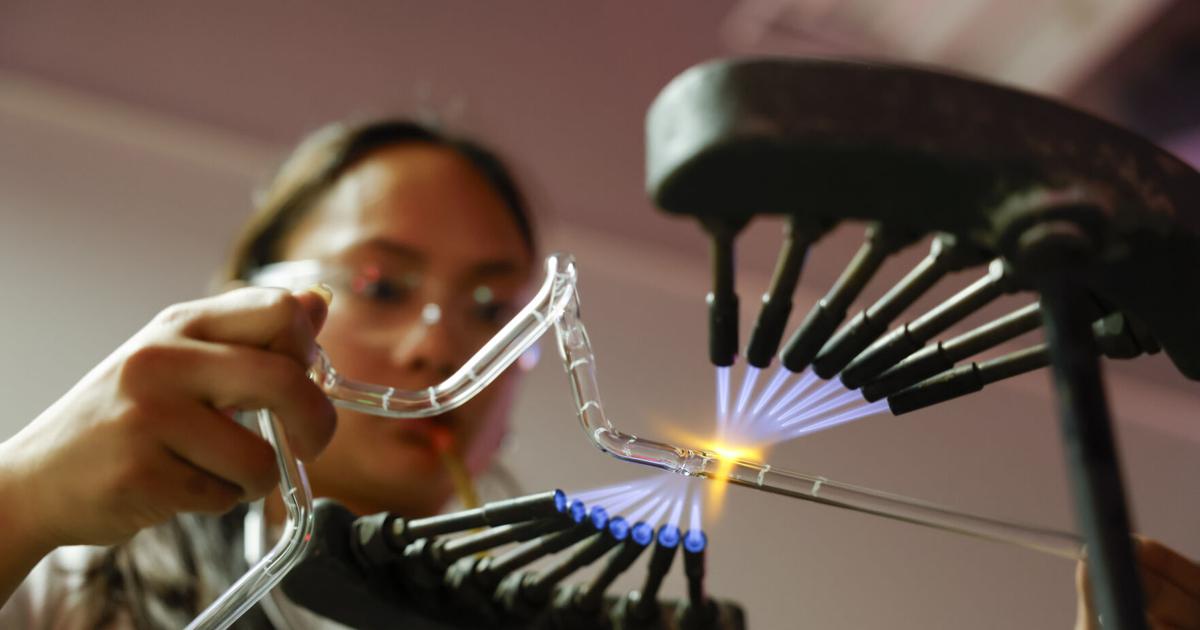
Tsai held a piece of glass over a torch. As she rotated it, Tsai blew into a tube connected to the glass.
Kylie Tsai heats a section of glass, getting it to a “plastic” state before physically bending the glass. Students have seconds to get the glass into the desired shape after heating.
RUTHIE HAUGE
“Imagine you have a garden hose and you bend it. It’s going to kink and crimp right where you bend,” Zickuhr said.
Blowing into the tube helps the glass keep its round shape so gas can travel through it, he said. The course uses two noble gases, neon and argon.
“These are not average light bulbs. … If it’s processed right, they can last 75 to 100 years,” Zickuhr said.
Tsai, an incoming senior studying graphic design, said she had wanted to take this course since her first year on campus. She created what looked like a wand, with a yellow star on top of a blue stick, which she said was inspired by the video game Super Mario Kart.
Zickuhr lit up the wand so Tsai could see the results of her hard work. The process involved lots of trial and error, but Tsai saw herself improve as time went on.
“I’m still so proud of myself,” Tsai said.
“You should be,” Zickuhr replied.
Kylie Tsai created what looked like a wand, with a yellow star on top of a blue stick, which she said was inspired by the video game Super Mario Kart.
RUTHIE HAUGE
On the first day of class, “I was shaking,” said Levendoski, an incoming junior studying art education. She contemplated quitting because she was so terrified of the glass and the heat. A few days later, though, her confidence started to grow.
“Everyone kept on telling me Tom will make you feel really comfortable. He won’t let you get hurt,” Levendoski said.
Levendoski is interested in fashion, so she decided to create a wearable piece of neon on a cowboy hat. Mikee Panganiban, an incoming senior majoring in design, innovation and society, made a bag out of neon stars and beads.
Vivian Ye created a series of small bends in her glass tubes to look like intestines, which she wrapped around a vase with faces on it.
“I fell in love with (neon). It’s very fun,” said Ye, an incoming senior studying fine arts.
Jade Levendoski was so terrified on the first day of class that she was shaking. As she became more comfortable working with glass and heat, her confidence grew.
RUTHIE HAUGE
The students created sketches of their designs. They measured and marked the glass tubes with wax pencils, turning back and forth between work benches and the torches.
Zickuhr also teaches the course in spring and fall. It’s become so popular that it has a waitlist. While art students receive priority enrollment, Zickuhr said he’s taught neon to students studying physics and business.
“Neon is very captivating,” he said. “It is very fun to look at. It’s very interesting, and people can’t get enough of it.”
The summer version of the class can be extra challenging, Zickuhr said. Rather than having a few months to practice, students work six hours a day over the course of a month, plus extra time outside of class.
Mikee Panganiban lines up a glass tube against a template. Panganiban created a bag out of neon stars and beads.
RUTHIE HAUGE
Tom Zickuhr, left, teaches the “Neon: Light as Sculpture” course at the University of Wisconsin-Madison. “We make neon, which is just simply a nickname for a light source using noble gasses,” he said.
RUTHIE HAUGE
“The community that’s formed in glass is really special because it is so much time and so physical that you just get really close to the people that you’re working with,” said Lars Shimabukuro, a graduate student in design studies.
In addition to the neon class, Shimabukuro took a scientific torchworking course this summer, learning how to make glass that could be used for research in labs.
“Just like neon, scientific glasswork is 100% handmade, so it’s made by human hands. There’s no automation,” Zickuhr said.
While Lars Shimabukuro generally works with textiles and teaches weaving, they took two glasswork classes this summer at the University of Wisconsin-Madison. Glass is “such an intriguing material. It’s really unlike other things,” Shimabukuro said.
RUTHIE HAUGE
After graduating from UW-Oshkosh, Zickuhr said he briefly worked as a social worker before moving to Colorado for a fresh start. He found a job at a neon shop.
“It took me almost five years to really get up to speed to be able to make a living at it,” he said.
Zickuhr runs a shop on Madison’s east side called the Neon Lab, where he does commercial work and signs. What Zickuhr’s most proud of from his career, though, is the class he teaches at UW-Madison.
“Every semester, the people in this class — and I say this without exaggeration — they continue to impress me and continue to surprise me with their ideas.”
Jade Levendoski, left, and Lars Shimabukuro, right, work on their final neon art pieces.
RUTHIE HAUGE