
Earth turns on a single axis, one steady spin that gives us day and night. Most asteroids behave the same way, rotating around a single axis in a pattern astronomers can predict years in advance.
A small rock in the asteroid belt does not follow that rule. Last year, NASA’s Lucy spacecraft swung past the asteroid, known as Donaldjohanson.

The spacecraft sent back data that Earth-based telescopes could not capture, revealing that the asteroid moves in a far stranger way than scientists expected.
Observing an asteroid that wobbles
Donaldjohanson circles the Sun in the inner main belt, the band of rubble between Mars and Jupiter. Lucy flew within 650 miles of it on April 20, 2025, at about 30,000 miles per hour.
The asteroid is small, measuring only about five miles from end to end. That brief pass overturned a long-held idea about how the rock moves.
Leading the work was Dr. Simone Marchi, deputy principal investigator of the Lucy mission at the Boulder, Colorado, branch of the Southwest Research Institute (SwRI).
From Earth, telescopes had watched Donaldjohanson’s brightness rise and fall in a steady rhythm, the mark of an elongated object turning end over end once every 10.5 days. That pattern was familiar.
Up close, Lucy caught a second motion. The asteroid rocks slowly around its long axis, with a wobble that repeats about every 26.5 days.
It tumbles rather than spins cleanly. Until the spacecraft arrived, no one had seen it.
Two space rocks became one
Those close-up images settled an older question about what Donaldjohanson looks like. Earlier observations had only suggested it was long and lopsided.
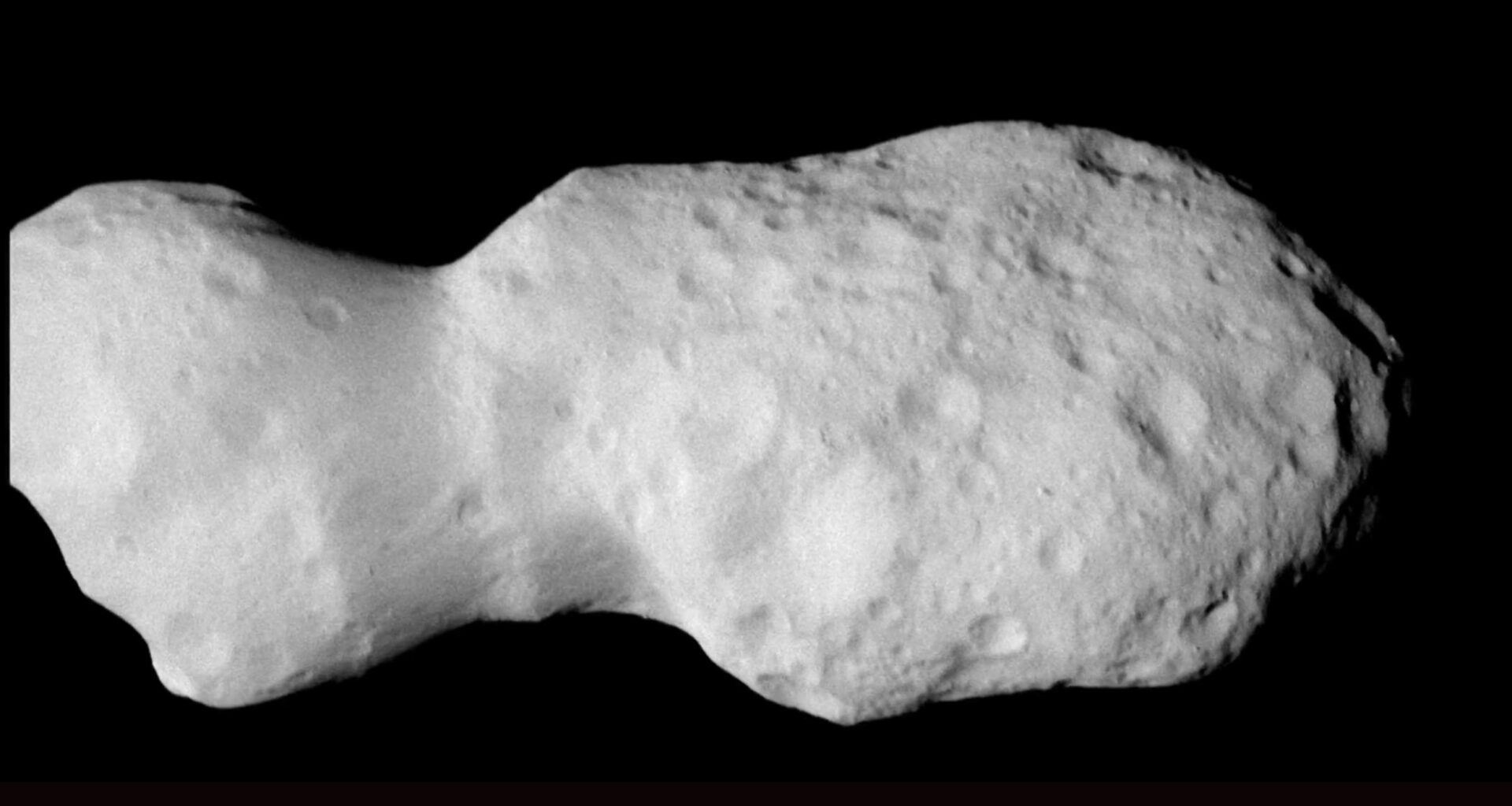
The photos revealed two rounded lobes joined by a narrow neck, giving the asteroid the outline of a peanut.
Once, they were two separate rocks. The lobes were probably independent chunks.
After a collision shattered a larger body, they drifted together and locked into contact under their own gravity, the team concluded.
Craters and ridges cover both lobes, and many of the craters look worn down rather than sharp. That softened appearance is a clue to the asteroid’s past, tied to how fast it once rotated.
Sunlight changed its spin
Donaldjohanson almost certainly spun much faster in its youth, likely at least ten times faster than it does today.
The team estimates it eased into its current slow rotation over the last 20 to 60 million years. As it slowed, loose rock slid downhill and gradually wore the craters smooth.
The slowdown most likely comes from a faint force caused by sunlight called the YORP effect. Sunlight warms the surface, which then radiates that heat back into space, giving the rock a tiny recoil.
Because the asteroid is lopsided, those tiny pushes do not cancel each other out. Instead, they add up.
Over millions of years, that nudge becomes a slow twist that can speed up a spin or slow it down, a force seen at work on other asteroids in a separate study.
Evidence of long-lost water
Lucy carried an instrument that reads the light bouncing off a surface and determines which minerals are present.
As it swept past, it detected the fingerprint of iron-rich clays, which form only when liquid water interacts with rock.
That water did not stick around long. Over time, the iron in these clays tends to be replaced by magnesium, and Donaldjohanson’s clays still retained their iron, suggesting the wet period was brief.
Other carbon-rich asteroids tell a different story. Rocks like Bennu and Ryugu, sampled by earlier missions, contain magnesium-rich clays, a sign that water soaked them for much longer.
Cousins across the asteroid belt
Donaldjohanson appears to be a close relative of Bennu and Ryugu, built, the team thinks, from the rubble of a larger carbon-rich parent body that shattered in a collision.
At about 155 million years old, however, it is far younger than those cousins, which date back one to two billion years.
It also stayed close to home. Bennu and Ryugu drifted into looping orbits that swing near Earth, making them easy targets for missions that collected samples.
Donaldjohanson never left. It has circled quietly in the asteroid belt since it formed.
“Every subtle difference is another clue to our origin story,” said Dr. Marchi.
She noted that small contrasts between similar rocks help pin down where and when each one came together. Comparing these look-alikes is the whole point.
Testing Lucy’s next adventure
The whole encounter was a practice run. Lucy is bound for the Trojan asteroids, two swarms of ancient rocks that lead and trail Jupiter, and Donaldjohanson let the team test its instruments.
The first Trojan, a rock named Eurybates, comes into view on August 12, 2027.
Its odd name honors paleontologist Donald Johanson, who in 1974 found a famous early human ancestor in Ethiopia and nicknamed the skeleton Lucy. The spacecraft took that name, and now the asteroid carries it too.
A single close pass rewrote the basics. A peanut once known only as a flicker of light became a tumbling, water-touched survivor with a long history on its worn face. Small rock, long story.
If a warm-up can do this to one small rock, the payoff at Jupiter could be huge. The older, stranger Trojans may force scientists to rethink how the planets and the space between them came together.
The study is published in the journal Science.
Image credit: NASA/Goddard/SwRI/Johns Hopkins APL/NOIRLab
—–
Like what you read? Subscribe to our newsletter for engaging articles, exclusive content, and the latest updates.
Check us out on EarthSnap, a free app brought to you by Eric Ralls and Earth.com.
—–