
But when sales stalled, it plunged the project into a court battle so toxic it aired claims of “malevolent” hatred, a “Nigerian money scam” and a “sham” land sale.
Williams and his companies have so far been court victors, with a May ruling in the Court of Appeal allowing the family’s land to be sold so some of the $67m-plus can be paid to his company.
However, the high stakes may not be over for Williams.
His legal team told the court his companies were racking up $350,000 in interest payments each month on a $27m debt they owed to their own lender, the court heard.
“The respondents are ‘haemorrhaging’ massive amounts of interest, are desperate to complete the stalled subdivision, and face the prospect of liquidation and personal bankruptcy,” Justice Sarah Katz said in May while rejecting legal action to stop the land sale.
To finish the project, Williams’ companies now need to buy the land or secure the co-operation of whoever does.
One of Auckland’s largest coastal housing projects
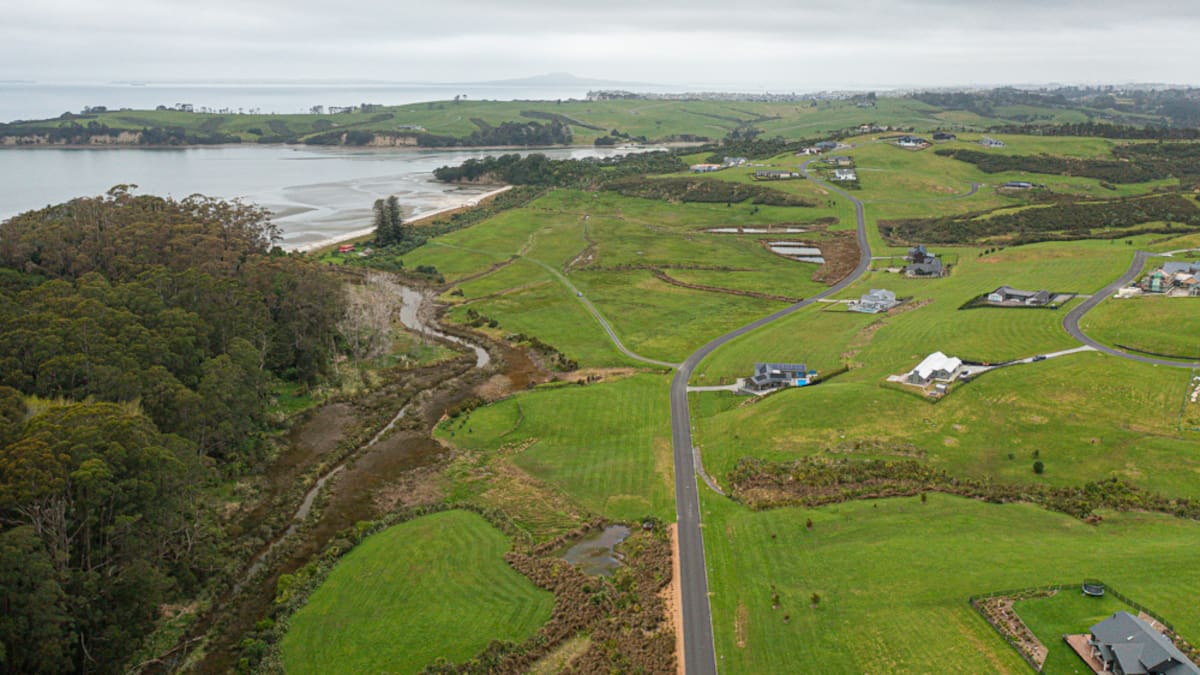
The failed housing project at Weiti Bay, south of Whangaparāoa, is next to a marine reserve and became the background for an epic legal showdown between tough businessmen that has resulted in millions of dollars in losses.
The June 30 sale is about more than one developer’s survival.
It could decide the fate of one of Auckland’s largest private coastal holdings – a 909ha block – bigger than Devonport and Bayswater combined – that is now split between warring parties.
It’s one that has also stirred controversy for years.
Williams, a former Te Papa chairman, once faced protests outside the national museum over claims the Auckland development was polluting its neighbouring marine reserve – claims he rejected as “dangerously wrong”.
The land now being sold is made up of two parcels.
That included a 23.7ha “Village 2”, earmarked for homes and shops with motorway connections on the way, and 716ha of forested hills running down to the coast.
Selling agents pitch the land as offering “future high-intensity development potential and large-scale environmental preservation” on a slice of coastline 30 minutes from Auckland’s CBD.
The May court ruling allowed the sale to go ahead, after the Liu family’s company, Green McCahill Holdings Ltd (GMHL), tried unsuccessfully to stop it.
The sale was permitted so Williams’ company, Ara Weiti Investments Ltd (AWIL), could recover some of the debt it was owed.
Justice Katz said GMHL’s court-ordered debt to AWIL had risen from $20m in 2020 to more than $67m – growing $1m-plus each month at 21% compounding interest.
Evan Williams, Weiti Bay project developer and ex-Te Papa national museum chairman, pictured in 2022. Photo / Jason Oxenham
The long-running fight has even touched the Wellington Children’s Hospital.
The housing project at one point owed more than $40m to Wellington philanthropist Sir Mark Dunajtschik’s company Lambton Quay.
He originally lent it money that he was intending to later use to help build the Wellington hospital, according to September’s High Court judgment.
He gave evidence saying the project was among the “worst commercial decisions” of his life.
Despite Williams’ legal wins so far, the battle is not yet closed.
The Liu family’s GMHL still has an appeal lodged with the Court of Appeal in which they contest all the substantial rulings against them in the High Court.
A coastal dream sours
This image from the real estate listing for the forced sale shows how it is Village 2 Land and the extra Balance Land parcels that are now up for auction on June 24. Village Land 1 was bought earlier by a company controlled by developer Evan Williams.
The Liu family had owned the 909ha block – ringed on three sides by a marine reserve – through GMHL for two decades before formally partnering with Williams in 2012 to develop it.
To fund the project, GMHL put a part of the land on the line, mortgaging it to secure loans for the project.
The borrowed millions built a 5km access road and the development’s first stage: a gated, 150-lot seaside community at Weiti Bay.
In turn, Williams – a former lawyer turned high-end developer – ran the development and provided financial forecasts, the High Court ruling said.
Land sales from that first stage were projected to repay the lenders and deliver the Liu family about $60m for its land.
Far more cash was then expected to flow in once other pieces of land still owned by the family were developed in later project stages, the ruling said.
But by 2019 sales had slowed, the loans weren’t repaid and the family hadn’t received payments it expected.
Williams proposed a project rescue plan at a February 2019 meeting.
Family head Tong Kuang Liu flew in from Taiwan for the meeting but rejected Williams’ proposal, Justice Andrew Becroft said in the September High Court ruling.
Liu walked out of the meeting, throwing the rescue plans “on the floor”, and later telling his sons the developer was “worse than a snake”, Justice Becroft said.
Becroft accepted Williams’ account of the event in which he said Liu told him words to the effect of: “How will you feel and what would your family feel when you go bankrupt without my support.”
‘Playing chicken’
The gated entrance to a section of the Weiti Bay housing development near Whangaparāoa and Stillwater. Photo / Anna Heath
From there, the postcard-perfect coastline became a battleground of bluff and manoeuvring, conduct Williams described as – with Justice Becroft agreeing – “a silly position of brinksmanship that ultimately proved disastrous”.
The Liu family’s company refused to release land titles to buyers unless it was paid first, choking off sales revenue the project needed to repay lenders, a move the judge found breached its agreements and “effectively tanked the development”.
The family believed that if the loans went unpaid and the lenders put the mortgaged land up for forced sale, no good buyer would emerge, Justice Becroft said.
That was because, the judge said, the mortgaged land sat surrounded by property the family still controlled – meaning any outside buyer would have to pass through the family’s land just to reach the piece they bought.
With no buyers expected, the family’s company could then force the lender to take a “haircut” by accepting it wouldn’t recover all the money it had loaned and hence might sell the mortgaged land cheaply, the ruling said.
The family hoped the tactic would push Williams out of the project, the judge found.
One lawyer described it as “playing chicken with the unpaid mortgagee” – a label the judge adopted as fair.
Liu was unrepentant about his refusal to negotiate when questioned in court.
“I wasn’t playing hardball,” he said. “I was playing no ball.”
The tables turn
Property developer and philanthropist Sir Mark Dunajtschik donated and helped build Wellington Children’s Hospital, but lost money lending to the Weiti Bay development. Photo / Mark Mitchell
But in 2020, Williams did what the family had seemingly bet was impossible. He found a buyer: himself.
In a series of complicated negotiations, Williams set up new companies that agreed to buy the unsold Weiti Bay lots and Village 1 mortgagee sale land for $35m.
He was able to do this by raising $20m from a new overseas lender, Clearwater Capital Partners (a debt that has now increased to more than $27m), and making complex arrangements for the other $15m, including taking out new loans with Lambton Quay.
Williams’ companies also negotiated with Lambton Quay to take over the mortgage debt that the Liu family’s GMHL had not yet repaid on the original Village 1 land.
That meant Williams’ companies now had the right to take legal action against GMHL if it did not settle the debt.
Justice Becroft accepted that for Lambton Quay, the new deal was about making the best of a bad situation.
Williams was candid in court that buying and taking over GMHL’s mortgage debt aimed to create “the necessary leverage to bring GMHL back to the table”.
The Liu family “smelt a rat” in the way Williams had been able to get the land and gain the legal right to force them to repay their debt.
They sued, alleging the sale was a sham designed to strip their company of its land – claims Justice Becroft rejected in September, ruling against the family on every cause of action.
“The biggest loser in all of this was GMHL,” he wrote. “Its strategy, deliberately adopted, backfired on it with disastrous consequences.”
Becroft ruled that Williams had been a more credible and reliable witness than Liu.
“I unhesitatingly conclude that Mr Williams is a reliable and credible witness,” Becroft said, while noting Liu’s evidence was “neither reliable nor credible”.
What happens on June 30
The failed housing project across an original 909ha was one of the largest private coastal holdings in the Auckland area. Photo / Jason Dorday
When the Village 2 land first went on sale in May, it was initially advertised as being sold at a June 24 High Court-ordered auction.
That auction had been open to anyone – but AWIL appeared to hold a card that rivals would find hard to match.
The company said in the recent Court of Appeal ruling that it planned to bid for the land at the auction.
The ruling explained that AWIL was allowed to bid to buy the land by deducting the purchase price from the debt it was already owed.
In practice, that meant an ordinary buyer would have to find real money for every dollar it bid, while AWIL could bid with no cash outlay because each dollar would simply comes off the $67m-plus debt.
However – as has often been the case in this project – a last-minute legal manoeuvre was executed.
In May, GMHL’s board of directors put the company into voluntary administration.
Then on June 10, a “body of creditors” claiming they are owed money by the housing project took over and had their own administrators appointed.
By Friday, June 19, the new administrators Teneo had taken over the sale process, changing it from a June 24 auction to a June 30 deadline sale.
While the High Court-ordered sale was being undertaken solely to recover money for Williams’ AWIL, the new sale aimed to raise money for all creditors, John Fisk, senior managing director with Teneo, said.
He didn’t name the creditors but said his team was aware of seven or eight parties claiming they were owed money.
For AWIL, the sale is critical.
If it can buy the land, it would gain control over the entire development area and be able to try to finish the project.
If another buyer secured the land, they could potentially cause another deadlock as Williams’ company’s land would again be surrounded by a separate owner.
Williams contacted the Herald on Friday to alert the paper to the last-minute sale process change and Liu has also contacted the Herald but is yet to provide comment.
SEE THE WEITI BAY LAND’S ONEROOF FOR SALE LISTING HERE.