
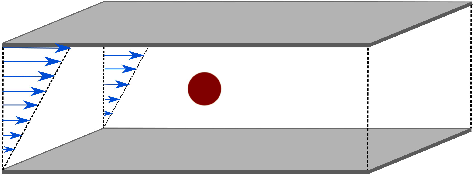
3.1. Effect of Carreau number, viscosity ratio and power-law index
We begin by examining the influence of shear thinning on the lateral migration of a neutrally buoyant spherical particle in plane Couette flow, with a fixed confinement ratio of

$\kappa = 0.2$
(which is maintained throughout this section unless otherwise specified). The extent of shear thinning is characterised by the Carreau number (

$Cu$
), which represents the relative importance of the shear rate to the intrinsic time scale of the fluid; larger values of

$Cu$
correspond to stronger shear-thinning effects. The viscosity ratio (

$\beta$
) quantifies the contrast between the infinite-shear and zero-shear viscosities, thereby controlling the strength of viscosity variation between regions of high and low shear rate. The power-law index (

$n$
) governs the degree of shear thinning in the intermediate shear-rate regime, with smaller values of

$n$
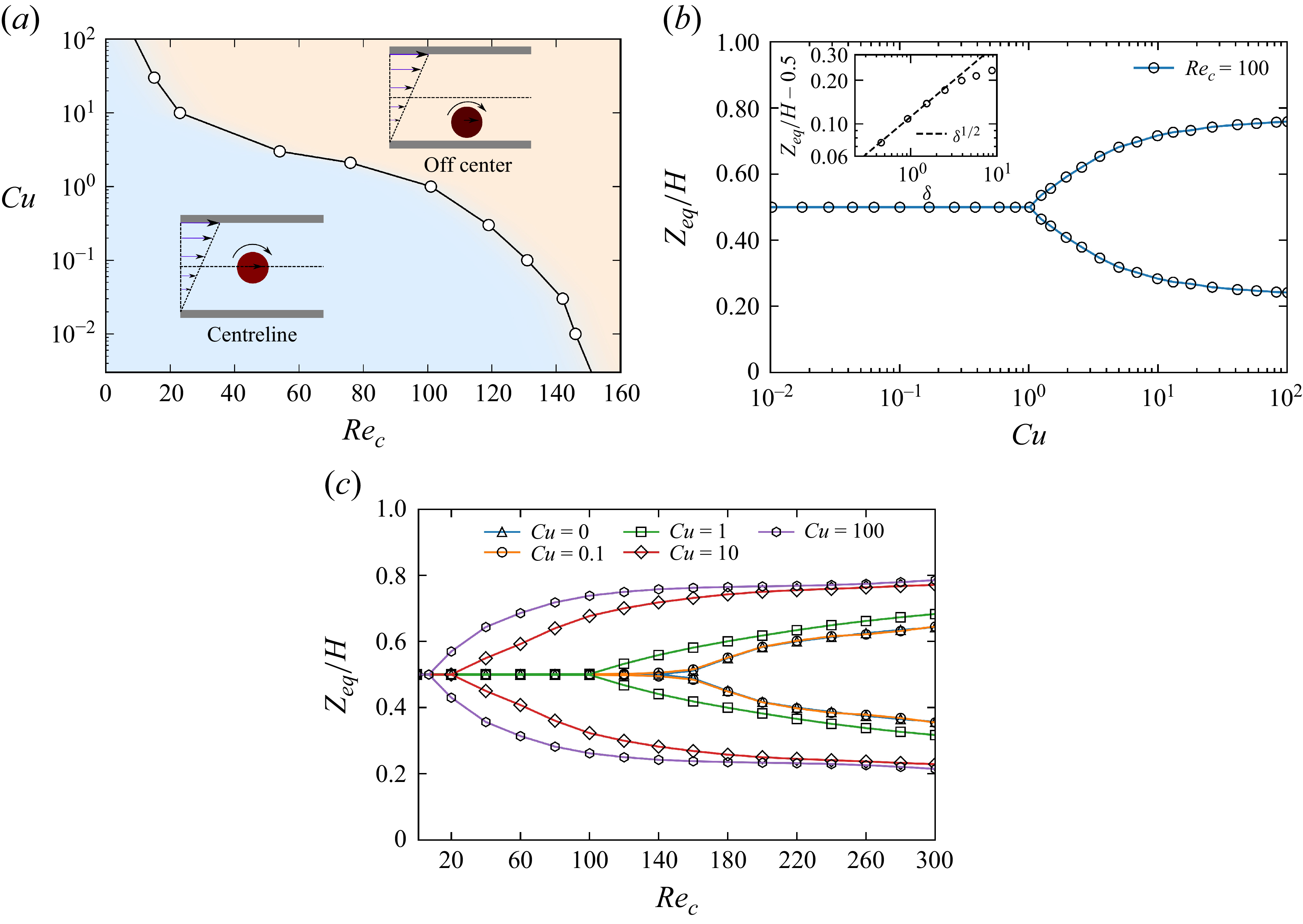
corresponding to more pronounced shear-thinning behaviour. We first examine the effect of the Carreau number by analysing the bifurcation behaviour of the equilibrium particle position. Figure 3(a) presents the regime diagram in the

$({\textit{Re}}_c, Cu)$
parameter space for

$\beta = 0.1$
and

$n = 0.25$
. The solid demarcating line represents the critical condition separating two distinct migration regimes. For a fixed Carreau number, this boundary corresponds to a critical Reynolds number

${\textit{Re}}_{{cr}}$
; conversely, for a fixed Reynolds number, it defines a critical Carreau number

$Cu_{{cr}}$
. Below this boundary (i.e.

${\textit{Re}}_c \lt {\textit{Re}}_{{cr}}$
for fixed

$Cu$
, or

$Cu \lt Cu_{{cr}}$
for fixed

${\textit{Re}}_c$
), the particle ultimately migrates to the channel centreline irrespective of its initial release position. In contrast, beyond the critical condition (

${\textit{Re}}_c \gt {\textit{Re}}_{{cr}}$
or

$Cu \gt Cu_{{cr}}$
), the centreline becomes unstable and the particle migrates towards an off-centre equilibrium position. The final equilibrium location depends on the initial release position. If the particle is released between the centreline and the lower half of the channel, it migrates to a stable off-centre position within that region. Similarly, if released between the centreline and the upper wall, it approaches a symmetric off-centre equilibrium in the upper half of the channel. Thus, the bifurcation is supercritical in nature: once the critical threshold (

${\textit{Re}}_{{cr}}$
for fixed

$Cu$
or

$Cu_{{cr}}$
for fixed

${\textit{Re}}_c$
) is exceeded, the centreline loses stability and symmetric off-centre equilibria emerge. Further insight into the nature of the bifurcation is obtained by examining the dependence of the equilibrium position on the Carreau number. Figure 3(b) shows the equilibrium position

$Z_{{\textit{eq}}}/H$
as a function of

$Cu$
for a fixed channel Reynolds number

${\textit{Re}}_c = 100$
, with

$\beta = 0.1$
and

$n = 0.25$
. This analysis is aimed at characterising the scaling behaviour of particle migration in a shear-thinning fluid near the onset of instability. For sufficiently small

$Cu$
, the steady equilibrium remains at the channel centreline (

$Z_{{\textit{eq}}}/H = 0.5$
), indicating stability of the symmetric state. Beyond a threshold value of

$Cu$
, the centreline loses stability and the particle migrates to an off-centre equilibrium position (

$Z_{{\textit{eq}}}/H \neq 0.5$
), with the direction determined by the initial release location. Furthermore, increasing

$Cu$
drives the particle progressively farther from the centreline and closer to the wall, reflecting the strengthening influence of shear-thinning effects. The value of

$Cu$
at which the transition from centreline to off-centre equilibrium occurs is defined as the critical Carreau number,

$Cu_{{cr}}$
. For the present parameter set, the transition is observed between

$Cu = 1$
and

$Cu = 2$
, yielding an estimate

$Cu_{{cr}} \approx 1.2$
. This estimate is obtained from simulations performed with refined parameter sampling in this interval (using increments of Carreau number

$\Delta Cu = 0.1$
) near the bifurcation point. In general,

$Cu_{{cr}}$
depends on

${\textit{Re}}_c$
,

$n$
,

$\beta$
and

$\kappa$
; for example, figure 3(a) shows that

$Cu_{{cr}}$
varies with the channel Reynolds number

${\textit{Re}}_c$
. In the present discussion, however, we restrict attention to this representative case. For

$Cu \lt Cu_{{cr}}$
, the particle migrates to the centreline irrespective of its initial position, whereas for

$Cu \gt Cu_{{cr}}$
, symmetric off-centre equilibria emerge and the final state depends on the initial condition. The inset of figure 3(b) highlights the near-critical behaviour using the reduced control parameter

$\delta = (Cu – Cu_{{cr}})/Cu_{{cr}}$
, with the vertical axis plotted as

$Z_{{\textit{eq}}}/H – 0.5$
. The observed square-root variation of

$\delta$
with

$Z_{{\textit{eq}}}/H – 0.5$
near onset is consistent with the canonical scaling of a supercritical pitchfork bifurcation. Additional insight is obtained by examining the variation of the equilibrium position with the channel Reynolds number. Figure 3(c) shows the steady-state equilibrium position

$Z_{{\textit{eq}}}/H$
as a function of

${\textit{Re}}_c$
for several values of

$Cu$
, with

$n = 0.25$
and

$\beta = 0.1$
. For each fixed

$Cu$
, the particle remains at the channel centreline (

$Z_{{\textit{eq}}}/H = 0.5$
) up to a critical Reynolds number, beyond which it migrates to an off-centre equilibrium position, thereby forming a bifurcation diagram in

${\textit{Re}}_c$
. The Reynolds number at which this transition occurs is defined as the critical Reynolds number,

${\textit{Re}}_{{cr}}$
. For example, in the Newtonian limit (

$Cu = 0$
) and for the present confinement ratio

$\kappa = 0.2$
, the critical value is approximately

${\textit{Re}}_{{cr}} \approx 153$
. For

${\textit{Re}}_c \gt {\textit{Re}}_{{cr}}$
, the particle migrates away from the centreline and settles at an off-centre equilibrium position (

$Z_{{\textit{eq}}}/H \neq 0.5$
). As

$Cu$
increases, this critical Reynolds number

${\textit{Re}}_{{cr}}$
decreases monotonically, indicating that shear-thinning effects reduce the inertial threshold required to destabilise the centreline equilibrium. Consistent with the trends observed earlier, for a fixed

${\textit{Re}}_c$
, larger values of

$Cu$
also shift the off-centre equilibrium progressively closer to the channel wall.
Figure 3.
(a) Regime diagram in the

$({\textit{Re}}_c,\,Cu)$
parameter space for

$\kappa = 0.2$
,

$\beta = 0.1$
and

$n = 0.25$
. The solid line represents the critical Reynolds number,

${\textit{Re}}_{{cr}}$
, separating two distinct migration regimes. For

${\textit{Re}}_c$
values to the right of the boundary, the particle migrates to an off-centre equilibrium position, whereas for

${\textit{Re}}_c$
values to the left of the boundary, the particle returns to the channel centreline. (b) Normalised equilibrium position of the particle,

$Z_{{\textit{eq}}}/H$
, as a function of the Carreau number,

$Cu$
. The results exhibit a supercritical pitchfork bifurcation, in which the particle migrates from the channel centreline to off-centre equilibrium positions as

$Cu$
exceeds the critical value,

$Cu_{{cr}}$
. Note that this

$Cu_{{cr}}$
is a function of

${\textit{Re}}_c$
. Here, the bifurcation shown corresponds to

${\textit{Re}}_c = 100$
,

$\kappa = 0.2$
,

$\beta = 0.1$
and

$n = 0.25$
. Inset: variation of

$Z_{{\textit{eq}}}/H – 0.5$
with

$\delta = (Cu – Cu_{{cr}})/Cu_{{cr}}$
near the bifurcation point, showing square-root scaling close to onset. (c) Normalised equilibrium position across the channel as a function of the channel Reynolds number

${\textit{Re}}_c$
for different Carreau numbers, with

$\beta = 0.1$
,

$\kappa = 0.2$
and

$n = 0.25$
.
Having established the influence of the Carreau number on the critical Reynolds number, we now examine how the remaining rheological parameters such as viscosity ratio

$\beta$
and power-law index

$n$
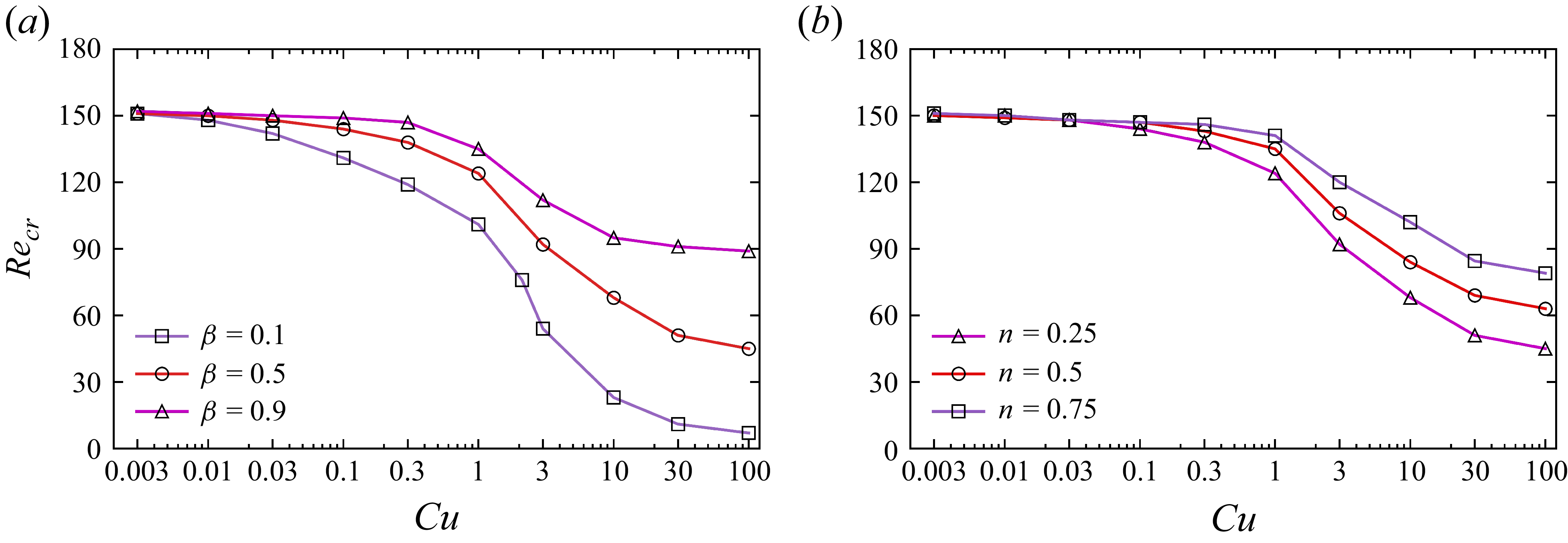
affect the onset of lateral migration. The dependence of

${\textit{Re}}_{{cr}}$
on

$Cu$
for different viscosity ratios is shown in figure 4(a) for

$\beta = 0.9$
,

$0.5$
and

$0.1$
, with

$n = 0.25$
. In each case,

${\textit{Re}}_{{cr}}$
is determined from simulations performed with unit increments of

${\textit{Re}}_c$
near the transition point. For all viscosity ratios,

${\textit{Re}}_{{cr}}$
decreases monotonically with increasing

$Cu$
. Moreover, the reduction becomes more pronounced as

$\beta$
decreases, corresponding to a larger viscosity contrast between low- and high-shear regions and therefore stronger shear-thinning effects. We next consider the role of the power-law index

$n$
. Figure 4(b) shows the variation of

${\textit{Re}}_{{cr}}$
with

$Cu$
for

$n = 0.25$
,

$0.5$
and

$0.75$
, at a fixed viscosity ratio

$\beta = 0.5$
. The results indicate that

${\textit{Re}}_{{cr}}$
decreases as

$n$
decreases, with the sensitivity becoming increasingly significant at lower values of

$n$
. Since smaller

$n$
corresponds to stronger shear-thinning behaviour, this trend is consistent with the variations observed with

$Cu$
and

$\beta$
. Taken together, these results demonstrate that enhanced shear thinning, whether achieved by increasing

$Cu$
, decreasing

$\beta$
or reducing

$n$
, lowers the critical Reynolds number required to destabilise the centreline equilibrium and promotes particle migration at weaker inertial forcing.
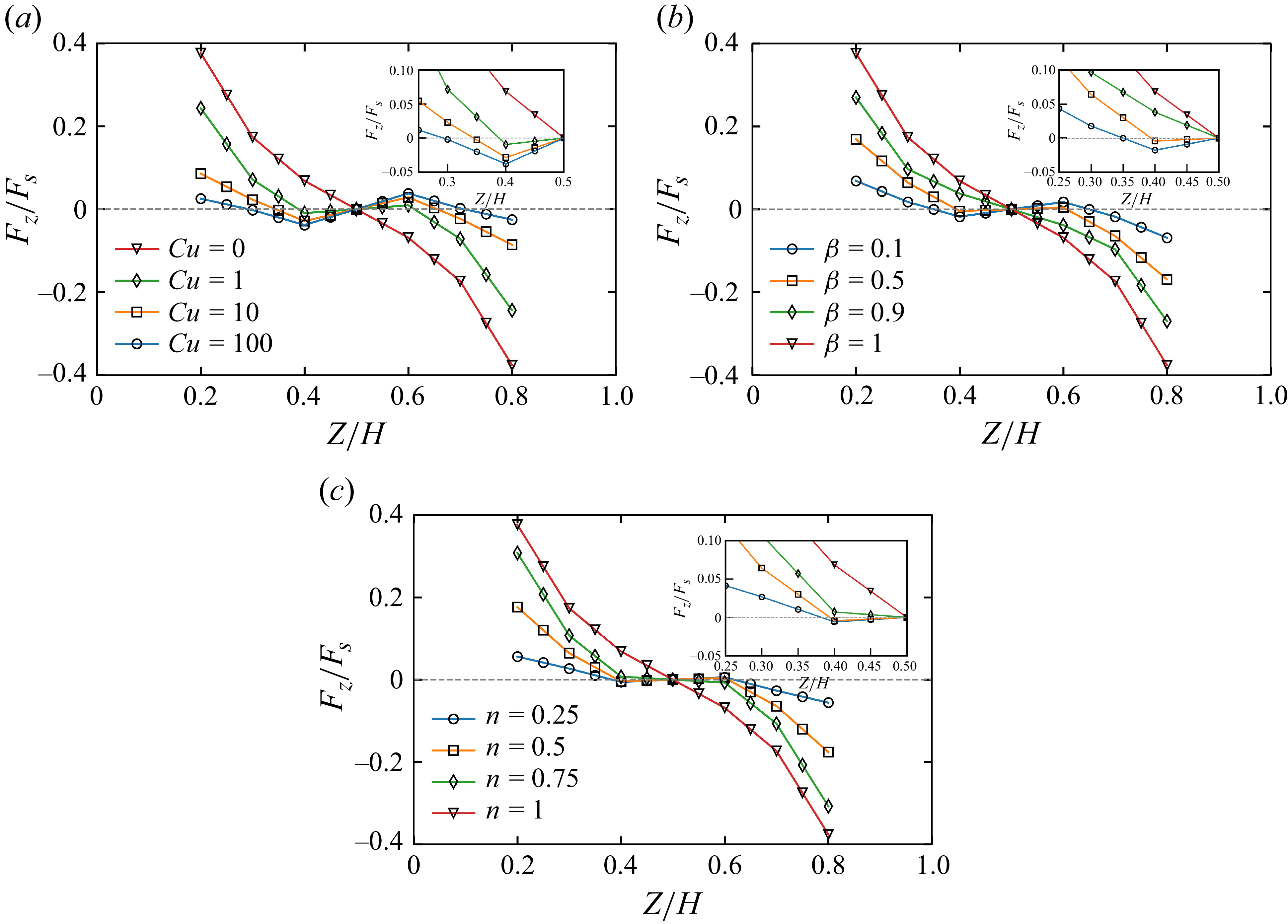
To further understand the bifurcation behaviour described above, we examine the stability of both the centreline and off-centre equilibrium positions by analysing the lateral force acting on the particle. Specifically, we compute the non-dimensional lift force as a function of the particle’s lateral position across the channel height, as shown in figure 5(a–c). The lift force is evaluated by placing the particle at various

$z$
-locations while allowing free translation and rotation in all directions except

$z$
, where translation is constrained. The resulting lift force is normalised using

$F_s = \rho V_w^2 a^4 / H^2$
(Ho & Leal Reference Ho and Leal1974), allowing direct comparison across different flow conditions and rheological parameters. Figure 5 presents the lift-force profiles for variations in the Carreau number (

$Cu$
), viscosity ratio (

$\beta$
) and power-law index (

$n$
), with all other parameters held constant. Figure 5(a) illustrates the effect of

$Cu$
for

$n = 0.25$
,

$\beta = 0.1$
and

${\textit{Re}}_c = 150$
. For a Newtonian fluid (

$Cu = 0$
), the lift-force profile exhibits a single zero crossing at the channel centreline, with a negative slope, indicating that the centreline is a stable equilibrium. As

$Cu$
increases, reflecting stronger shear-thinning effects, two additional off-centre zero crossings emerge. These off-centre crossings have negative slopes, identifying them as stable equilibrium positions, while the slope at the centreline becomes positive, signalling the loss of its stability. This transition indicates that stronger shear thinning promotes off-centre migration, even when the particle initially resides at the centreline. Figure 5(b) explores the role of the viscosity ratio

$\beta$
for

$Cu = 10$
,

$n = 0.25$
and

${\textit{Re}}_c = 150$
. For higher

$\beta$
values (closer to unity), the lift-force profiles resemble those of Newtonian fluids, with a single stable equilibrium at the centreline. Reducing

$\beta$
, which increases the contrast between zero and infinite shear viscosities, destabilises the centreline and promotes the appearance of off-centre stable equilibria. This demonstrates that the distribution of shear-dependent viscosity across the channel can significantly influence particle migration, with stronger viscosity contrasts favouring lateral displacement from the centre. Figure 5(c) highlights the influence of the power-law index

$n$
for

$Cu = 10$
,

$\beta = 0.5$
and

${\textit{Re}}_c = 150$
. As

$n$
decreases, corresponding to stronger shear-thinning behaviour, the centreline equilibrium is progressively destabilised, and stable off-centre equilibria emerge. This shows that it is not only the magnitude of shear thinning (via

$Cu$
), but that also the intrinsic rheological character of the fluid (via

$\beta$
and

$n$
) critically governs the equilibrium positions of the particle. Collectively, these results reveal a consistent and unified trend: increasing the intensity of shear thinning, whether by increasing

$Cu$
, decreasing

$\beta$
or reducing

$n$
, leads to an earlier onset of lateral migration and the formation of stable off-centre equilibrium positions. By systematically varying one parameter at a time, the lift-force profiles provide a clear and quantitative picture of how shear thinning modulates particle stability, highlighting the intricate interplay between fluid rheology and inertial effects in confined flows. To place these findings in context, it is useful to compare them with Newtonian fluids. Previous studies have shown that the lift force decreases with increasing Reynolds number, a phenomenon attributed to inertial screening (Fox, Schneider & Khair Reference Fox, Schneider and Khair2021). As Reynolds number increases, the disturbance flow induced by the particle becomes increasingly confined to its vicinity, thereby reducing hydrodynamic interactions with the channel walls and leading to a weaker lift force. In shear-thinning fluids at fixed

${\textit{Re}}_c$
, we observe a qualitatively similar reduction in lift force on increasing

$Cu$
, decreasing

$\beta$
or reducing

$n$
(see figure 5
a–c), although the underlying mechanism is different. Here, the shear-thinning rheology reduces the viscosity in regions of high shear rate near the particle surface, thereby diminishing local viscous stresses. This rheological effect confines the disturbance flow more closely to the particle, effectively screening particle–wall interactions which in turn reduces the overall lift force. These insights emphasise that even subtle changes in the fluid’s shear-rate-dependent properties can markedly alter the behaviour of suspended particles, offering a predictive framework for understanding particle migration in complex fluids.
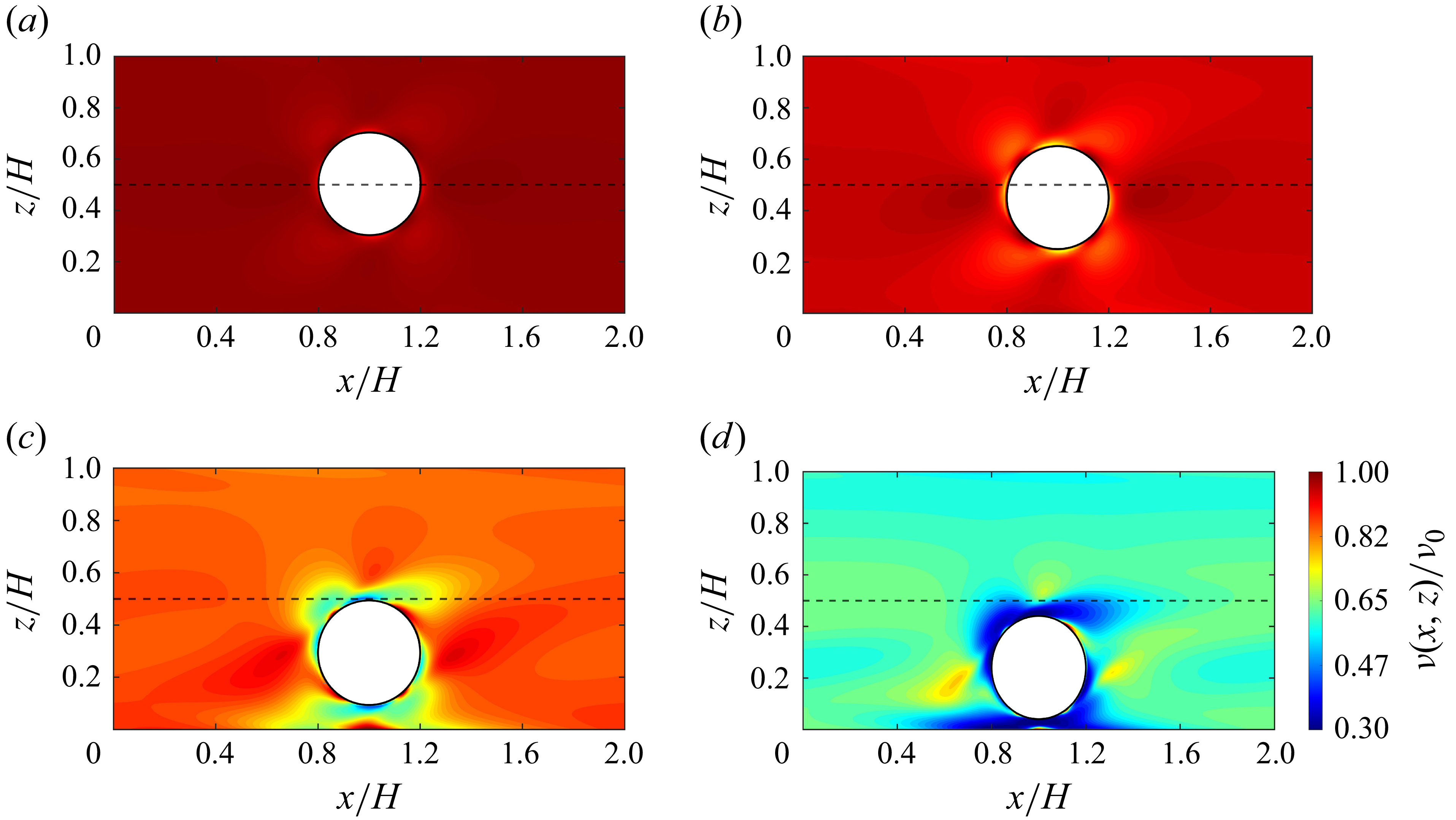
Next, to examine the reduction in the critical Reynolds number

${\textit{Re}}_{{cr}}$
with increasing

$Cu$
and decreasing

$\beta$
and

$n$
, kinematic viscosity

$\nu (x,z)$
contours are plotted, where the viscosity is normalised by the zero-shear-rate viscosity

$\nu _{0}$
. Figure 6(a–d) presents steady-state viscosity contours for increasing Carreau numbers,

$Cu = 0.1,\, 1,\, 10$
and

$100$
, at fixed

$\beta = 0.1$
,

$n = 0.25$
and

${\textit{Re}}_c = 150$
. These contours illustrate how varying

$Cu$
affects the local viscosity field around the particle and, consequently, its equilibrium. At low Carreau number (

$Cu = 0.1$
, figure 6
a), the fluid exhibits very weak shear thinning, resulting in a nearly uniform viscosity field across the channel. In this regime, viscosity is only slightly reduced in the vicinity of the particle due to localised shear. Consequently, the particle remains near the channel centreline, as the weak and nearly symmetric viscosity gradients generate negligible lift asymmetry. As

$Cu$
increases (figure 6
b–d), the shear-thinning response becomes progressively stronger, leading to a pronounced reduction in viscosity near the particle surface, where local velocity gradients are largest. This reduction in viscosity locally around the particle modifies the local stress distribution which eventually destabilises the centreline equilibrium, causing the particle to migrate towards an off-centre equilibrium position, the exact location of which depends on the initial particle position. The destabilisation of the centreline can be rationalised through the Carreau constitutive relation: larger local velocity gradients induce a stronger reduction in viscosity near the particle surface, which decreases the local viscous force. This reduction effectively makes local inertial force stronger than the viscous force, thereby accelerating the onset of inertial migration away from the centreline. At low

$Cu$
, where the fluid behaviour is nearly Newtonian, the centreline remains a stable equilibrium. However, as

$Cu$
increases, the enhanced shear thinning generates progressively stronger viscosity gradients, which in turn promote off-centre migration. This mechanism is reflected quantitatively in the critical Reynolds number,

${\textit{Re}}_{{cr}}$
, for lateral migration. For instance, at

$\beta = 0.9$
(figure 4
a), the Newtonian limit (

$Cu \to 0$
) yields

${\textit{Re}}_{{cr}} \approx 153$
, whereas at

$Cu = 10$
,

${\textit{Re}}_{{cr}}$
decreases markedly to

${\textit{Re}}_{{cr}}\approx 96$
. This reduction demonstrates that local shear thinning lowers the effective viscous resistance, facilitating an earlier onset of off-centre equilibrium positions as

$Cu$
increases. Overall, the viscosity contours provide a clear visualisation of how shear thinning modulates the local stress field around the particle, thereby governing its migration behaviour in confined flows.
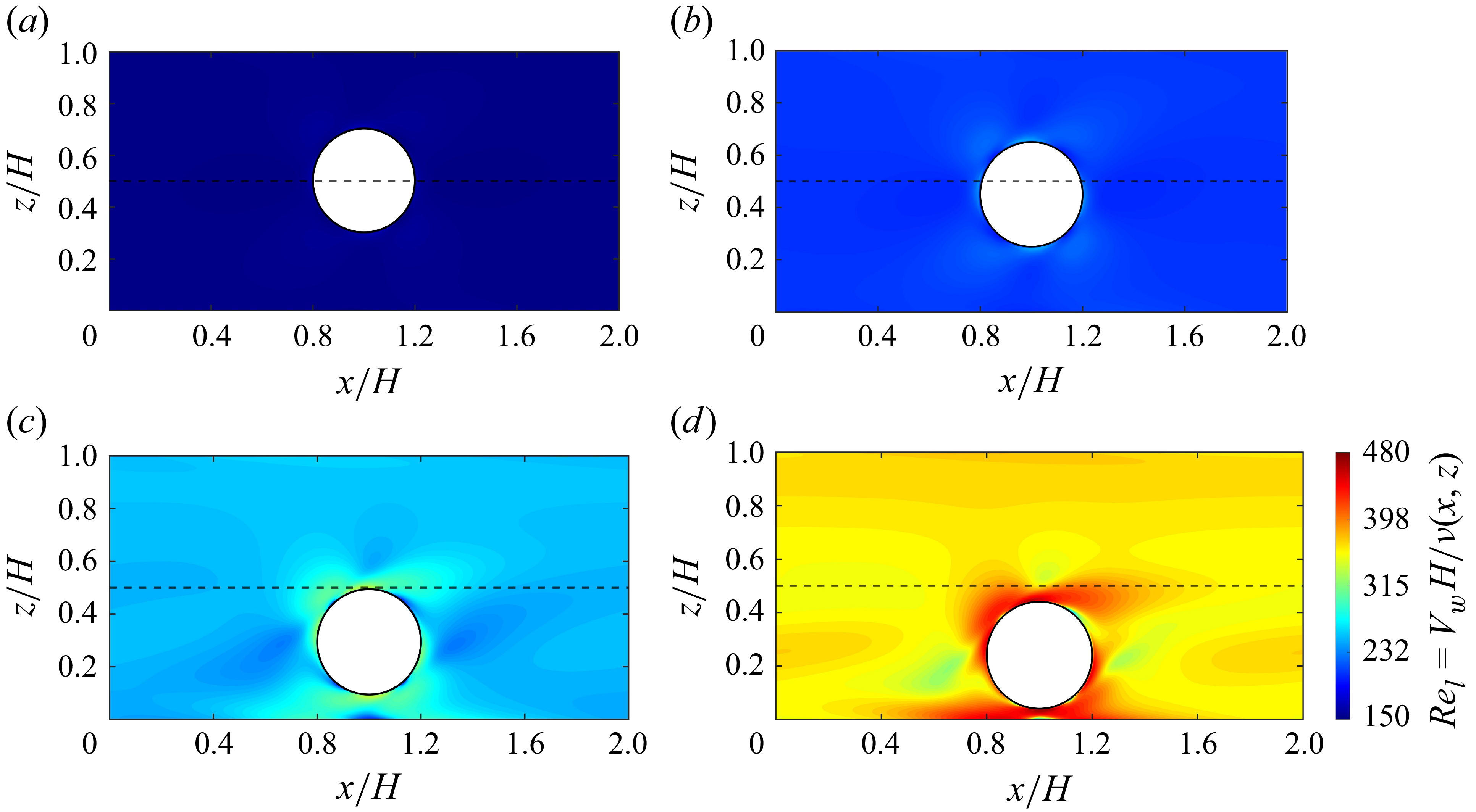
To rationalise this migration using the local Reynolds number distribution, we quantify the spatial variation of

${\textit{Re}}_{\ell }(\boldsymbol{x})$
, following Lashgari et al. (Reference Lashgari, Picano, Breugem and Brandt2012) and Patel, Rothstein & Modarres-Sadeghi (Reference Patel, Rothstein and Modarres-Sadeghi2022), in the mid-plane (i.e.

$xz$
-plane) passing through the particle centre. The local Reynolds number is defined as

${\textit{Re}}_{\ell }(\boldsymbol{x}) = V_w H / \nu (x,z)$
, which provides a local measure of the balance between inertial and viscous stresses and can therefore be interpreted as an effective local Reynolds number. Contours of

${\textit{Re}}_{\ell }(\boldsymbol{x})$
at steady state for

$Cu = 0.1$
,

$1$
,

$10$
and

$100$
are shown in figure 7(a–d) for

${\textit{Re}}_c = 150$
,

$\beta = 0.1$
and

$n = 0.25$
. As the Carreau number increases from

$Cu = 0.1$
to

$100$
,

${\textit{Re}}_{\ell }$
increases both around the particle surface and in the bulk region far away from the particle. Away from the particle, the distribution of

${\textit{Re}}_{\ell }$
is nearly uniform. This uniform far-field value corresponds to the Reynolds number based on the effective base viscosity associated with the imposed background shear rate according to the Carreau relation. The increase in the far-field

${\textit{Re}}_{\ell }$
with increasing

$Cu$
is due to the reduction in the base viscosity for a fixed background shear rate in the absence of the particle, as predicted by the Carreau rheology. This behaviour is also evident in the viscosity contour plots shown in figure 6(a–d). Closer to the particle surface, however, the distribution of

${\textit{Re}}_{\ell }(\boldsymbol{x})$
shows a significant local increase compared with its far-field value for each Carreau number. This local amplification arises from the enhanced shear rates generated around the particle, which further reduce the viscosity in shear-thinning fluids. Consequently, the local viscous stresses decrease, leading to a locally more inertia-dominated region in the vicinity of the particle. Although the global channel Reynolds number

${\textit{Re}}_c$
is fixed, the particle experiences a locally higher effective Reynolds number over a finite region surrounding it. In comparison with the Newtonian case at the same

${\textit{Re}}_c$
, the shear-thinning-induced reduction in viscous stress causes the particle to effectively experience a higher Reynolds number flow in its immediate neighbourhood. As a result, the equilibrium position shifts away from the centreline. For example, configurations that remain centred in the Newtonian limit shift to an off-centre equilibrium position at finite

$Cu$
, as shown in figure 4(a). Specifically, while the Newtonian case (

$Cu \to 0$
) yields

${\textit{Re}}_{{cr}} \approx 153$
, increasing the Carreau number to

$Cu = 10$
reduces the critical Reynolds number to

${\textit{Re}}_{{cr}} \approx 96$
, consistent with the enhanced local inertial effects discussed above. Overall these results indicates that even in the absence of flow curvature, shear thinning alone can generate localised inertia-dominated regions around the particle, destabilising the centreline equilibrium and causing off-centre migration.
Classical studies by Ho & Leal (Reference Ho and Leal1974) and Schonberg & Hinch (Reference Schonberg and Hinch1989) examined inertial migration of particles in shear and Poiseuille flows at small but finite Reynolds numbers using matched asymptotic expansions. In their framework, the flow is divided into distinct regions, one in the immediate vicinity of the particle (called the Stokes region) where viscous and pressure stresses dominate and the Stokes equations are valid, and the other far from the particle (called the Oseen region) where inertial stresses dominate. Consistency of the asymptotic analysis requires an intermediate region in which viscous and inertial stresses are comparable, which enables matching of the inner and outer solutions. In the absence of such a region, the matched asymptotic expansion approach breaks down. Further, Hood et al. (Reference Hood, Lee and Roper2015) revisited this problem numerically and found that, even at moderate channel Reynolds numbers (

${\textit{Re}}_c=10$
), viscous and pressure stresses exceed inertial contributions at all radial distances from the particle, leaving no region of co-dominance and contradicting the predictions of Ho & Leal (Reference Ho and Leal1974) and Schonberg & Hinch (Reference Schonberg and Hinch1989). At higher channel Reynolds numbers (

${\textit{Re}}_c=50$
and

$80$
), inertial stresses increase but scale linearly with

${\textit{Re}}_c$
, acting as a passive correction rather than establishing a new dominant balance. Further, in Newtonian shear flows, particle migration at finite Reynolds numbers has been interpreted in terms of inertial screening (Ho & Leal Reference Ho and Leal1974; Fox et al. Reference Fox, Schneider and Khair2021; Anand & Subramanian Reference Anand and Subramanian2023). Fox et al. (Reference Fox, Schneider and Khair2021) also showed that increasing particle Reynolds number confines the particle-induced velocity disturbance to a thin region near the particle surface, thereby weakening long-range hydrodynamic interactions and particle–wall coupling. Existing studies (Ho & Leal Reference Ho and Leal1974; Anand & Subramanian Reference Anand and Subramanian2023) show that, for ambient shear flow, the characteristic inertial screening length scales as

$\ell _s \sim a {\textit{Re}}_{\!p}^{-1/2}$
, or equivalently in channel scaling,
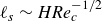
$\ell _s \sim H {\textit{Re}}_c^{-1/2}$
. When

${\textit{Re}}_c \ll 1$
,

$\ell _s \gg H$
and the walls lie within the inner Stokes region, with inertia acting as a regular perturbation. When

${\textit{Re}}_c = O(1)$
or larger,

$\ell _s \lesssim H$
and the walls lie in the Oseen region. In the present case, one further insight may be drawn. Since

${\textit{Re}}_c \gt O(1)$
, it follows that

$\ell _s \lesssim H$
, and the confining walls lie in the Oseen region. Consequently, inertial effects influence the global disturbance field rather than acting solely as a regular perturbation. Furthermore, owing to shear thinning, the viscosity decreases with increasing

$Cu$
, leading to a reduction in the effective base viscosity at the imposed shear rate as per Carreau fluid rheology. As a result, even far from the particle, the effective local Reynolds number increases in correspondence with the channel Reynolds number

${\textit{Re}}_c$
. In addition, the shear rate is significantly elevated in the immediate vicinity of the particle, producing a further local reduction in viscosity and a pronounced enhancement of the local Reynolds number, as demonstrated by the spatial distributions of

${\textit{Re}}_{\ell }$
shown in figure 7. Notably, this near-particle amplification of

${\textit{Re}}_{\ell }$
exceeds its far-field value. Such a localised enhancement of inertia is consistent with a stronger spatial localisation of the particle-induced disturbance. Consequently, relative to a Newtonian fluid at the same nominal channel Reynolds number, the effective inertial screening length,

$\ell _s$
, is further reduced in the shear-thinning case. This reduction in the screening length, together with the associated attenuation of the disturbance field, is reflected in the variation of the non-dimensional lift force across the channel height, as shown in figure 5(a), obtained at a fixed channel Reynolds number

${\textit{Re}}_c = 150$
with

$\kappa$
,

$n$
and

$\beta$
held constant. As

$Cu$
increases from

$0$
(Newtonian) to

$100$
, the magnitude of the lift force decreases at all fixed positions

$z/H$
, leading to progressively flatter lift-force profiles at higher

$Cu$
. This reduction in lift is consistent with enhanced inertial screening of the particle-induced velocity disturbance. At larger

$Cu$
, the disturbance becomes increasingly confined to the immediate vicinity of the particle surface, thereby weakening long-range hydrodynamic interactions between the particle and the confining wall, particularly wall-mediated interactions responsible for lift are weakened and reducing the net lift force. A similar trend is observed upon decreasing

$\beta$
(figure 5
b) or decreasing the power-law index

$n$
(figure 5
c), both of which intensify shear thinning. In each case, stronger shear thinning leads to a further reduction in the lift force, consistent with a greater spatial localisation of the particle-induced disturbance. Overall, our results show that, even in the absence of flow curvature, shear thinning alone is sufficient to destabilise the centreline equilibrium and trigger off-centre inertial migration. This transition can occur at relatively low channel Reynolds numbers, as shear thinning reduces the critical Reynolds number

${\textit{Re}}_{{cr}}$
compared with a Newtonian fluid. The mechanism arises from the formation of localised inertia-dominated regions around the particle, where reduced viscous stresses and increased inertial effects produce a significant local rise in

${\textit{Re}}_{\ell }$
. The resulting migration behaviour differs fundamentally from that observed in Newtonian channel flows. Overall these findings highlight the important role of the shear-thinning rheology in modifying the local stress balance and in turn affecting the nature of inertial migration.
Figure 8.
Time-dependent trajectories of a particle released from different initial positions. (a) Effect of the Carreau number at

$n = 0.25$
,

$\kappa = 0.2$
,

$\beta = 0.1$
and

${\textit{Re}}_c = 150$
. (b) Effect of the viscosity ratio at

$Cu = 10$
,

$n = 0.25$
,

$\kappa = 0.2$
and

${\textit{Re}}_c = 150$
. (c) Effect of the power-law index at

$Cu = 10$
,

$\beta = 0.5$
,

$\kappa = 0.2$
and

${\textit{Re}}_c = 150$
. (d) Influence of the Carreau number,

$Cu$
, on the particle migration time. The evolution of the normalised particle position,

$Z/H$
, with

$Gt$
illustrates the time taken to attain the equilibrium position. Results correspond to

${\textit{Re}}_c = 50$
and

$\beta = 0.5$
,

$n = 0.25$
for

$\kappa = 0.2$
.
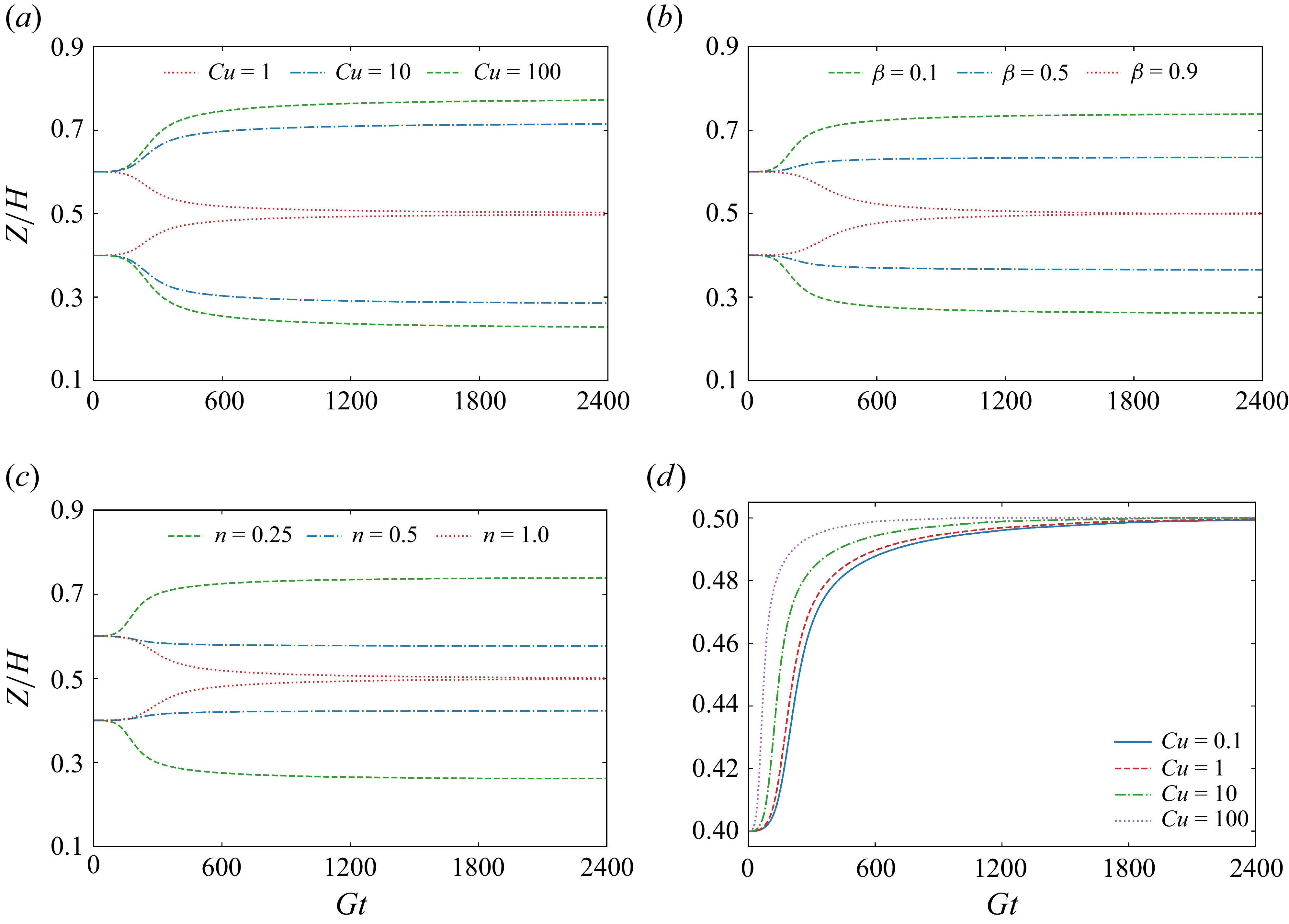
Figure 8(a–c) presents the lateral migration trajectories of particles released from two different initial positions,

$Z_0/H=0.4$
(below the centreline) and

$Z_0/H=0.6$
(above the centreline), within the channel. The particles are free to translate and rotate, and their trajectories are followed until they reach steady-state equilibrium positions in the

$z$
-direction. In figure 8(a), the Carreau number is varied while fixing the other parameters as

$\beta =0.1$
,

$n=0.25$
and

${\textit{Re}}_c=150$
. For

$Cu=1$
, the particle migrates to the centreline (

$Z/H=0.5$
), independent of the initial position. As

$Cu$
increases, however, two stable equilibria appear symmetrically about the channel centreline; a particle released from

$Z_0/H=0.4$
migrates to an off-centre position between the lower wall and the centreline, whereas a particle released from

$Z_0/H=0.6$
stabilises symmetrically between the centreline and the upper wall. This demonstrates that sufficiently strong non-Newtonian effects break the uniqueness of the centreline equilibrium, and the final state becomes sensitive to the initial release height. Figure 8(b) illustrates the role of the viscosity ratio

$\beta$
for

$Cu=10$
,

$n=0.25$
and

${\textit{Re}}_c=150$
. At larger values of

$\beta$
, the centreline remains the sole equilibrium position, and trajectories are independent of initial lateral positions. Reducing

$\beta$
, however, produces two off-centre equilibria symmetrically about the channel centreline, such that a particle released near the lower wall remains trapped below the centreline while one released near the upper wall stabilises above it. A similar trend is observed when varying the power-law index

$n$
(figure 8
c) at fixed

$Cu=10$
,

$\beta =0.5$
and

${\textit{Re}}_c=150$
: for

$n=1$
(Newtonian case), particles invariably migrate to the centreline, but as

$n$
decreases, corresponding to stronger shear-thinning behaviour, the centreline equilibrium becomes unstable and stable off-centre equilibria emerge. To further understand the migration dynamics in comparison with the Newtonian case, we consider a parameter set for which the particle migrates to the centreline, namely

${\textit{Re}}_c = 50$
,

$\beta = 0.5$
and

$n = 0.25$
, as shown in figure 8(d). It can be observed that as the Carreau number increases from

$Cu = 0.1$
to

$100$
, the time required for the particle to reach the centreline decreases. In addition to that, we have observed that the streamwise distance travelled by the particle before reaching its equilibrium position is also reduced. This behaviour indicates that in a shear-thinning fluid the particle experiences a lower effective hydrodynamic force than its Newtonian counterpart. The reduction in viscosity with increasing shear rate decreases the overall viscous resistance acting on the particle, allowing it to migrate more rapidly and over a shorter streamwise distance toward the centreline. Taken together, these trajectories provide direct numerical confirmation of the multiple stable equilibrium positions predicted by the lift-force analysis shown in figure 5(a–c). The viscosity contours (figure 6) and the local Reynolds number distributions (figure 7) further clarify the underlying mechanism, demonstrating that shear thinning enhances local inertial effects through viscosity reduction in high-shear regions around the particle. As a consequence, the migration dynamics and equilibrium locations differ fundamentally from the Newtonian case, and particle migration is governed primarily by the coupled influence of fluid rheology and inertia. All the above results correspond to a confinement ratio

$\kappa = 0.2$
. It is therefore important to examine how these equilibrium states and migration characteristics are modified as the degree of confinement is varied. This aspect is addressed in the following section.
3.2. Effect of confinement ratio
To elucidate the role of geometric confinement on inertial migration, we examine the effect of the confinement ratio

$\kappa = a/H$
, which quantifies the particle size relative to the channel height. In the present study,

$\kappa$
is varied between

$0.05$
and

$0.2$
, corresponding to weak confinement (

$\kappa = 0.05, 0.1$
) and strong confinement (

$\kappa = 0.2$
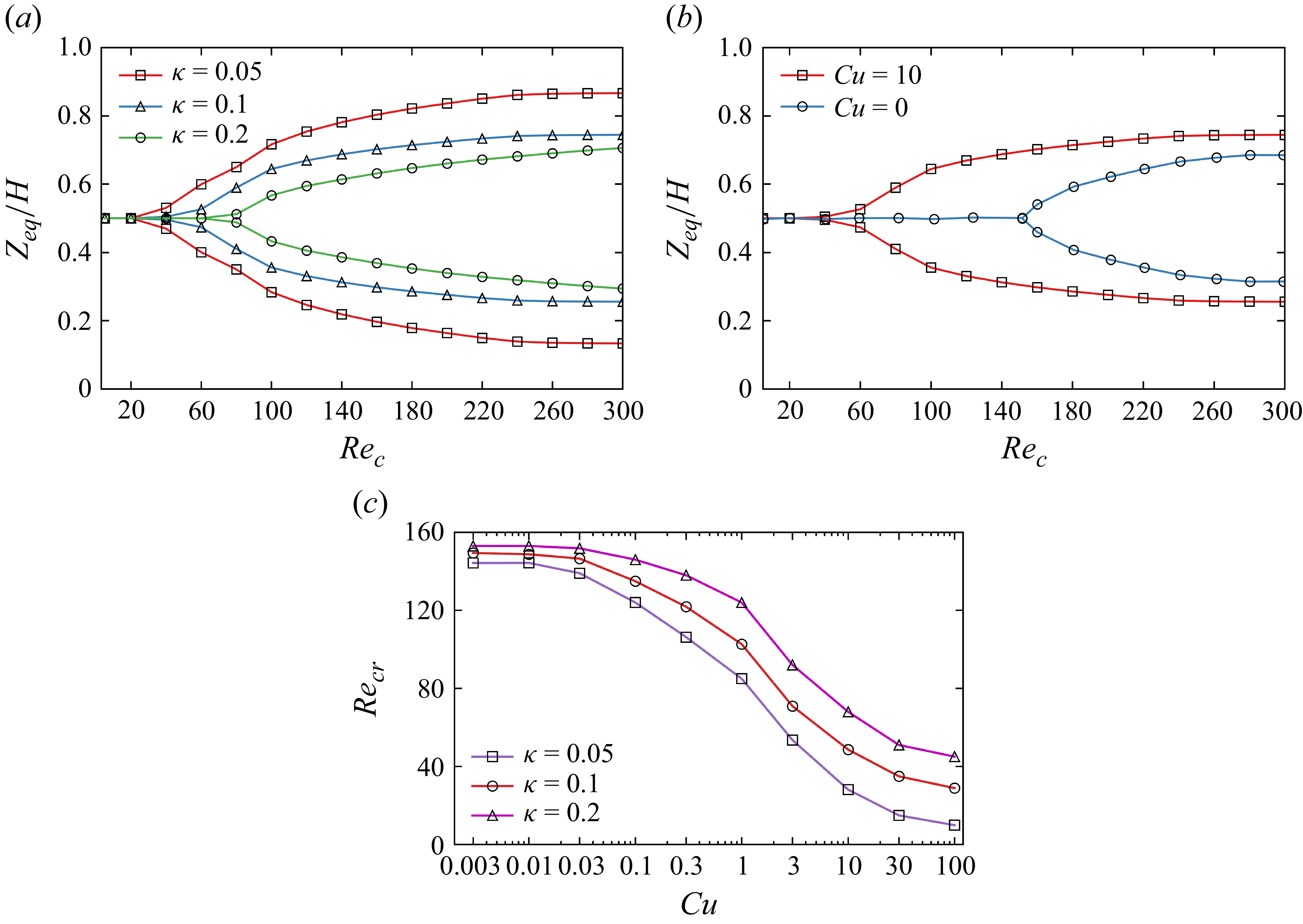
). Figure 9(a) shows the normalised stable equilibrium position as a function of the Reynolds number

${\textit{Re}}_c$
for different confinement ratios at fixed rheological parameters

$Cu = 10$
,

$\beta = 0.5$
and

$n = 0.25$
. It is evident that the critical Reynolds number

${\textit{Re}}_{{cr}}$
increases with increasing confinement. In particular, for strong confinement (

$\kappa = 0.2$
), the onset of off-centre migration occurs at a significantly higher

${\textit{Re}}_c$
compared with the weakly confined cases (

$\kappa = 0.05, 0.1$
), indicating a stabilising influence of the channel walls. The influence of shear-thinning at a fixed confinement is illustrated in figure 9(b), which compares equilibrium positions for two Carreau numbers at

$\kappa = 0.1$
, with

$\beta = 0.5$
and

$n = 0.25$
. At low

${\textit{Re}}_c$
, the particle remains centred; however, beyond a critical Reynolds number

${\textit{Re}}_{{cr}}$
, a symmetry-breaking bifurcation occurs and stable off-centre equilibrium positions emerge. Importantly, increasing the Carreau number leads to a systematic reduction in

${\textit{Re}}_{{cr}}$
, consistent with the trends observed under stronger confinement. This demonstrates that shear thinning accelerates the onset of inertial migration irrespective of the confinement level. Figure 9(c) summarises these trends by showing the variation of the critical Reynolds number

${\textit{Re}}_{{cr}}$
with the Carreau number

$Cu$
for confinement ratios

$\kappa = 0.05, 0.1$
and

$0.2$
, at fixed rheological parameters

$n = 0.25$
and

$\beta = 0.5$
. In the limit of very small

$Cu$
, corresponding to a flow approaching the Newtonian regime,

${\textit{Re}}_{{cr}}$
decreases with decreasing confinement ratio and approaches closer to

${\textit{Re}}_{{cr}} \approx 148$
specifically when

$\kappa = 0.05$
. This value is in good agreement with the analytically obtained critical Reynolds number reported by Anand & Subramanian (Reference Anand and Subramanian2023) for a neutrally buoyant particle in a Newtonian fluid. As the Carreau number increases,

${\textit{Re}}_{{cr}}$
decreases markedly, indicating an enhanced role of shear thinning in promoting the instability. Furthermore, for a fixed value of

$Cu$
, reducing the confinement ratio, equivalently increasing the channel height relative to the particle size, leads to a further reduction in

${\textit{Re}}_{{cr}}$
. Overall, the dependence of

${\textit{Re}}_{{cr}}$
on

$\kappa$
reflects a balance between wall-induced hydrodynamic interactions and viscosity-driven asymmetries. Under strong confinement, enhanced particle–wall interactions generate stabilising wall-induced lift forces that delay the onset of bifurcation. In contrast, weak confinement diminishes wall effects, allowing non-Newtonian modifications of the flow field to dominate the lateral force balance and trigger earlier symmetry breaking. It is further observed from figure 9(c) that, at lower Carreau numbers, corresponding to the near-Newtonian limit, the variation of the critical Reynolds number

${\textit{Re}}_{{cr}}$
with confinement ratio is relatively weak. However, as

$Cu$
increases, a pronounced dependence of

${\textit{Re}}_{{cr}}$
on confinement emerges, indicating that confinement effects become significantly amplified in the shear-thinning regime.
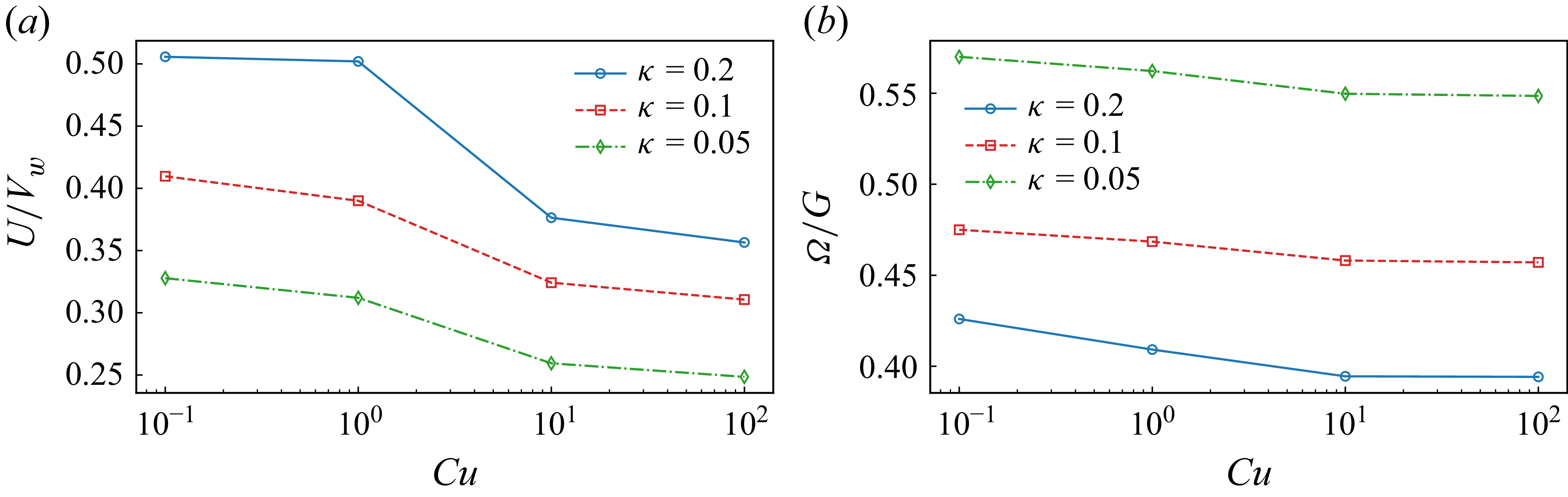
Next, we look at the translational and angular velocities of the particle at steady state. Figure 10(a, b) shows the magnitude of particle translational velocity

$(U=|\boldsymbol{U}|)$
normalised by the wall velocity

$V_w$
, and the magnitude of angular velocity

$(\varOmega = |\boldsymbol{\varOmega }|)$
normalised by the imposed shear rate

$G$
, for varying Carreau numbers as a function of confinement ratio

$\kappa$
. The results correspond to

${\textit{Re}}_c = 150$
,

$\beta = 0.1$
and

$n = 0.25$
. It is observed that both the translational and angular velocities decrease with increasing

$Cu$
. Furthermore, as the confinement ratio

$\kappa$
decreases (i.e. for wider channels), the translational velocity decreases, whereas the rotational velocity increases. This behaviour is linked to the shift in the equilibrium position of the particle. For the present parameter set, all cases except

$\kappa = 0.2$
at

$Cu = 0.1$
migrate toward off-centre equilibrium positions between the bottom wall and the centreline, since the particle is initially released in the lower half of the channel. As

$Cu$
increases and

$\kappa$
decreases, the equilibrium position moves progressively closer to the wall. The reduced local streamwise fluid velocity near the wall leads to a decrease in translational speed, while the enhanced velocity gradients in the wall vicinity promote increased particle rotation.