
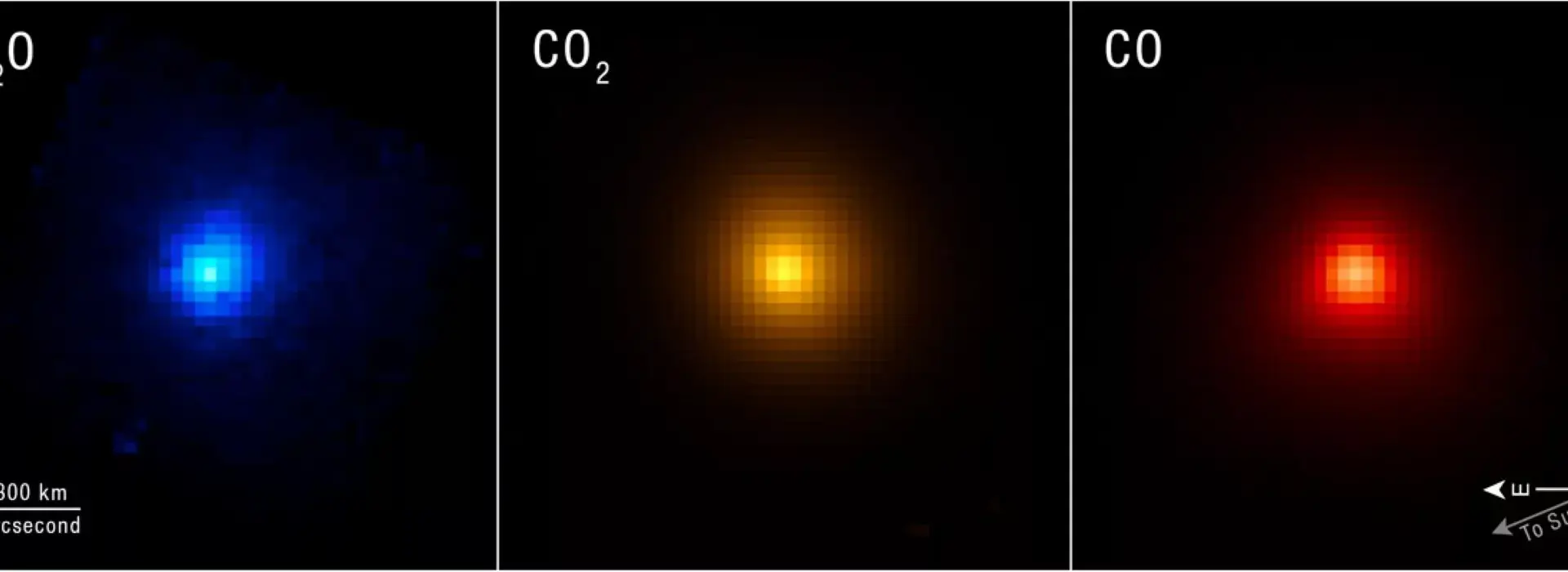
When a comet from beyond our solar system streaks past the Sun, astronomers know they’re witnessing something extraordinary. 3I/ATLAS, the third confirmed interstellar visitor, has now revealed secrets that stretch back nearly to the dawn of the galaxy, thanks to the piercing eyes of NASA’s James Webb Space Telescope.
Unlike the vast majority of comets native to our own solar system, 3I/ATLAS exhibited aberrantly high gas production rates near perihelion. That made it an excellent target for spectroscopic examination. They pounced, quickly repurposing Webb’s Near-Infrared Spectrograph (NIRSpec) to obtain its chemical signature.
Astro-chemist Martin Cordiner of NASA’s Goddard Space Flight Center, lead author of the study, explained: “This was a unique opportunity to study an ancient object from the distant galaxy, probably pre-dating our Sun and solar system. On the one hand, we get direct insight into that distant time and place, and on the other, we learn something about how unusual our own solar system may be.”
Webb’s measurements stunned researchers. Using NIRSpec, the researchers identified deuterium levels 30 times higher than those measured in comets in the solar system. It is consistent with 3I/ATLAS having formed in a very cold region, where the “heavy water” ice was not recycled into H₂O as it is on Earth.
Growing Tail of Interstellar Comet 3I/ATLAS Captured
It also observed traces of carbon-13, which are more diluted than those from carbon-12. As stars live and die, stellar systems accumulate carbon-13; the observed lack of this isotope indicates a very old origin.
The team estimates 3I/ATLAS may have formed 10–12 billion years ago, during the universe’s “cosmic noon,” when star formation was at its peak. Its birthplace was likely a dense, frigid cloud where radiation was abundant but warmth scarce, conditions that locked deuterium-rich ice into its nucleus.
Another study directed by Cyrielle Opitom of the University of Edinburgh examined cyanide molecules in the comet using the Very Large Telescope at the European Southern Observatory. Discussing the results together, they offer up a portrait of an object born in the galaxy’s infancy, carrying chemical artifacts across deep interstellar swaths of stellar real estate.
Stefanie Milam of NASA Goddard, co-author of the Webb study, emphasized the broader implications:
“For us as scientists, finding these rare isotopes is fascinating, but the bigger picture here is looking at the possibilities of prebiotic chemistry elsewhere in the galaxy. So far, we know of only one place in the vast cosmos where chemical ingredients led to life, our solar system, our Earth. Analysis of these interstellar objects is a major step towards learning how common, or uncommon, the conditions for the evolution of life are in the universe.”
NASA detected a comet that originated from interstellar space
The James Webb Space Telescope is an international collaborative effort between NASA, ESA, and CSA. Most of Webb’s work has focused on the long journey that 3I/ATLAS made through ancient space, but it also provides an uncommon window into environments before our Sun was present.
It reminds us that the galaxy is a time capsule, and any comet native to an interstellar system that wanders into our midst may come with vestiges of its primordial history.
Journal Reference:
Cordiner, M., Roth, N.X., Micheli, M. et al. Isotopic evidence for a cold and distant origin of 3I/ATLAS. Nature (2026). DOI: 10.1038/s41586-026-10771-6