
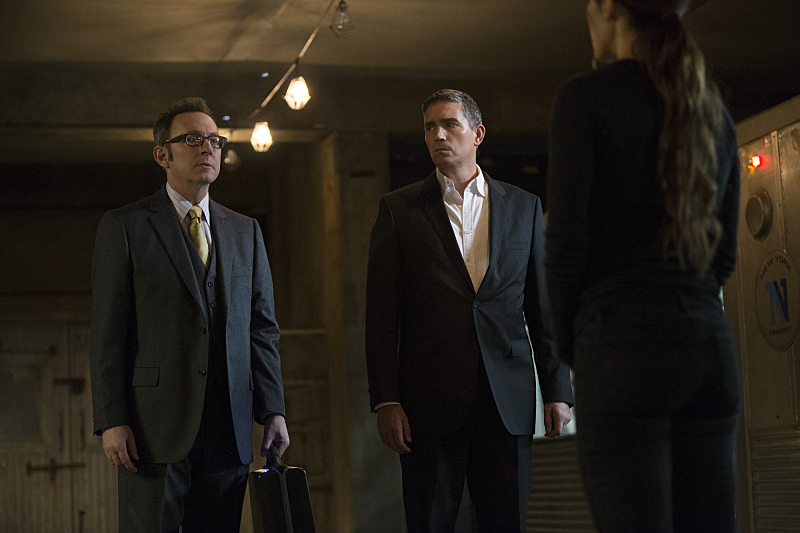
Credit: Giovanni Rufino/Warner Bros. Entertainment Inc. é2016 WBEI. All rights reserved.
[Warning: This post contains spoilers for the series finale of PERSON OF INTEREST.]
On paper, the CBS drama PERSON OF INTEREST had a relatively simple premise: Harold Finch (Michael Emerson) created an artificial superintelligence (known as the Machine) as a tool for the government to help prevent large-scale acts of terror. But thanks to the countless amounts of data the Machine processed (video feeds, social media, e-mails; essentially any kind of digital footprint), it also received information about “irrelevant” individuals, people who were on the verge of being involved in smaller threatening situations—either they were about to be the victim or a perpetrator of a crime.
But rather than delete that information, Finch went rogue and recruited John Reese (Jim Caviezel), a former soldier, to be his partner to save as many people as they could. Armed with only a social security number, each episode of the five-season series found the duo, along with Team Machine—composed of, at various times, Detective Joss Carter (Taraji P. Henson), Detective Lionel Fusco (Kevin Chapman), hacker Root (Amy Acker), and former marine Sameen Shaw (Sarah Shahi)—trying to figure out whether the person they were led to might be in danger or could be a risk they needed to contain.
In execution, the Jonathan Nolan-created series was a layered, thought-provoking drama, with a procedural spine. The show was timely, and also hyperaware of where our technology could be going in the near future, grappling with the moral obligations (the potential good that could come from it, as well as the dangers) of those who utilized these tools. Though artificial intelligence and surveillance were already being utilized in the real world, the show shone a spotlight on how easily any average person could be tracked—and how much access to our lives we were handing over by ourselves.
By the time the drama ended in June 2016, the on-screen team had faced a number of blows, losing Carter and Root, along with numerous allies. (Though the Machine opted to take on Root’s voice and personality after her death.) Team Machine also had to face off against another artificial superintelligence, Samaritan, and Finch opted to destroy both ASIs to save the world—and Reese sacrificed himself to help the Machine put the final pieces in place.
But the work wasn’t entirely done: The final moments of the series revealed that a duplicate of the Machine lived on, and connected with Shaw to seemingly continue the work.
Now, a decade after the CBS drama concluded, Nolan and co-showrunner Greg Plageman sat down with Give Me My Remote to reflect on the series, ending on their own terms, the evolution of technology, and more.
Starting with a light question: How many times a week do you go, “We tried to warn you?”
Jonathan Nolan: It’s gotten so weird now that the framing of it doesn’t quite land that way for me anymore. I mean, those are the thoughts [I had] a few years ago. Now, we’re just into a whole other level of weird s—. Coming out of PERSON OF INTEREST into WESTWORLD, between the two of them…I’m just as bewildered as anyone else with the directions all these things have taken. It’s just the f—ing weirdest. It is the dumbest version of what we thought could have happened, you know?
I think there was a bit of optimism that a Harold Finch-like character would exist; I think there are one or two folks out there who sort of have the moral character necessary. But the idea that there would be a responsible [gatekeeper]—someone like that, I think that was the fantasy, right? The technology wasn’t fantasy. The fantasy was the moral conscience of the people involved. [Laughs.]
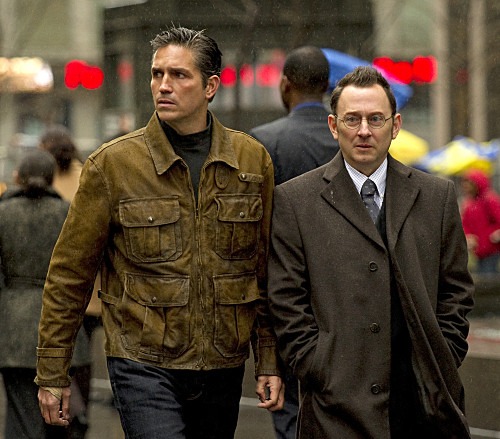
©2011 CBS Broadcasting Inc. All Rights Reserved
You guys were open during the run of the series that the show was spiritually “hanging out five years in the future.” Now that it’s actually ten years after the show ended, outside of the lack of Finch-like figure, what has changed the most from where you thought things would be?
Greg Plageman: Well, I have to give Jonah a lot of credit here, because we would bring people into the writers’ room [help us look ahead]…we would talk to people like Nick Bostrom, [who wrote the 2014 book] “Superintelligence.”
Nolan: [Journalist] Shane Harris.
Plageman: We even tried to get the CEO of Palantir, the guy who’s in the monastery…we tried to get them all to come into the writers’ room, all of them, because we were crazy, and we were just like, “Oh, this will be fun. Let’s try to make that happen, and that would be interesting.” And we were just having fun. I think the whole thing was, “Okay. We’ll do episode of the week [format], we’ll crank that out for CBS, but, at the same time, we were like, no, what would be more interesting?”
And Jonah would get bored. “This is boring, if it’s just this case of the week s—, I’m out.” [Both men laugh.] We’ve got to do that, or we’re going to get canceled—which eventually happened.
Nolan: I feel like we canceled ourselves. From the beginning, I always thought this was a CBS show, right? And we had that conversation with [executive producer] J.J. [Abrams].
Plageman: Much gratitude, CBS.
Nolan: I think my friends at Bad Robot thought Fox was a good fit for it when we were taking it out. I was always into CBS, so was [former Warner Bros. CEO] Peter Roth, right? Peter Roth and I were both [thinking] CBS, in part because I’d grown up watching shows like MAGNUM [P.I.], that I thought were terrific. But also because of the case of the week structure—which eventually I would bridle out a little bit and get a little bored with—it was exactly where the pitch started. We didn’t start with, like, “Oh, this is going to be like a WESTWORLD.” It wasn’t supposed to be a novel-like TV show. The random access nature of the premise [made it] perfect for a case of the week show. And I grew up loving case of the week shows.
So, from the beginning, we thought, “Find the place, find the network, that can support a case of the week show, because that’s sort of essential. And you get to reach this massive audience, which is super cool.”
And, God bless them, there [was] a moment in the pitch, I remember, with Nina [Tassler], who ran the network. She bought the pitch in the room…[Prior to the pitch,] I read all these interviews with [LOST showrunner Damon] Lindelof, and other folks like that, where it was like, “You can’t ever tell [the people you’re pitching to] what the show is really about.” We get to the middle of the pitch—the pitch is going fine—but [Tassler]’s like, “I feel like—what’s the show about, really, for you?”
She wasn’t saying the pitch wasn’t going well; I think the pitch was going fine. But she was like, “What’s the thing you’re interested in here?” And I was like, “F— it, it’s AI. I want to tell a story about AI. I want to tell a story about where this is all going. I think [we] backdoor our way into this cool case of the week thing, but I really want to explore these questions of technology, and where it all goes.” And that was the moment I could feel Peter kind of stiffening [up], and I could feel like my mentors in the television world going, “You f—ing idiot, you’re not supposed to tell them that.” And then [Tassler’s response] was, “Yeah, let’s do it. It sounds fun.”
It was an example of, you receive wisdom you could never tell the muckety-mucks up at the top what you’re actually [doing,] but Nina totally bought it in the room…and she was excited about the fact that the show was about something, right? That it wasn’t just that sort of nihilistic [attempt to] try to get a show to, you know, 300 episodes. It was like, no, there’s a real story here.
And that [was the] tension for Greg and I, over the next five years, of yes, you have this natural case of the week structure to it, but you also have a longer story that you’re trying to tell. Honestly, we’ve seen it done so f—ing badly, so many times; it’s such a hard thing to do. And I credit Greg and the extraordinary team of writers that Greg put together, who largely stayed with the show for years, with that balancing act.
You’ve got to tell a story every week, and that’s kind of fun, because it allows the writer of the episode to take ownership of the story, so they get to own the A-story, and then Greg and I would be nudging, along with the rest of the writers, this larger architecture through the season.
This was my first enterprise in television. Looking back at it, having worked on a number of shows since then, we did remarkably well. You would think if you had a writers’ room with 15 people in it, that you’d just get group-think muck, right? We just got really lucky; we got really fantastic writers, fantastic co-EPs, who came in…I think we recognized that we had sort of a special opportunity to do something a little weird on broadcast television, if we kind of colored largely within the lines.
And then there was this wonderful moment a few seasons in, where Peter Roth, who really was a champion for the show, came to us after, I think, the end of the second season. CBS moved us to a different time slot; we were doing well for them, but of course we weren’t a CBS-owned show, which meant that we had to do not just well, we had to do really, really well to stay on the air every year, because they didn’t get the economics that they would have if it was developed internally.
They moved us from Thursday night [to] Tuesday night, from 9 PM to 10 PM, and the writing was on the wall. Peter came to us—and I will never forget this, and I’ll be eternally grateful to him for this. [To Plageman.] Remember, he came and sat with us? [Plageman starts quietly laughing, prompting Nolan to laugh, too.] And he’s like, “Look, I see what you guys do with the show, and I love what you’re doing with the show. If you do less of the mythological stuff and more of the case of the week stuff, it’ll probably go for seven seasons.”
Plageman: I think he quoted Dustin Hoffman in CHEF.
Nolan: Yeah. Play the hits. But the thing I loved about it was he gave us the advice.
Plageman: Peter was on our side. Peter was great.
Nolan: Yeah. And he said, “But I like what you’re doing, so you guys do whatever the f— you want.” And we knew, sitting there, okay, if we take this path…maybe we get five seasons. Probably no more than that, but we will be proud of what we did.
And if we go the other way, we’ll have more episodes, but wind up the situation of so many shows that we saw during that era: Where you got the show with six, seven, sometimes eight seasons, and then they just f—ing cancel it. And…they do a cliffhanger for the seventh season, because they’re really hoping to get like a limited order for an eighth season, and then [the show is] just f—ing gone. And all the time that you spent, the 200 hours you spent watching this show, there’s no ending, right? I’ve been there; that sucks.
So I think Peter gave us great advice, and the respect to let us make that decision. And Greg and I talked. Peter left, and we sat, and we sort of looked at each other, like, “F— it, let’s keep doing what we’re doing.” Because we’re proud of it, and because every season had this kind of shape to it, and it allowed us to do both things.
Speaking of your mythology balance, the show always had serialized elements—you introduced the flashbacks and played with structure very early, foes-turned-allies Elias (Enrico Colantoni) and Root popped up in season 1, etc. But season 5 was the most serialized year of the show, with also the fewest episodes you had to work with. From what you recall, what was the balance like in digging so deep into that final arc while still making it a CBS-friendly show?
Nolan: Well, we always had a number, right? I don’t think we ever broke that. The number sometimes was Finch, Reese, Root, or Shaw. There was always a number, and we never broke that. That didn’t feel like a constraint; that felt like the meter, the structure of it, the haiku of it all. You’ve got to have a number; I don’t think we ever broke from that. I think that helped guide us.
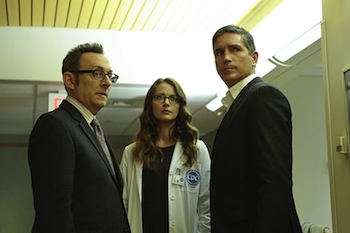
“Reassortment” — Reese and Finch become trapped in a hospital that becomes ground zero for a deadly viral outbreak. Also, Samaritan’s newest recruit has second thoughts, and Shaw continues to struggle with reality, on PERSON OF INTEREST, Tuesday, May 24 (10:00 — 11:00 PM ET/PT) on the CBS Television Network. Pictured L-R: Michael Emerson as Harold Finch, Amy Acker as Root, and Jim Caviezel as John Reese Photo: Giovanni Rufino/Warner Bros. Entertainment Inc. é2015 WBEI. All rights reserved.
Greg, I don’t know if you’d agree, but I think that structure meant that we were always going to sort of be close to the right storytelling cadence for CBS, right? This is part of the reason why I think it always felt like it would be a great fit for, you know, the big tent of broadcast television…The inherent premise was Reese and Finch constantly jumping from one f—ing story that might be connected to the larger story and the randomness of it; that kind of fire hose of data that Shane and others talked about.
There’s two distinct sort of technological moments that are sort of captured in the show: There’s surveillance technology, and there’s AI. Those are two distinct things, right? There’s a lot of snake oil s— happening now, where they’re trying to blend those two things together. There’s an assumption, and interestingly…this is something that the show sort of anticipated cannily, although not at all consciously; I guess we read s—, that AI would emerge from large amounts of data, right? That the way that these LLMs work—and the reason why China may well win—is because they have the biggest data pool.
At one point, when we were making the show, I was invited out to talk to a Chinese technology company, and I sat there [listening to] everything they were talking about. I was like, “Oh, f—, this is either a buzzword or this is about to happen.” And the emphasis there was on the sheer quantity of data and computing, and that is still very much the world we’re living in. So the two things do collapse into each other, but they are distinct topics, and they were distinct things that we were covering.
Everyone’s gotten very curious about the AI of it all, and I think they’ve taken their eye off the ball a tiny bit in terms of the surveillance part. We sort of, in that f—ing frog in a pot of water way, just decided to trade privacy for security, right? That was always the gambit. I don’t think it works; I think it actually works the other way around.
Our joke was always with the show—the show came off the air in 2016; it came off the air [at] the beginning of the Trump era—and the line we always used was, “You’re comfortable with the government giving itself this technology because the government, to this point, you’ve largely trusted.”
We’re in a very, very different moment now. [As we’re doing this interview], they’re about to let FISA lapse…they’re going to let it expire, which is actually going in the opposite direction, right? Picture the US intelligence community basically being blindfolded. Which is also scary. [Laughs.] It’s just a fascinating moment. I could go on about this forever. We did for 103 episodes.
Plageman: This is the s— we talked about in the writers’ room ad nauseam; like, it was like on and on and on. These are like philosophical, larger, technological conversations. But what’s crazy is the premise of the show was an artificial superintelligence that spit out a number, and then we created another artificial superintelligence called Samaritan.
But like Jonah and I always talked about, if we get like a three- [or] four-episode arc here, and then we can build this thing out, we could still close this case out. So we understood that the gift we had on CBS, which was this is a tremendous platform, and we were grateful for that. It was just that they didn’t really understand us…We were trying to make a show that your mom could watch, but yet maybe our kids could watch, too. [Laughs.] And somehow I think we got caught a little bit in between.
It’s a beautiful final season and series finale, but you were also tasked with ending season 5 without knowing for sure it would be over. (CBS only officially confirmed the series was ending in March 2016, after production on season 5 concluded.) Looking back on that experience, what are your feelings about that, and what did it teach you about crafting this kind of story in your future projects?
Nolan: Well, for a total beginner, but armed with a partner and a team of people vastly more experienced [in] television [who are] really smart, we actually kind of nailed it.
We got wind that there was some brinksmanship between the network and the studio—again, we were a Warners TV show on CBS. And so towards the end, every upfront, there was this [conversation] like, “Oh, you’re on the wall [as part of the schedule for next season], you’re not on the wall.”…And I became frustrated with the existential part of that, because we were dead set on avoiding that outcome: [Being] hat in hand, hope to squeeze out another [year]. It became clear to us [as] we’re going to do this half order [for the] fifth season.
We never got a call from the network at that point. Nina was gone; different folks [were in charge] from the folks who greenlit the show in the first place. And that always happens; I don’t think I ever had a movie or a show or anything where the entire executive suite was intact from the green light to broadcast or to the opening weekend. So that’s fine. Which means you’ve got people who aren’t as invested; they’re excited with the new stuff they’ve got. So you better put up numbers—and your numbers better be 20-30 percent higher than any CBS homegrown show to stay on the air.
We did the math on that. We had this very good piece of advice from Peter two years beforehand, stuck in the back of my head. We were told that we were off the wall for a minute, then we were back on….[We realized] if you wanted to, you could try to squeeze out one more season of 13 episodes; you can find your way to Friday nights, and you can limp on along for [a few] more seasons. We decided to just f—ing cancel the show ourselves. We hadn’t been canceled, we had been parked in this, like, reduced order situation, and do we want to try to, like, cajole, beg our way into another reduced order season, or do we want to just have the f—ing dignity of an end?
And so we gave an interview where we’re like, “Yeah, show’s done, we’re wrapping it up this season.” We knew we’d made the right decision when no one called us to correct that. We never got an angry phone call [from] the network saying, “What do you mean it’s over?” And I think there was reading the room, but there was also steering the f—ing ship a little bit, right? I think if we’ve done a cliffhanger, we put up the good numbers, [if] we got a reduced license fee, and [we could have kept] making a cheaper and cheaper and cheaper version of the show. What we decided to do instead was try to go out in good form, tell a complete story, repay the fans that stuck with the show the whole way through, and give them that complete story. And I think it was, in hindsight, a very canny move on our part to basically call it and steer towards a finale. And when they didn’t call to say, “How dare you?” we knew we’d made a very good decision. So we set about sitting down to architect a fifth season that we could be proud of.
Plageman: I think the economics always work against every Warner Bros. show. Same with Sony. We were fighting [during the show’s run,] “Is there, please, a streaming option somewhere where people can find this show?” And there was nowhere to find the show.
Credit: Warner Bros.
It was impossible to even purchase episodes on iTunes, from what I can recall, in those early years, let alone any kind of official streaming. (The series has bounced around to various streaming homes since the show concluded, but, right now, is available to stream on Prime Video.)
Plageman: There was no way to watch it…it was frustrating, because it felt like we were making something that was kind of cool, and prescient, and we just felt like we didn’t [always] have a strong partner in that regard. I remember [in] the first season we did the Elias episode [“Witness”], and they were like, “Can you just bury this? We don’t want to see this episode ever.”
Nolan: That was the first real [conflict] with the network. Greg, correct me if I’m wrong—
Plageman: I’m talking out of school, Jonah. Sorry.
Nolan: No, this is illustrative of how this s— works, right? So the Elias episode is episode 7; I think we tried to do it as episode 4, and [the executives] kind of put off with, like, “Too soon.” And then when it came to episode 7, the response from the network was, “This doesn’t work. This doesn’t work. They lose, you can’t have this.”
Plageman: “Can you bury this, please?” [Laughs.]
Nolan: And it became this conversation [where] we felt strongly that this was a moment where we decided if the show was going to be [what we wanted]…You’ve got to understand that the way that it used to work in broadcast is you develop the show with one team, and then Current [takes over]. So you do the pilot with one team, and then episode 2…it’s seamless for the audience, but for us, we transition to a year of development with one team, and then get tossed into the pool with a totally different group of people. All great people, but they’re like, “What the f— is this show?”
At one point, with the Current team, they’re like, “It’s like you’re saying the show is kind of about AI.” I did the thing in the meeting where I copped to what the show actually was, but these people weren’t part of it, so you started the creative process from scratch with a totally different team. And so they pushed back on [“Witness”] being episode 4—and, in fact, I think they’re probably right about whether it should be episode 4 or 7. Where they weren’t right was where they got to episode 7, and we shot it. [Director] Fred Toye—who I’ve now worked with on three or four shows—shot this beautiful final moment with Enrico and his guys walking away, right?
Plageman: Nina Simone!

“The Devil You Know” — Reese and Finch are caught in a power struggle for control of the city’s gangs when Elias (Enrico Colantoni, pictured) is targeted by Dominic, the ambitious leader of the Brotherhood, on PERSON OF INTEREST, Tuesday, Nov. 25 (10:01-11:00 PM, ET/PT) on the CBS Television Network. Photo: John Paul Filo/CBS é2014 CBS Broadcasting Inc. All Rights Reserved.
Nolan: [We had a] Nina Simone [song playing]! We’re like, this is f—ing great, this is a great episode. I was like, “Oh, we got a cool thing here. This is neat, it’s a case of the week, but there’s a bigger story.” Which, again, was something that were my favorite episodes of MAGNUM—the ones where you learn about his kid, and his ex, and his time in Vietnam, and all that kind of stuff, right? It was few and far between, and these clues that you’re putting together [were] over the course of like ten seasons of television, because that’s all you got to do. I was like, “Oh, we can do this in episode 7. This would be great.” And they came back, and they were very unhappy. They didn’t think the episode was bad. They’re just like, “You can’t have an episode where the good guys lose.”
Plageman: The bad guy wins!
Nolan: The bad guy wins in spectacular fashion—like a cool song [is playing], it looks cool, and the good guys kind of look like schmucks. They got played [because Elias tricked them by concealing his identity, and got away in the end]. To us, we were like, “This is where the show comes alive for people.”
I remember our post[-production] producer was like, “That episode was really cool.” [We felt] people are starting to get what we’re trying to do.
So, we had this very respectful [conversation]. I call the approach polite, but firm. We went back and forth, and then, finally, what saved us was it was sweeps. [They said,] “Let’s air episode 8,” and we’re like, “We haven’t even shot it yet. So you either air this one or we’re off for a week in sweeps.” And they begrudgingly [asked], “Okay, well, can you take a song off?” We’re like, “No, we really like the song.” It is just back and forth of, “We think this will be cool, we think the audience will like it.”
And it’s hard to say…I think a group of people who were watching the show dug in even harder [at that point]. Whether or not the opposite is true—were there casual fans who were watching it [and stopped]? I don’t even remember if the ratings went up or down.
Plageman: Nobody remembers.
Nolan: Who gives a s—?! It was where we sort of dug our heels in a little bit, but, like, if we don’t have this, then…this is not the show we want to make. We’ve got to have [the good guys] lose.
Plageman: That was one seminal moment. There were two others that I remember: When time slots mattered, we thought we were gonna get the Super Bowl slot. They called us, and they go, “We’re gonna give the post Super Bowl slot to [someone else].” And we’re like, “What are you talking about?” And they’re like, “Yeah, but you guys don’t need it. Show is great.” [Nolan laughs.] [We were like,] “Huh?!”
Nolan: Well, different model, not a CBS[-owned] show.
Plageman: Back then, [getting that slot] kind of mattered.
Nolan: It mattered for everything. Marisa, to your point, one of the things I really appreciate about that experience was we must have been one of the last shows [to not have streaming rights]…that’s how TV was for like 50 years, this model of if you didn’t catch the show Thursday night at 9 PM, you had to wait six months for a rerun. Consequently, the writer who wrote that show got a good check; there’s residual income that all disappeared, right? But you had to watch it as it aired. We were not on Netflix [until the hiatus between seasons 4 and 5]; we were not streaming anywhere. The whole run of the show was identical to how a TV show would have aired in the 1950s. And I’m very proud of the fact that people found a way to watch it, that they found a way to kind of assemble [our storytelling].
It was difficult for us in the writers’ room to keep the thread of the larger story. There’s a lot of work, and a lot of hard work on the part of our writers’ assistants, [to keep the mythology straight].
Plageman: It was a lot of work.
Nolan: And the audience wasn’t able to refer back. We put out a DVD box set for each season, but for the audience to be able to look back and try to remember exactly what was happening, and how it worked, was certainly challenging. But it was kind of cool to be in that kind of…not [quite] ephemera, but, like, yeah, if you didn’t watch it, you’re reading your recap somewhere. And I do miss a little bit of that—miss the event nature of how broadcast television used to work, the appointment television aspect of it. I think it’s a little sad that that’s gone now.

Credit: CBS/WB
Greg, you said there were three defining moments. What was the third?
Plageman: We would disappear into our own navels about Samaritan—we talked about the [1970] movie COLOSSUS a lot, where there were these two competing intelligences. So [in our show], Samaritan was the other ASI, artificial superintelligence, and that became the be-all, end-all of the final season. And the network would call us and say, “Can you just lose the whole Samaritan thing? Can you stop talking about Samaritan?”
It was hilarious, because, like, now in hindsight, when you look at it, you go, wait, what are you talking about? Like, that’s the ultimate villain of the final season. [Nolan laughs.] That’s the whole show.
Nolan: I can’t remember, Greg, was that season 4 or season 5?
Plageman: I think it started in season 4.
Nolan: Season 4 was literally like, “Can you not use the word ‘Samaritan?’”
Plageman: Yeah. We were negotiating with the network.
Nolan: And this is it, right? And this is where, at the end of the day, I’ve got a lot of love for the show, and the whole experience of making it, because there were various moments in which very smart people shared with us the mistakes we were making, and let us make our own decisions. So, they kind of tried to maybe [get us to] stop talking about Samaritan, but we didn’t. And they respected that. And after that first back and forth in the first season about Elias, it was like, “Hey, you know what, it’s going to be both things, and that’s going to be okay.” And I think the experience of, yeah, you could have maybe [stretched] it to seven or eight seasons, if you sort of begged, borrowed, or stolen a few more episodes here and there, [but] we didn’t want to do that.
And so on the one hand, you know, they weren’t necessarily wrong to try to steer us away from the bigger mythological storyline. We probably could have limped along for a few more seasons. If you can’t go back and rewatch the episodes, if you don’t exist anywhere outside Tuesday nights at 10 o’clock or Thursday nights at 9 o’clock, how is an audience supposed to keep track of this larger story? That’s a reasonable thing to point out, right? But we weren’t interested in telling that kind of story. And so we kept doing the story that we wanted to do, and ultimately read the writing on the wall, and wrapped it up ourselves.
Look, if it had gone a different way—and sometimes it goes a different way. Sometimes you win these things, sometimes you don’t—I might have felt differently about it. But I really feel like we got to do the exact show that we wanted to make. Was it tough, was there some back and forth? Absolutely. Was there confusion about how the show should be put out there? Yeah. But at the end of the day, we kind of got to do it exactly the way we wanted to do it. That’s a very, very special thing, even now, even in this day and age.
Greg would always laugh at me about the different Golden Ages of Television. There’s the ER Golden Age of Television, the NYPD BLUE Golden Age of Television, the HILL STREET BLUES Golden Age of Television, THE SOPRANOS Golden Age of Television—many, many golden ages of television. We’ve lived through several of them now. But there was something very, very special about making 22, 23 episodes a year. And you would think that with a huge staff, and all the battles with the network and the back and forth, the economic models, and all the lack of streaming—you’d think that you get something pretty compromised. I’m amazed when I look back on the show and how uncompromising it feels in that way. And how distinct the storytelling was. And I think that’s a testament to everyone who worked on it: network, studio, and the writers’ room, and the amazing cast and crew in New York. I’m very proud of it.
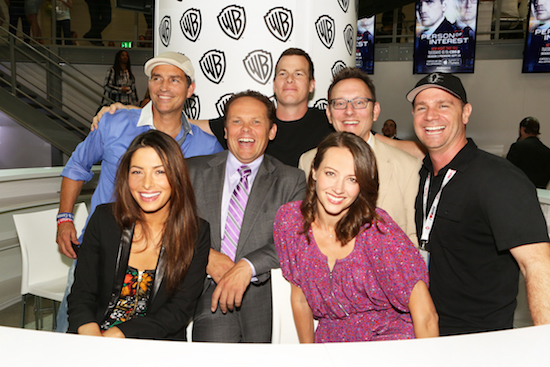
Nolan and Plageman with the PERSON OF INTEREST season 5 cast at Comic-Con. Credit: WB
I imagine it’s not easy to say farewell to the characters you spent so many hours of your life thinking about. In the past decade, when and how have they stayed with you? Are there things that you wish you could have written for them, things you think about where they are now, or just general stories you wish you could have tackled that you can share?
Nolan: The funny thing about writing, and it’s a world that is somewhat in the past now [for me], but writing a network television show where you write 23, 24 episodes a year—it’s not at all like a movie or anything else in my career. It’s become… We joke that the audience[’s] relationship with them is like a family. And that’s really how it felt for us a little bit, too. These characters you live with for so long, you spend so much time with them. I think about them all the time and I always say they are still with us. Ironically, [I] think that Finch, and the idea of someone principled bringing the end of the world, is an important story. The science-fiction idea that you have one person who built AI by themselves seemed far-fetched at the time, but we are seeing that a very small number of people are going to have undue influence over how these things work out. And the character of that person is going to matter.
The Machine noted, “If even a single person remembers you, then maybe you never really die.” Even though POI has been off the air for ten years, it feels like the fans (and the state of the world) have kept it alive in big and small ways. For you, what do you feel the legacy of the show is? What do you hope its legacy is for the fans?
Nolan: More than anything else, the legacy of the show is an entertaining and hopefully still prescient look at the very dawn of that thing coming into existence. And a really lovely group of people who came together to make a TV show in New York for five years. There were so many wonderful people I got the chance to interact with making this show, who have remained friends for life. That’s the legacy of this show for me.
The obvious question: So many shows have been rebooted or revived. There were certainly doors left open in the final season of POI, both with the surviving characters and just the general world. What interest, if any, do you have in returning to this world at some point?
Nolan: If the timing was right. More than anything else, the extraordinary thing I took from the show are the friendships and people I got to work with. You never close that door.
This interview has been condensed and edited for clarity.
–
Related:
Follow @GiveMeMyRemote and @marisaroffman on Twitter for the latest TV news. Connect with other TV fans on GIVE ME MY REMOTE’s official Facebook page or our Instagram.
And be the first to see our exclusive videos by subscribing to our YouTube channel.
As an Amazon Associate we earn from qualifying purchases made through links/ads placed on the site.