
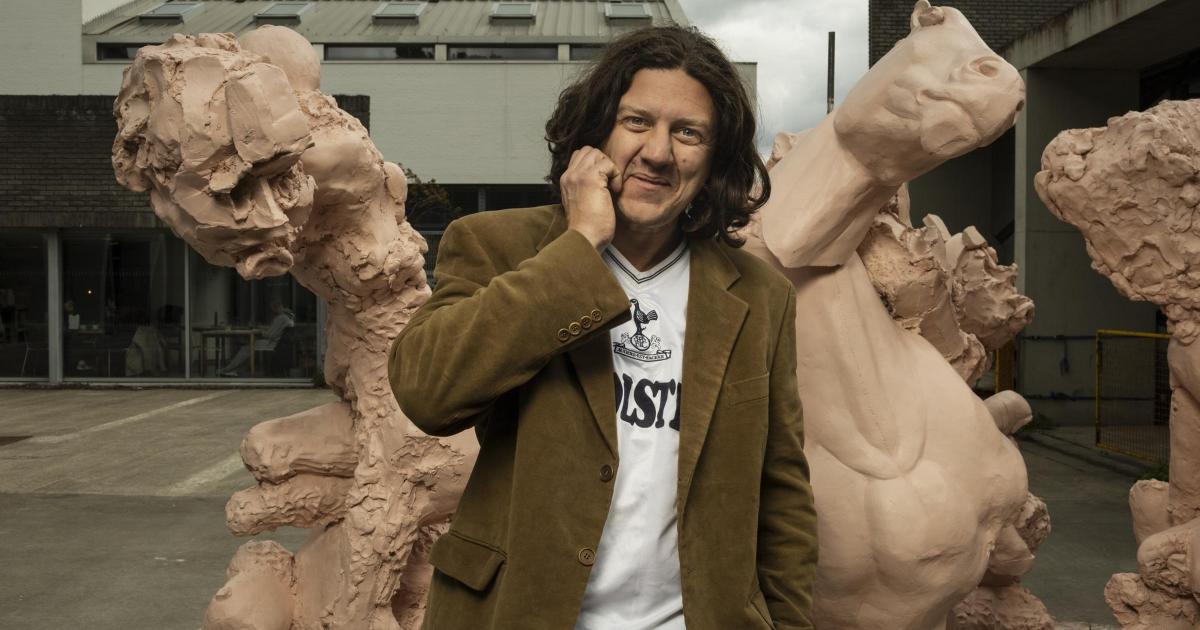
Fitzpatrick is in Norway when we talk, putting the finishing touches to a solo show in Trondheim’s Kunsthall arts venue titled National Theatre. “This one’s looking at how myth, history and folklore inform a sense of cultural identity, then how those cultural identities are able to be weaponized by ethno-national political movements,” he explains.
Intrigued and disturbed by the way politicians such as Donald Trump were using AI-generated imagery, Fitzpatrick fed into AI elements of right-wing policy documents relating to immigration, culture and society and then asked this question: can you make a landscape based on what that country looks like? The AI brain duly obliged. So alongside new sculptural works National Theatre will present painted theatre sets showing Fitzpatrick’s take on these idealised pastoral scenes. It’s also a knowing nod to his side hustle as a scenery operator – or flyman, in stage parlance – at Glasgow’s Theatre Royal and the Edinburgh Playhouse.
Sculptor Jamie Fitzpatrick with a selection of his work (Image: Ross Fraser McLean)
Next month, Fitzpatrick opens another new show, this time in his home town. Memorials to Sausage Politics will occupy the entire downstairs gallery of Edinburgh Printmakers – eight metres high and “chapel-like”, in the artist’s estimation – and present more new sculptural works alongside prints the artist made using techniques honed during a Royal Scottish Academy-funded residency there in 2022. Which is where the statues come in, Fitzpatrick’s creative starting point for Memorials to Sausage Politics being his belief that the importance of public statuary is not really about who the statue is portraying, rather it’s about the where and the how and the why.
Expanding on that he says he thinks statuary “is actually just a collection of rhetorical symbols that are placed in a civic environment as a way of preserving ideas of social hierarchy, essentially. You get these things that are particular modes of dress, or regalia, or even poses and posture. You put them in a material that is almost immaterial, that will outlast any living person. You place it high up in a place of civic environment, and it is there as a sort of social place-maker that tends towards reinforcing ideas of social hierarchy.”
For an artist with a keen brain, a sharp eye and a mischievous streak, that’s too good a subject to walk past – especially in a city like Edinburgh, where any circuit of the historic centre requires you to walk past a seemingly endless array of statues. Everywhere you look, they’re there. Here’s George IV lording it over the New Town from his perch on Hanover Street. Here’s Greyfriar’s Bobby in the Old Town. Here are relatively recent arrivals such as the statue of Wojtek the Soldier Bear, unveiled in Princes Street Gardens in 2013, and Alexander Stoddart’s 1997 sculpture of David Hume.
That last work sits outside the High Court on the High Street, one toe shiny from being rubbed constantly by superstitious tourists though these days it is just as much scowled at as honoured – Hume’s suspect beliefs about the superiority of white Europeans have provoked the ire of campaigners, particularly since the rise of the Black Lives Matter (BLM) movement.
Fitzpatrick’s interest in statuary and its meaning predates that, though he admits BLM’s foregrounding of the issue, and in particular the toppling of statues such as the one of Edward Colston in Bristol, did give him pause. “I started stepping back,” he says. “I felt that I didn’t want to look like I was overly capitalising on what was quite a sensitive subject. Also I felt there were other voices that were now in this discourse that were a bit more important than mine at that point, to be absolutely honest with you.”
Although now a less direct influence, perhaps, statuary remains a key stepping-off point in an ongoing body of work that is, essentially, a critique of power. For the Edinburgh show he will present one-to-one sized prints, and two large new sculptures made using Jesmonite AC730, a rapid setting cement composite which makes the works very heavy but does mean they can also go outside. “My thinking was if you make work that big, I have to give someone the option of putting it outside, otherwise I really limit myself as to where they go,” he laughs.
Another new development for Fitzpatrick is the way he can now bring together two forms which have both been popular with repressive regimes. “I’m interested in how sculpture and printmaking are the two artistic forms whose repeatability has lent themselves to being art forms of propaganda,” he explains.
Read more Barry Didcock
“Repetition is built into printmaking. But there’s also sculpture, and the fact that you have molds, so there’s the idea that you can cast a sculpture and place that around the country. You put a sculpture of a leader, whether that’s Stalin or whoever, and not only does it operate as a sort of flag in the ground in terms of possession, but it’s also like this kind of proto-CCTV – these figures that stand above you and watch you.”
The title, meanwhile, is a nod to what he calls “the white male sense of cultural authority” and the oft-used social media pejorative ‘gammon’ to describe angry, red-faced, middle-aged men who often seem to dominate the national discourse. The intention isn’t to lampoon, however. Instead he wants to try to offer a critical look at the subject.
“It’s more about structures of power,” he says. “It just so happens that almost universally those statues are of white men – apart from when it’s a white woman who happened to be a queen. Or,” he adds, in a nod to Wojtek, “a bear.” And, although there’s a slight Spitting Image feel to his work in its use of comic grotesquerie, it isn’t satire either. “For me, it’s about the systems rather than the individuals,” he says.
Pleasing on the eye and delivered with bravura and a cheeky wink, Jamie Fitzpatrick’s work also digs deep into no less a subject than power – who holds it, what they do with it, and the means they use to express it.
Jamie Fitzpatrick: Memorials to Sausage Politics opens at Edinburgh Printmakers on July 23 (until October 25, 2026) as part of the Edinburgh Art Festival.