
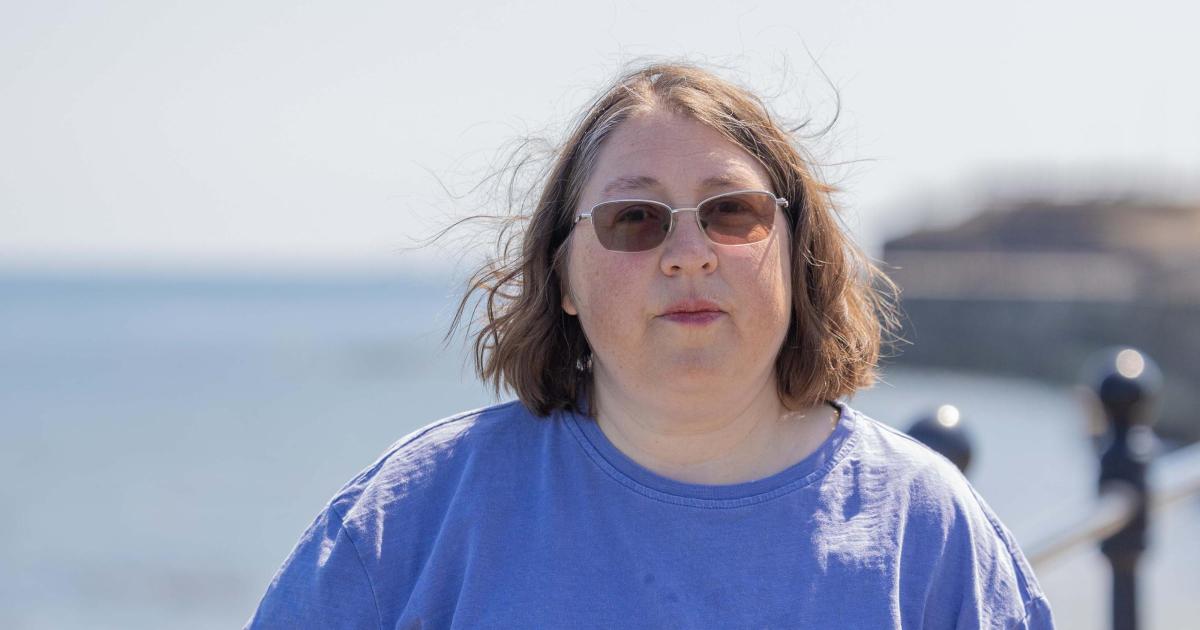
Dawn Lord, 52, who had battled with heavy periods for some time, believed that she was attending a routine appointment at the University of Hartlepool Hospital in May 2023 to discuss future procedures when she was told she would be having a biopsy.
Ms Lord, from Hartlepool, said no one explained to her what was going to happen.
She said: “I was told to go into a changing room and put a gown on. When I walked into the next room, I was shocked when it was a big operation room.
“I was anxious. I didn’t know what was planned. I’d had a difficult birth, so procedures make me anxious and no one had explained anything to me.”
After the biopsy failed, Dawn was given a hysteroscopy – an examination which uses a small telescope-like device inserted into the cervix – without it being explained to her.
Dawn Lord from Hartlepool who wasn’t offered pain relief during a procedure at the University of Hartlepool Hospital. (Image: SARAH CALDECOTT)
She said: “It was the most horrific pain I’ve ever had in my life. Aside from labour. It was horrendous. And I’m saying ‘it’s really painful’ over and over again.
“One of the nurses asked if I wanted some gas and air, but they couldn’t find it. Then the doctor said ‘I suppose we could do a local anaesthetic’, but it didn’t help.
“I was shouting over and over again. Eventually, I was given the gas and air, and I could hear my guttural scream in my head. That scream stayed in my head for months afterwards.
“I felt faint. The room was spinning. I felt sick. I was sweating. I felt like the chair was tipping upside down.”
Dawn was then taken into a separate room with her husband and was told to take some paracetamol when she got home.
“There was absolutely no follow-up or being told to come back if I feel unwell,” she said.
“I got home and I was in extreme pain. I was bleeding heavily.
“I had a really traumatic birth and got PTSD from it, but I hadn’t had visions in about 11 years at this point. That night after the procedure, I started to get visions of the childbirth mixed with visions of the procedure.”
Ms Lord rang the hospital over the weekend as the pain continued, but she was told to come in on the following Monday.
Eventually, Dawn was contacted by someone from the hospital.
She said: “It was only then that it was explained what had happened to me. I was like ‘why wasn’t I told? Why wasn’t I offered pain relief’? The woman just said she didn’t know.”
Ms Lord went ahead with a formal complaint and received an apology in October 2023, five months after her appointment.
The North Tees NHS Hospital Trust apologised to Mrs Lord for not meeting “the high standard of care” they aimed to provide and paid her £400 in compensation.
A spokesperson for the University of Hartlepool Hospital said: “The concerns raised by Ms Lord have given us the opportunity to review the care given, identify learning and make improvements.
“We have not met the high standard of care we strive to provide to our patients and have written to Ms Lord to apologise.”
Now, Dawn is dedicated to ensuring that everyone has the correct information so that no one else goes through what she did.
She has started a Facebook group called Hysteroscopy Trauma, where Dawn and others speak about their experiences and contains multiple files that women can use and take to their appointments to ensure they are given informed consent and pain relief options when they go for a procedure.
She said: “Setting up that page was so that women know that they are entitled to informed consent and all the information when they go to these procedures.
“I was always quiet and I never spoke up, and that was part of my problem. I sat in that chair and just let the doctor do stuff to me without asking questions. I want to stop that from happening to someone else.
“Even though the damage and the trauma was a while ago, it’s still the little things that can trigger the panic. Even now, when I go past the hospital, it triggers me. I don’t want people to have their lives changed when it’s something that could be simple.”
This year, Dawn’s local MP, Jonathan Brash, wrote to ministers and the Care Quality Commission on her behalf.
He said: “Dawn has shown real courage in speaking out about what happened to her. No patient should be left in pain, confused about what is happening to their own body, or made to feel that consent is an afterthought.
“When Dawn brought this to me, I wrote to Ministers and to the Care Quality Commission to support her case because the issues she raised are extremely serious. Informed consent is not a box-ticking exercise. It is fundamental to safe, dignified healthcare.
“I welcome the apology that Dawn received, but the most important thing now is that lessons are properly learned so that no other woman in Hartlepool, or anywhere else, is put through the same traumatic experience.”
Baroness Gillian Meron, Parliamentary Under-Secretary of State at the Department of Health and Social Care, responded in a letter: “It is unacceptable that women have poor experiences, including pain during procedures.
“Women must be fully informed in advance and supported through shared decision-making, with clear discussion of pain relief options.
“It is important that healthcare professionals provide women with information ahead of the procedure, so that they can make an informed decision.
“Women must be given the opportunity to speak to the doctor or nurse before having the procedure about what to expect, and to discuss pain relief options, including the option of local or general anaesthetic.
“The healthcare professional should inform the patient that if she is finding the procedure too painful then she can ask for the procedure to be stopped at any time.”