
Close by, a three-legged orange cat lounges on the back step before gently demanding to be carried upstairs for some peace and quiet. His humans take a minute to bask in the sun streaming in the kitchen window and from here, you can spy Dobbyn’s studio at the end of the garden.
That space is the complete opposite of the family home, fortuitously already there when they bought the place.
“I thought there’d be some kind of off-ramp, but there isn’t. And I wouldn’t take it if there was, because I’d miss it too much.’ Photo / Sylvie Whinray
With no windows, it is dark, but more cocoon-like than dreary. Curved orange and beige brick walls radiate their own version of sunshine, while trinkets and mementos of a life lived large are perched everywhere you look; guitars strung from the ceiling, gold records leaning above a well-loved piano, posters from past tours scattered like postcards. There are wires everywhere, connecting microphones to amps to mixing desks.
Dobbyn’s wife of more than 40 years, Anneliesje, visits briefly, carefully balancing a cup of tea that will soon go cold near a laptop plastered with words from a label maker: Love one another.
It’s the kind of spot you could imagine whiling away the hours, while the rest of the world can just bloody wait. But sometimes, waiting is a luxury hard to afford. And Dobbyn’s not one to waste time overthinking things.
“When you’ve got a disadvantage like me, with the Parkinson’s, it makes you perform better in a way. You have to overcome the restrictions of it and then be able to just loosen up and not worry about what’s going to happen or whether I’m going to be weak or whatever. It’s just like [being in] another world. Although when I finish, I’m usually pretty knackered. Not that I’m doing a lot of choreography.”
Hey, never say never.
“Yeah, exactly. Pyrotechnics would be good, but I’d probably blow myself up. [But being on stage] is just so addictive. So necessary, like food.”
Dobbyn has spoken about living with Parkinson’s disease, which he was diagnosed with in 2022, a little – but not a lot. Today, the effects are obvious; he walks a little slower, talks a little slower and his strength is not what it was.
It hasn’t stopped him performing, not really. Although he reveals there was a time he did have to step away from the stage, maybe the longest break he’s ever had from performing live since he started playing guitar for Th’ Dudes in the mid 70s.
“A couple of years ago I was busy battling, well, not only Parkinson’s, I had prostate cancer, but that’s gone, along with the prostate,” he shares candidly.
“And I’ve got mild emphysema, like COPD, which can be limiting. I’m unable to do a lot of aerobic exercise without getting completely puffed.”
COPD, or chronic obstructive pulmonary disease, is a progressive lung disease that restricts airflow and causes breathing problems. In conversation, there are moments when it’s clear talking is not as simple as it once was. So you would imagine bopping around on stage for a couple of hours would be a real effort. Except it’s not. That’s the one place Dobbyn doesn’t struggle.
“For some reason it doesn’t occur [on stage]. I can sing and play and it hasn’t affected my voice. I can still project my voice when I need to. And so it’s almost like it’s a different set of rules once you’re performing.
“Everything lifts up. It’s like, oh yeah, I can do that. Or [the effect of Parkinson’s means] I can’t play that anymore, but I could play this, because things do start limiting. I can’t quite do a lot of the chords like I used to. But then I’ll be able to sort of rip into a solo and go, where did that come from …”
The body is a weird thing. Dobbyn agrees. He reckons his must be running on muscle memory at least some of the time these days. And even when it doesn’t work the way he wants, there’s no resentment.
He thinks being angry is “a waste of energy”. He thinks things happen, and when they happen you’ve just got to deal with it. You accept things as they come.
“You forgive yourself and you forgive everyone else, because it’s nobody’s fault,” he says.
“I love the fact that you can be in a state of acceptance against, you know, pretty steep odds sometimes. But it balances out. There are other rewards and there are other ways of looking at things that more than make up for things I can’t do or whether or not I can perform or not. I know that I can, and so as long as I know that, I can just keep doing it.”
Dobbyn (centre) joined Th’ Dudes in the 70s.
One of five kids, Dobbyn was raised Catholic in Auckland’s Glen Innes, and met his Th’ Dudes bandmates Ian Morris, Peter Urlich and Peter Coleman, at Sacred Heart College.
Today, he says his relationship with God is “deeper” than it has been, particularly when it comes to his health and the moments when it feels overwhelming.
“I’ve deepened my belief in Jesus Christ and everything he represents and the love that he has and that he’s showering down on people right, left and centre, on the good and the bad … But I get a huge amount of support from him.
“I put a lot of it down to my faith, you know, that God always manages to whisper to you, I’ll take care of this.”
Dobbyn has always been a nervous performer, or maybe nervous to perform is a better description. Famously, he would play with his back to the audience early in his career. Then, someone told him he was mistaking adrenaline and excitement for fear, so he turned around.
“I still get the tingles and the scared shitless feeling. But once we’re on [stage] it sort of calms down and gets into the groove. That’s magic.”
Nerves and anxiety still come along at times – according to Parkinson’s New Zealand, anxiety affects up to 40% of people with the disease. Dobbyn finds airports particularly tricky. But he’ll be closer to home in July, when he plays a one-night-only concert at The Civic in Auckland, featuring his hits performed by an eight-piece band, which includes his son Eli on percussion.
Dobbyn loves The Civic. He wrote a song about The Civic. He calls it a “golden palace”.
“When we were kids, it was a big treat to come along the waterfront on the rattly old diesel buses, come into town to Britomart and then, holding on to each other’s shirt tails, going up the street to get to The Civic.”
The Auckland show has been preceded by a handful of shows around the country in the past year. He already knows it will open with either Kingdom Come or Bell Tower. He doesn’t know what he will finish with: “It depends on whether we get an encore or not”.
Yeah, in what universe, mate …
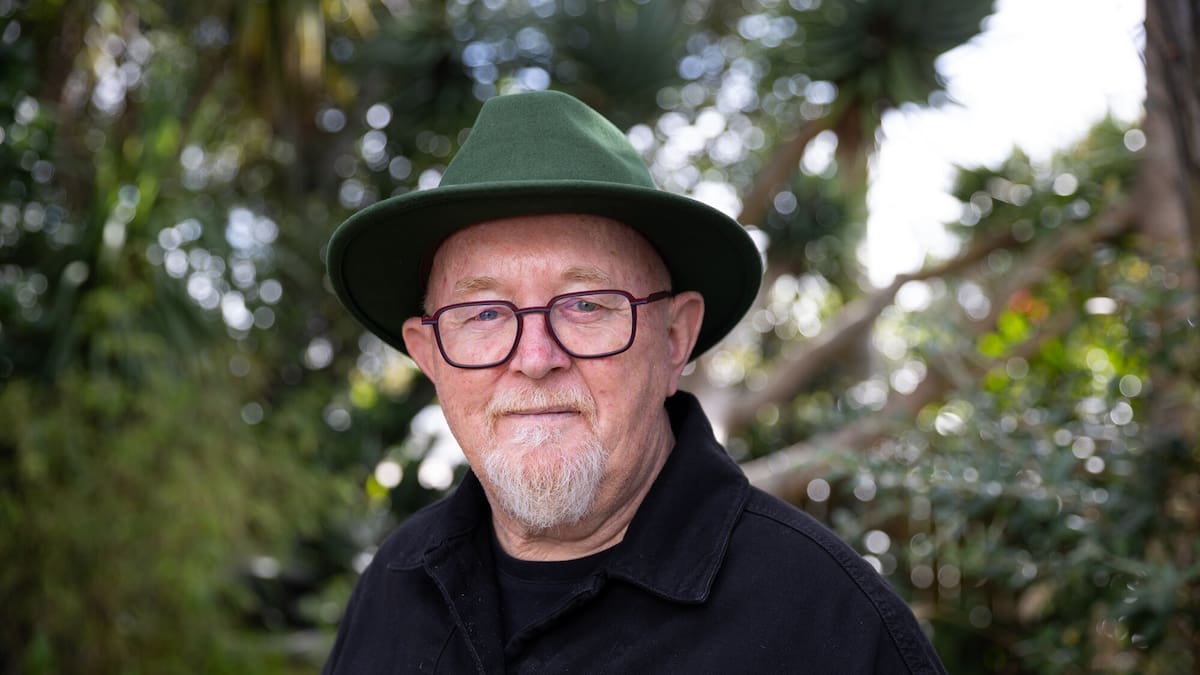
Dobbyn, photographed at his home in Grey Lynn, will perform at The Civic in July. Photo / Sylvie Whinray
Pulling the shows together forced Dobbyn to look back over his career and the songs he’s written. The process surprised him; even after choosing the 22 hits and putting them in the right order (he mentions something about flow), there were still so many songs left, so many more he could have included.
Yet over the years, he has worried about his musical legacy. He worries less so today.
“I would often get the feeling that whoever I ran into, they’d come to the music, and would not realise that there was a depth to it, layers and layers of songs, and songs that painted their own stories, or told their own stories. I’d get quite anxious about that, but I don’t worry about it now. I know the song will stand on its own.”
Dobbyn has won the Silver Scroll Award for song-writing three times – more than anyone else in New Zealand. He reckons the best song he’s ever written is Welcome Home. He wanted it to be as “memorable as Now Is The Hour” and remembers feeling like it wrote itself in the same time it took to sing it through.
“And when it does you really listen. You listen and obey the song”.
What about Slice of Heaven, New Zealand’s unofficial national anthem? Does he hum along when he hears it playing at the supermarket?
“I jokingly go ‘ka-ching! ka-ching!’,” he says, punctuated with that mischievous smile of his.
Maybe it’s his age, maybe it’s his health, but Dobbyn is focused on the finer details these days. Living in the moment comes more naturally now than it did when he was younger.
“It’s always the really small things that make a life, I reckon. It’s all those series of tiny little things and they become really precious. Like when you’re looking at your kids or when you look into your wife’s eyes or you just spot something new each time and never never get sick of it. And so you really appreciate it.”
That goes for playing and touring and spending time with his audiences too.
“I can’t do it forever but I’ll try, I’ll give it my darndest. And, you know, hopefully when I’m up in the heavenlies I’ll be in some kind of band or choir.
“I just don’t want it to end.”
See Sir Dave Dobbyn’s Selected Songs – Encore at The Civic on July 25. Visit ticketmaster for more details
Bridget Jones joined the New Zealand Herald in 2025. She has been a lifestyle and entertainment journalist and editor for more than 15 years.