
Butterflies are everywhere in the tropical rainforests of Central and South America, where life exists on an astonishing scale.
Costa Rica alone is home to about half a million species – five times more than the entire country of Canada – even though Costa Rica has about 200 times less land area.

It’s one of the most biodiverse places on Earth, and even after centuries of research, scientists are still finding surprises.
Some of the region’s most familiar plants and animals have become part of the landscape.
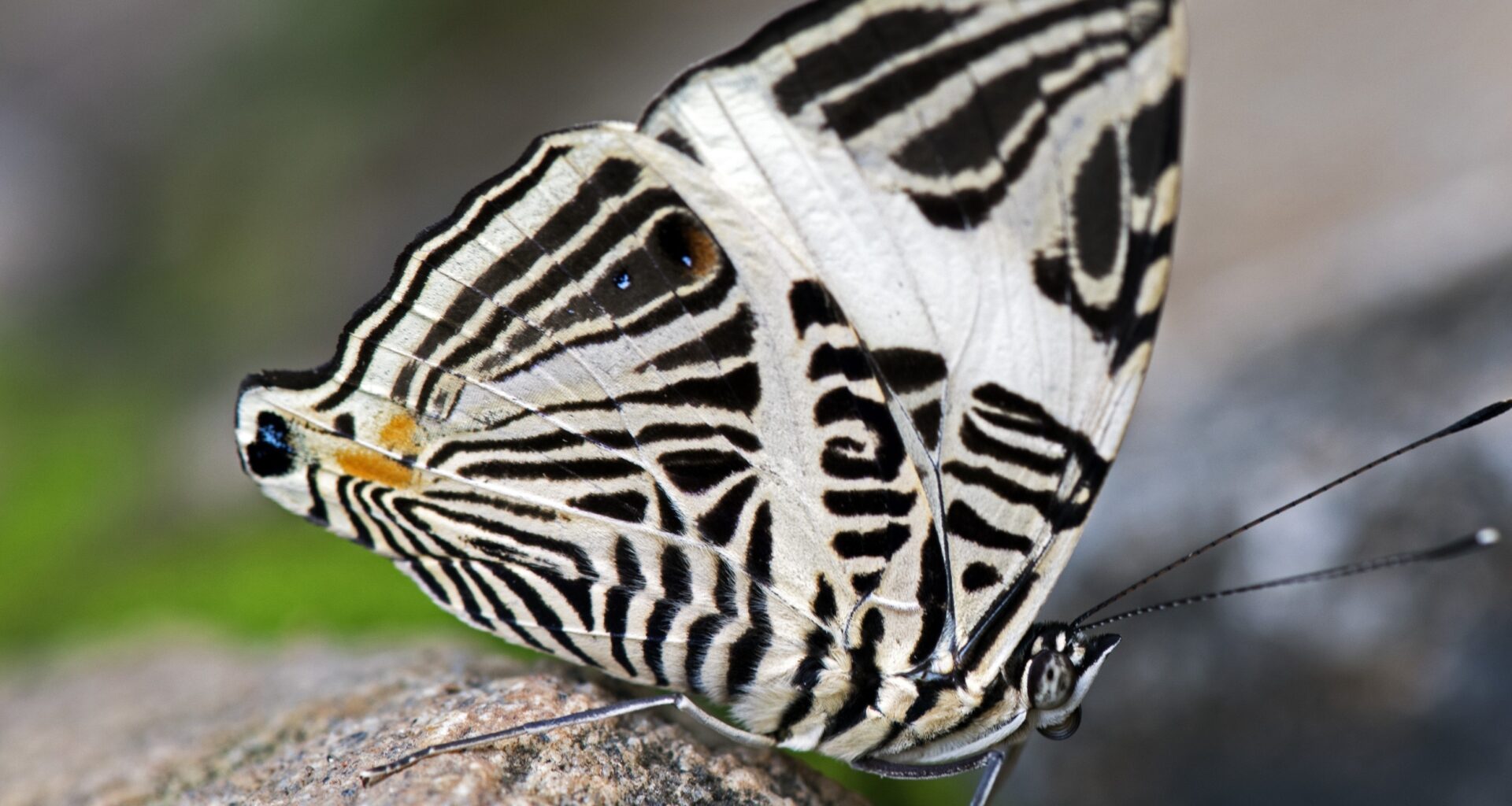
The Colobura butterfly is one of them, a common sight across much of the tropical Americas.
Scientists thought they knew this butterfly well. They were wrong.
A butterfly mystery hiding in plain sight
After the second species was recognized in 2001, researchers realized the story still wasn’t complete.
Working at the Florida Museum of Natural History, doctoral student Anisha Sapkota led a study that identified a third species.
“If you go to the neotropics, Colobura is one of the first butterflies you see,” she said.
For more than 200 years after Carl Linnaeus first described Colobura dirce in 1758, scientists believed the genus contained only one widespread species.
That assumption seemed reasonable because adult butterflies look almost identical, even when they live in the same forests at the same time.
Tiny differences made all the difference
The adults differ only by slight changes to a gray band beneath their forewings.
Some bands become slightly wider, while others stay the same width or either touch or stop short of a yellow band beneath them.
The caterpillars reveal a little more. All have black bodies covered with bright yellow spines, but their cream-colored markings vary.
One species has teardrop-shaped marks, another has rings, and the newly discovered species has no cream-colored markings at all.
“These butterflies look almost exactly the same and are found in the exact same place at the same time,” Sapkota said.
A problem that’s finally solved
Back in 1852, Dutch entomologist Jan Sepp argued that differences in caterpillar markings pointed to two separate species.
Other scientists dismissed the idea for about 150 years, believing the markings reflected normal variation or differences between males and females.
That changed in 2001 when Keith Willmott, now a curator at the Florida Museum’s McGuire Center for Lepidoptera and Biodiversity, and his colleagues formally described Colobura annulata.
“We assumed that was the problem solved,” Willmott said.
Still, he couldn’t completely shake the feeling that another species might exist.
“I had a few indications that there was a third species, but I thought it was too implausible.”
“It’s a very distinctive butterfly. It’s hard to imagine there being two species in the same area that look alike because they’re so different from anything else.”
DNA exposed the truth
Years later, Andrés Orellana discovered caterpillars feeding on a Cecropia sapling in Venezuela.
Unlike the others, these caterpillars had no cream-colored markings. The photographs convinced researchers to investigate again.
Sapkota combined DNA barcoding with complete mitochondrial and nuclear genome sequencing from museum specimens collected across the tropical Americas.
The genetic evidence clearly showed three separate evolutionary lineages that matched the subtle physical differences.
Searching for clues
Orellana also spent hours studying preserved butterflies, searching for overlooked clues. Eventually, she noticed a faint violet shimmer beneath their wings.
“I checked it with a spectrometer and found that even though the butterflies didn’t look violet to me, it reflected UV light,” she said.
The three species reflected ultraviolet light differently. Colobura dirce averaged 376 nanometers, Colobura annulata averaged 370 nanometers, and the newly named Colobura cryptica averaged 344 nanometers.
Many butterflies can see ultraviolet light even though humans cannot.
Three butterflies in the same forests
The DNA evidence confirmed that all three species remain genetically separate even though their ranges overlap across Central and South America.
Colobura dirce has the widest distribution, stretching from Mexico to southeastern Brazil, including both sides of the Andes and the Caribbean islands.
Colobura annulata also occupies much of the region but does not occur in the Greater Antilles. Colobura cryptica has the smallest range, extending from southern Mexico to the foothills of the Andes.
Scientists usually expect new species to form after populations become separated by physical barriers such as mountain ranges.
Since these butterflies often live in the same places, researchers think something else may be keeping them apart.
“There could be vertical stratification between these butterflies,” Sapkota said.
“Colobura dirce is typically found in the undergrowth and C. cryptica and C. annulata are usually found in the canopy, but we do not know for sure because there have been mixed signals coming from different studies.”
Questions that still need answers
Researchers also don’t know how these butterflies recognize members of their own species. Unlike many butterflies and moths, they lack scent glands used to release mating chemicals.
Their ultraviolet wing patterns may help them identify suitable mates, but studies have not yet confirmed that idea.
One finding is already clear. The nuclear DNA showed no signs that the three species are interbreeding. Each is following its own evolutionary path despite living side by side.
The discovery is a reminder that biodiversity still hides in plain sight.
Even one of the tropical Americas’ most familiar butterflies turned out to be three different species, suggesting many more surprises may still be waiting in forests scientists have studied for centuries.
According to Sapkota, the only way to answer the remaining questions is simple.
“Someone has to go the field to find it out themselves.”
The full study was published in the journal Zootaxa.
—–
Like what you read? Subscribe to our newsletter for engaging articles, exclusive content, and the latest updates.
Check us out on EarthSnap, a free app brought to you by Eric Ralls and Earth.com.
—–