
Regnier, P., Resplandy, L., Najjar, R. G. & Ciais, P. The land-to-ocean loops of the global carbon cycle. Nature 603, 401–410 (2022).
Battin, T. J. et al. River ecosystem metabolism and carbon biogeochemistry in a changing world. Nature 613, 449–459 (2023).
Cole, J. J. et al. Plumbing the global carbon cycle: integrating inland waters into the terrestrial carbon budget. Ecosystems 10, 172–185 (2007).
Raymond, P. A. et al. Global carbon dioxide emissions from inland waters. Nature 503, 355 (2013).
Hagedorn, B., El-Kadi, A. I. & Whittier, R. B. Controls on the δ13CDIC and alkalinity budget of a flashy subtropical stream (Manoa River, Hawaii). Appl. Geochem. 73, 49–58 (2016).
Nydahl, A. C., Wallin, M. B., Laudon, H. & Weyhenmeyer, G. A. Groundwater Carbon Within a Boreal Catchment: Spatiotemporal Variability of a Hidden Aquatic Carbon Pool. J Geophys. Res. Biogeosci 125, (2020).
Lauerwald, R., Laruelle, G. G., Hartmann, J., Ciais, P. & Regnier, P. A. G. Spatial patterns in CO2 evasion from the global river network. Global Biogeochem. Cycles. 29, 534–554 (2015).
Hotchkiss, E. R. et al. Sources of and processes controlling CO2 emissions change with the size of streams and rivers. Nat. Geosci. 8, 696–699 (2015).
Drake, T. W., Raymond, P. A. & Spencer, R. G. M. Terrestrial carbon inputs to inland waters: A current synthesis of estimates and uncertainty. Limnol. Oceanogr. Lett. 3, 132–142 (2018).
Alin, S. R. et al. Physical controls on carbon dioxide transfer velocity and flux in low-gradient river systems and implications for regional carbon budgets. J Geophys. Res. Biogeosci 116, (2011).
Richey, J. E., Melack, J. M., Aufdenkampe, A. K., Ballester, V. M. & Hess, L. L. Outgassing from Amazonian rivers and wetlands as a large tropical source of atmospheric CO2. Nature 416, 617–620 (2002).
Dubois, K. D., Lee, D. & Veizer, J. Isotopic constraints on alkalinity, dissolved organic carbon, and atmospheric carbon dioxide fluxes in the Mississippi River. J Geophys. Res. Biogeosci 115, (2010).
Li, S., Lu, X. X. & Bush, R. T. CO2 partial pressure and CO2 emission in the Lower Mekong River. J. Hydrol. (Amst). 504, 40–56 (2013).
Yang, C., Telmer, K. & Veizer, J. Chemical dynamics of the St. Lawrence riverine system: δDH2O, δ18OH2O, δ13CDIC, δ34Ssulfate, and dissolved 87Sr/86Sr. Pergamon Geochim. et Cosmochim. Acta. 60, 851–866 (1996).
Crawford, J. T. et al. Basin scale controls on CO2 and CH4 emissions from the Upper Mississippi River. Geophys. Res. Lett. 43, 1973–1979 (2016).
Pawellek, F., Frauenstein, F. & Veizer, J. Hydrochemistry and isotope geochemistry of the upper Danube River. Geochim. Cosmochim. Acta. 66, 3839–3853 (2002).
Pawellek, F. & Veizer, J. Carbon cycle in the upper Danube and its tributaries: δ13CDIC constrains. Israel J. Earth Sciences 43, (1994).
Li, M. et al. The carbon flux of global rivers: A re-evaluation of amount and spatial patterns. Ecol. Indic. 80, 40–51 (2017).
Maier, M. S., Teodoru, R., Wehrli, B. & C. & Spatio-temporal variations in lateral and atmospheric carbon fluxes from the Danube Delta. Biogeosciences 18, 1417–1437 (2021).
Maier, J., Visser, A. N., Schubert, C. M., Wander, S. T. & Barth, J. A. C. Hydrodynamic and primary production effects on seasonal DO variability in the Danube River. Biogeosciences 22, 5123–5137 (2025).
Raymond, P. A. & Hamilton, S. K. Anthropogenic influences on riverine fluxes of dissolved inorganic carbon to the oceans. Limnol. Oceanogr. Lett. 3, 143–155 (2018).
Schulte, P. et al. Applications of stable water and carbon isotopes in watershed research: Weathering, carbon cycling, and water balances. Earth Sci. Rev. 109, 20–31 (2011).
Doctor, D. H. et al. Carbon isotope fractionation of dissolved inorganic carbon (DIC) due to outgassing of carbon dioxide from a headwater stream. Hydrol. Process. 22, 2410–2423 (2008).
van Geldern, R., Schulte, P., Mader, M., Baier, A. & Barth, J. A. C. Spatial and temporal variations of pCO2, dissolved inorganic carbon and stable isotopes along a temperate karstic watercourse. Hydrol. Process. 29, 3423–3440 (2015).
Schubert, C. M. et al. An unusual carbon cycle budget of a small stream in a mountain silicate terrain: The case of the Gravona river (Corsica). Ecohydrology 16, (2023).
Senarathne, S., van Geldern, R., Chandrajith, R. & Barth, J. A. C. Unexpected contributions by carbonates and organic matter in a silicate-dominated tropical catchment: An isotope approach. Science Total Environment 948, (2024).
Richey, J. E. The global carbon cycle: integrating humans, climate and the natural world. in Pathways of atmospheric CO2 through fluvial systems (eds. Field, C. B. & Raupach, M. R.) vol. 43 329–340 (School of Oceanography, University of Washington, P.O. Box 355351, Seattle, WA 98195 – 7540, USA, (2004).
Li, S. et al. Daily CO2 partial pressure and CO2 outgassing in the upper Yangtze River basin: A case study of the Longchuan River, China. J. Hydrol. (Amst). 466, 141–150 (2012).
Yao, G. et al. Dynamics of CO2 partial pressure and CO2 outgassing in the lower reaches of the Xijiang River, a subtropical monsoon river in China. Sci. Total Environ. 376, 255–266 (2007).
Sommerwerk, N. et al. The Danube River Basin. Rivers Europe 59–112 (2009).
Bohm, O., Jacobeit, J., Glaser, R. & Wetzel, K. F. Flood sensitivity of the Bavarian Alpine Foreland since the late Middle Ages in the context of internal and external climate forcing factors. Hydrol. Earth Syst. Sci. 19, 4721–4734 (2015).
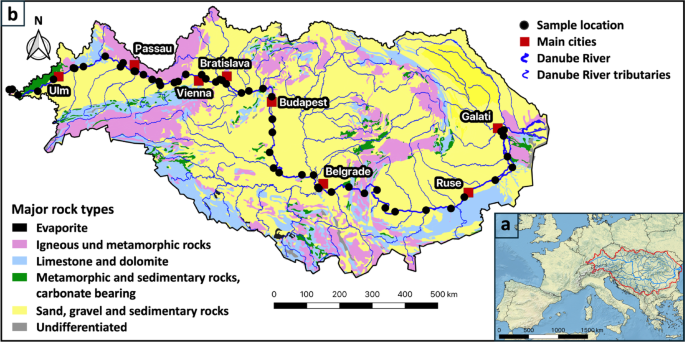
Bayerisches Landesamt für Umwelt. Geologische Karte von Bayern 1:500,000 (GK500) [GIS dataset]. last access November 17,. from (2025). https://www.lfu.bayern.de/geologie/geo_karten_schriften/gk500/index.htm (2025).
GeoSphere, A. Bundesanstalt für Geologie, Geophysik, Klimatologie und Meteorologie. https://gis.geosphere.at. last access 17 November. (2025).
Habersack, H. et al. Challenges of river basin management: Current status of, and prospects for, the River Danube from a river engineering perspective. Sci. Total Environ. 543, 828–845 (2016).
Liška, I. et al. Joint Danube Survey 4 Scientific Report: A Shared Analysis of the Danube River. Vienna: International Commission for the Protection of the Danube River-ICPDR. (2021).
ICPDR. Danube River Basin Hydrological Information System (DanubeHIS), Https://Www.Danubehis.Org, Last Access: 11 March 2025. (2025).
St-Jean, G. Automated quantitative and isotopic (13 C) analysis of dissolved inorganic carbon and dissolved organic carbon in continuous-flow using a total organic carbon analyser. Rapid Commun. Mass Spectrom. 17, 419–428 (2003).
van Geldern, R. et al. Stable carbon isotope analysis of dissolved inorganic carbon (DIC) and dissolved organic carbon (DOC) in natural waters – Results from a worldwide proficiency test. Rapid Commun. Mass Spectrom. 27, 2099–2107 (2013).
Coplen, T. B. Guidelines and recommended terms for expression of stable-isotope‐ratio and gas‐ratio measurement results. Rapid Commun. Mass Spectrom. 25, 2538–2560 (2011).
Dickson, A. G., Sabine, C. L., Christian, J. & Robert Guide to Best Practices for Ocean CO₂ Measurements (North Pacific Marine Science Organization, 2007).
Marx, A. et al. A review of CO2 and associated carbon dynamics in headwater streams: A global perspective. Rev. Geophys. 55, 560–585 (2017).
Parkhurst, D. L. & Appelo, C. A. J. Description of input and examples for PHREEQC version 3—a computer program for speciation, batch-reaction, one-dimensional transport, and inverse geochemical calculations. US Geol. Surv. techniques methods 493, (2013).
Clark, I. D. & Fritz, P. Environmental Isotopes in Hydrogeology (CRC press/Lewis, 2013).
Cerling, T. E., Solomon, D. K., Quade, J. & Bowman, J. R. On the isotopic composition of carbon in soil carbon dioxide. Geochim. Cosmochim. Acta. 55, 3403–3405 (1991).
Myrttinen, A., Becker, V. & Barth, J. A. C. A review of methods used for equilibrium isotope fractionation investigations between dissolved inorganic carbon and CO 2. Earth Sci. Rev. (2012). https://doi.org/10.1016/j.earscirev.2012.08.004
Mayer, B. et al. Assessing the usefulness of the isotopic composition of CO2 for leakage monitoring at CO2 storage sites: A review. Int. J. Greenhouse Gas Control. (2015). https://doi.org/10.1016/j.ijggc.2015.02.021
R Core Team. R: A Language and Environment for Statistical Computing, [online] (2023). Available from: https://www.r-project.org/. Preprint at.
Miller, J. B. & Tans, P. P. Calculating isotopic fractionation from atmospheric measurements at various scales. Tellus B: Chem. Phys. Meteorol. 55, 207 (2003).
Schmidt, B., Janauer, G. A., Barta, V. & Schmidt-Mumm, U. Breg and Brigach, Headstreams of the River Danube: Biodiversity and Historical Comparison. in Macrophytes of the River Danube Basin (Academia, 2015).
Hötzl, H. Origin of the Danube-Aach system. Environ. Geol. 27, 87–96 (1996).
Barth, J. A. C., Cronin, A. A., Dunlop, J. & Kalin, R. M. Influence of carbonates on the riverine carbon cycle in an anthropogenically dominated catchment basin: evidence from major elements and stable carbon isotopes in the Lagan River (N. Ireland). Chem. Geol. 200, 203–216 (2003).
Liu, J. & Han, G. Effects of chemical weathering and CO2 outgassing on δ13CDIC signals in a karst watershed. J Hydrol. (Amst) 589, (2020).
Lee, K. Y., van Geldern, R. & Barth, J. A. C. Extreme gradients in CO2 losses downstream of karstic springs. Science Total Environment 778, (2021).
Gaillardet, J., Dupré, B., Louvat, P. & Allegre, C. J. Global silicate weathering and CO2 consumption rates deduced from the chemistry of large rivers. Chem. Geol. 159, 3–30 (1999).
Ehleringer, J. R., Cerling, T. E. & Denise Dearing, M. Atmospheric CO2 as a Global Change Driver Influencing Plant-Animal Interaction. Integr. Comp. Biol. 42, 3–7 (2002).
Mook, W. G., Bommerson, J. C. & Staverman, W. H. Carbon Isotope Fractionation between Dissolved Bicarbonate and Gaseous Carbon Dioxide. Earth Planet. Sci. Letters 22 (1974).
Fry, B. Stable Isotope EcologySpringer New York, NY,. (2006).
Striegl, R. G., Dornblaser, M. M., Aiken, G. R., Wickland, K. P. & Raymond, P. A. Carbon export and cycling by the Yukon, Tanana, and Porcupine rivers, Alaska, 2001–2005. Water Resour. Res 43, (2007).
Ogrinc, N., Markovics, R., Kanduč, T., Walter, L. M. & Hamilton, S. K. Sources and transport of carbon and nitrogen in the River Sava watershed, a major tributary of the River Danube. Appl. Geochem. 23, 3685–3698 (2008).
Kanduč, T., Szramek, K., Ogrinc, N. & Walter, L. M. Origin and cycling of riverine inorganic carbon in the Sava River watershed (Slovenia) inferred from major solutes and stable carbon isotopes. Biogeochemistry 86, 137–154 (2007).
Wetzel, R. G. Limnology: Lake Ad River Ecosystems (Academic, 2011).
Rank, D., Papesch, W., Heiss, G. & Tesch, R. Isotopic composition of river water in the Danube Basin – Results from the Joint Danube Survey 2 (2007). Aust. J. Earth Sci. 102, 170–180 (2009).
Voss, B. M., Wickland, K. P., Aiken, G. R. & Striegl, R. G. Biological and land use controls on the isotopic composition of aquatic carbon in the Upper Mississippi River Basin. Global Biogeochem. Cycles. 31, 1271–1288 (2017).
Maier, J. et al. Natural abundance δ13C constraints on the detection of microplastic-derived carbon in freshwater environments. Environ. Pollut. 389, 127435 (2026).
Dokulil, M. T. Phytoplankton of the River Danube: Composition, Seasonality and Long-Term Dynamics. Danube River Basin. https://doi.org/10.1007/698_2014_293 (2015).
Dornblaser, M. M. & Striegl, R. G. Suspended sediment and carbonate transport in the Yukon River Basin, Alaska: Fluxes and potential future responses to climate change. Water Resour. Res 45, (2009).
Luo, X. et al. Mapping the global distribution of C4 vegetation using observations and optimality theory. Nat Commun 15, (2024).
Deirmendjian, L. & Abril, G. Carbon dioxide degassing at the groundwater-stream-atmosphere interface: isotopic equilibration and hydrological mass balance in a sandy watershed. J. Hydrol. (Amst). 558, 129–143 (2018).
Polsenaere, P. & Abril, G. Modelling CO2 degassing from small acidic rivers using water pCO2, DIC and δ13C-DIC data. Geochim. Cosmochim. Acta. 91, 220–239 (2012).
Venkiteswaran, J. J., Schiff, S. L. & Wallin, M. B. Large carbon dioxide fluxes from headwater boreal and sub-boreal streams. PLoS One. 9, e101756 (2014).
Maier, J. and J. A. C. Barth. Seasonal Dataset of DIC, 𝛿13𝐶𝐷𝐼𝐶, DOC, 𝛿13𝐶𝐷𝑂𝐶, 𝑝𝐶𝑂2(aq), FCO2 and Biogeochemical Parameters in the Danube River (2023–2024), PANGAEA dataset. https://doi.org/10.1594/PANGAEA.993653