

Between 2000 and 2022, the number of self-employed Canadians with paid employees—the founders most likely to scale, hire, and challenge incumbents—fell by 57 percent, from 3.0 to 1.3 per thousand working-age adults. As Falice Chin documented in The Hub, this quiet collapse sits at the heart of one of Canada’s most consequential and least discussed economic problems: the country is producing fewer builders than it used to.
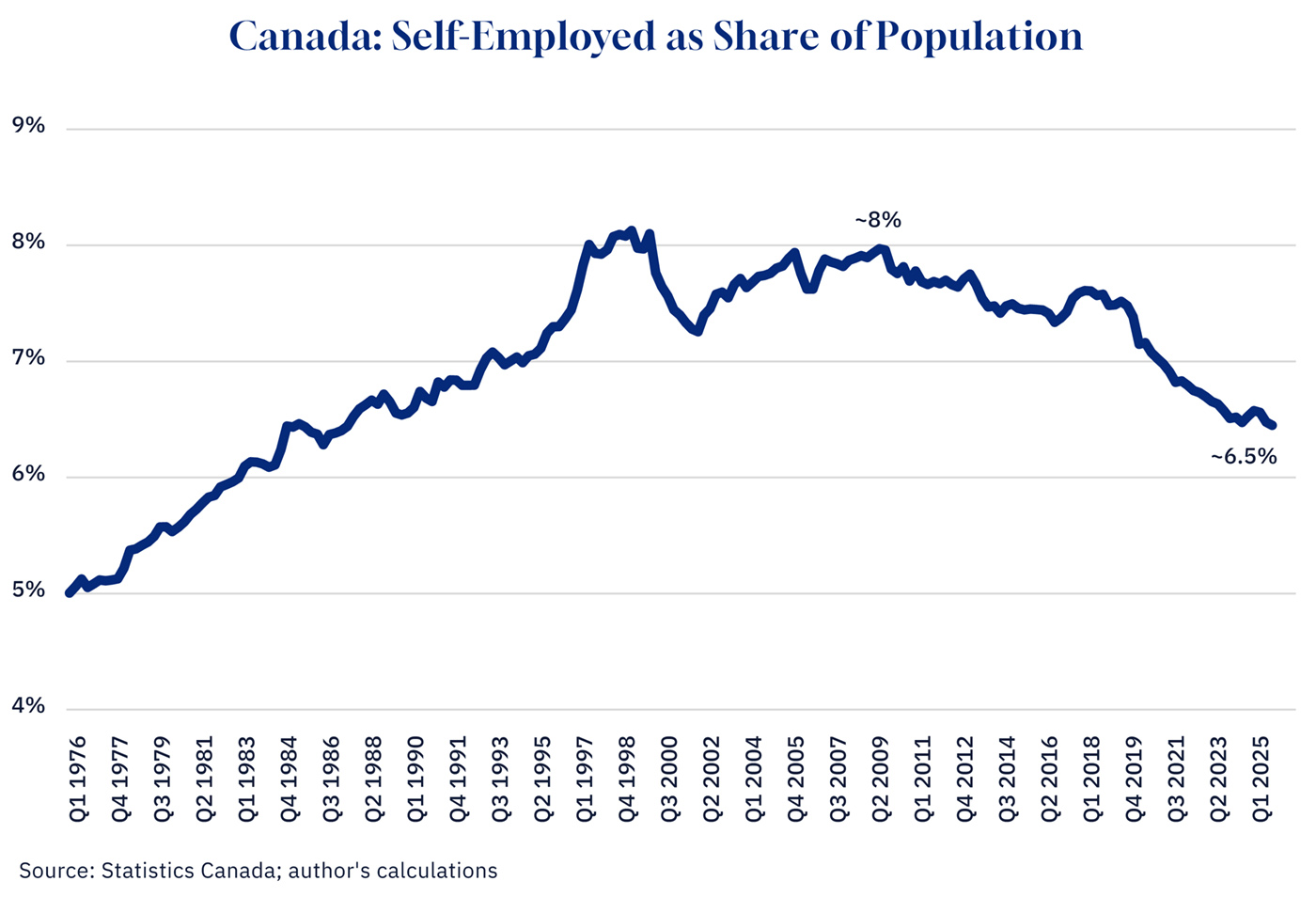
The broader picture is no more reassuring. Self-employment has slipped from 17 percent of total employment a quarter-century ago to 12.8 percent, the lowest share in 45 years. The business entry rate fell from 15.2 percent in 2008 to 12.3 percent in 2023, a fraction of the nearly 25 percent Canada achieved in the early 1980s. The Canadian Federation of Independent Business now describes an “entrepreneurial drought,” pointing to six consecutive quarters in which more businesses closed than opened—something that rarely happens even in recessions.
The international comparison is what should sting. Between 2015 and 2024, annual business formation in Canada was essentially flat. Over the same period, business entries rose 34 percent in the United States, 40 percent in the United Kingdom, and 86 percent in France. The exodus compounds the damage: in 2024, for the first time, more Canadian-educated founders who raised significant capital launched their companies in the U.S. than at home.
This is not a niche concern for economists. Entrepreneurship determines who gets to build the future—and Canada has increasingly chosen to manage its past instead. The median age of the country’s 15 largest public companies was 122 years in 2021, compared with just 45 years in the United States. Even the firms Canadians cite as success stories, Shopify and Lululemon among them, are now decades old. The challenge is not that Canada has forgotten how to build great companies. It is that the country slowed down doing so.
Graphic credit: Janice Nelson
The causes are policy choices, not bad luck. Federal industrial regulatory requirements grew 37 percent between 2006 and 2021, before provincial and municipal rules are even counted. A nation of 40 million too often functions as 13 fragmented markets. Top marginal tax rates exceeding 50 percent in most large provinces blunt the incentive to take risks, while a small-business tax structure that rewards smallness discourages firms from scaling. Venture capital, meanwhile, cratered from nearly 0.5 percent of GDP in 2021 to 0.2 percent in 2024.
The consequences extend well beyond the founders themselves. A low-entrepreneurship economy is a low-growth economy—one that grows more comfortable with incumbency than disruption, more focused on redistribution than wealth creation, more inclined to manage decline than pursue abundance. Weak business formation eventually shows up everywhere: in stagnant wages, strained public finances, and diminished national ambition.
The encouraging news is that dynamism responds to deliberate policy. Estonia, Ireland, Singapore, and Israel built thriving ecosystems through regulatory reform, competitive taxes, and environments that reward risk. Canada has the universities, talent, and institutions. What it lacks is a policy environment that consistently rewards people who dare to build. Recognizing the problem is the first step. Acting on it is the only thing that will keep Canadians from renting their future from someone else.
Canada is experiencing a significant decline in entrepreneurship, with the number of self-employed Canadians with paid employees dropping by 57 percent from 2000 to 2022. This decline is contributing to a broader economic crisis characterized by stagnant business formation and a low-growth economy. Factors such as increased regulatory burdens, high tax rates, and a lack of supportive policies for scaling businesses are identified as key issues. There is an urgent need for deliberate policy changes to foster a more dynamic entrepreneurial environment and prevent Canadians from relying on external opportunities for their future.