
“The walls were just running with water.”
And when the 81-year-old climbs the scaffolding, put there to examine and repair his roof, a crane rises to the north where Fletcher Living is building The Hill, a $500 million development of about 370 homes on the edge of Ellerslie Racecourse.
On the scaffolding surrounding his home as his roof is repaired, Ian Calhaem has a view of the The Hill development. Photo / Mike Scott
Calhaem blames the construction, including vibration from earthworks, for damaging his tiled roof and causing leaks.
It was damage to neighbouring houses, happening at the same time, that made him think the leaks were more than wear and tear.
The Herald also visited Susan Rees at her home on Derby Downs Place, a house her late husband Brian, an architect, designed.
After a fortnight of earthworks in August, 2025, she was in the kitchen making sausage rolls when she heard a “crack, crack, crack, crack”.
“All my tiles in my laundry, toilet and here [the atrium] have all left the concrete. I have to replace the whole lot.”
Fletcher Living offered to repair one affected patch but Rees refused because she claims the damage was more widespread.
She has since sent the company a legal demand letter putting the damage at almost $30,000.
Fletcher offered her $7000 to settle but only if she signed a confidentiality agreement.
“I just said, ‘Oh, get lost’,” Rees said.
Deborah Chait believes The Hill development, being built by Fletcher Living, is damaging her home. She has cracks in walls, doors and windows that no longer shut and the house is now damp. Photo / Mike Scott
On Ladies Mile, Deborah Chait’s house has cracks in plaster walls, windows that won’t shut and are held closed with cable ties and a front door that has been modified to fit four times.
“We don’t want to have people over to our house, it’s like living in a fridge … It’s so damp.”
Kitchen cabinetry installed in 2019 had pulled away and skewed from the wall as the house shifted, she claimed.
“It was all flush,” she told the Herald, placing a finger into gaps she said didn’t previously exist.
An example of the cracks in the walls of Deborah Chait’s home. Photo / Mike Scott
Auckland Council says the site has been found compliant with its consent conditions.
Fletcher Living denies construction at The Hill is responsible for the damage.
The company says all works are “well within the limits allowed under our consents”, and it “absolutely dispute[s] any allegations to the contrary”.
It has encouraged residents to lodge claims with their own insurers or against the contractor’s insurance.
Calhaem has taken a different approach – no lawyer and for now no claim.
When, in August last year, the construction work allegedly rattled his home so hard he couldn’t write with a pen in his upstairs office and his roof started to leak, he decided it was time to get measuring.
And when he researched how vibrations should be measured under The Hill’s own consent conditions, Calhaem concluded the monitoring had been done in the wrong place – on the ground, rather than upstairs.
A seismologist
Calhaem has led quiet a life. “I’ve done some things.”
His CV runs for 10 pages and makes for interesting reading. Highlights include two seasons in Antarctica, a printing-technology career that reached the Palace of Westminster and a doctorate in geophysics.
There have been Royal Society chairmanships, numerous universities, lectures, presentations, publications and even a walk across China and mention of Nasa.
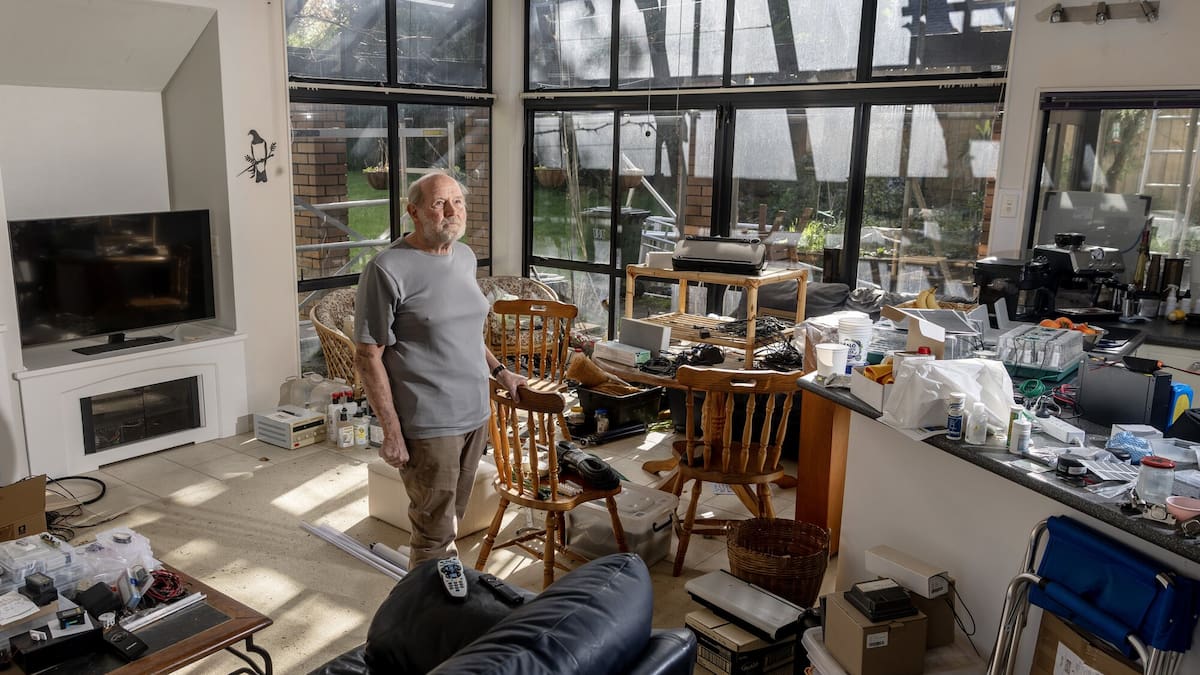
He still does forensic imaging work for police investigations, based out of his home laboratory, which is a mess thanks to the house damage.
The history of Calhaem’s career includes work as a seismologist helping design and install the micro-earthquake network that monitored the filling of the Pukaki hydro dam.
Ian Calhaem, stands in his home laboratory which is critical for his forensic imaging work. Photo / Mike Scott
So, he knows earth movement and it was logical for him to analyse the recent shaking like a scientist.
Even before construction began on The Hill, he had three seismographs recording from his house foundations to monitor for earthquakes, sharing the data publicly.
He said he matched the recordings against visual confirmation of construction work, and cross-checked them against the measurements taken by Fletcher Living’s own vibration consultants, Marshall Day Acoustics, at Susan Rees’ house about 100m away. Calhaem also assessed weekend and night-time recordings to eliminate traffic as a source of the vibrations.
“I’m a scientist, you’ve got to verify everything.”
He read DIN 4150-3 – the German standard that outlines how to measure and assess ground vibration impacts. It is the document used to consent The Hill development and is in the Auckland Unitary Plan.
The standard required measurements to be taken on the highest floor of a building. So in March, Calhaem bought an additional seismograph and installed it upstairs.
The difference was immediately apparent. He said the new upstairs unit recorded movement around 10 times greater than the seismographs in his foundation.
That sent Calhaem back to August last year, when the shaking had stopped him working at his desk.
The scientist reasoned that if the foundation seismograph readings he recorded then were increased by a factor of 10, the measurements would have reached the level that causes “minor damage”, according to the German standard.
Minor damage is symptoms like “cracks form in plastered surfaces of walls, existing cracks in the building are enlarged and partitions become detached from load-bearing walls or floors”.
“Don’t forget this is 100 metres away from the rock-breaking, so the houses closer will have experienced much higher shaking,” Calhaem claimed.
The corner of a broken roof tile retrieved from the roof of Ian Calhaem home. Photo / Mike Scott
The standard also outlines how vibrations differ, depending on their nature.
Short-term, more isolated single jolts, can be absorbed by a building at higher levels.
Long-term – more sustained or repeated shaking – is judged against a lower level of movement because the cumulative effect does more damage.
Calhaem believed constant earthworks at The Hill meant the vibrations fell into the more damaging long-term category and that the result on his home was the broken roof tiles.
He is confident in his methodology.
His biggest question was whether official vibration monitoring occurred on the top floor of homes close to The Hill construction.
“If measurements are only gathered at ground level, they do not match the requirements of the standard that was used to get consent,” he claimed.
The Herald talked with Dr Andrew Stolte, a senior lecturer in civil and environmental engineering at the University of Auckland, setting out Calhaem’s methodology and the instruments used.
Without a full review of the data, Stolte said Calhaem’s method and instruments appeared sound.
“I would just say that his approach seems reasonable, and he has the personal expertise that lends itself to giving me confidence in what he’s trying to do.”
However, a full review of the raw data would answer whether the vibrations experienced by Calhaem were short-term or long-term under the standard and therefore which amount of vibration was allowed.
Ian Calhaem stands amid the disorder of his home thanks to repair and renovation work he has to undertake. Photo / Mike Scott
Sharing the data and the response
With Calhaem’s instruments live-streaming, anyone can watch his house vibrate in real time.
He sent the links to Fletcher Living’s consultants, Marshall Day Acoustics, and to Auckland Council. He handed printouts to a Fletcher staff member at a neighbour’s house.
A Fletcher Living spokesperson said Marshall Day had reviewed the data and found it did not reach infringement risk levels.
Marshall Day’s predicted and measured levels indicated ongoing compliance, which Auckland Council had been satisfied with, the spokesperson said.
Asked whether vibration had been monitored on the highest floor of nearby houses in accordance with the German standard, Fletcher Living’s spokesperson did not confirm it had done so.
“Requested access to neighbours’ homes has not always been granted, in which case the consultant takes readings from the closest location, which generally produces higher (more conservative) readings.”
Auckland Council’s manager environmental monitoring, Robert Laulala, said supplied public information, like Calhaem’s data, could be helpful.
But the council relied on its officers or experts using calibrated equipment following standardised procedures to ensure “readings are accurate and legally defensible”.
The measurements used by the council to assess levels were supplied by Fletcher Living’s consultants and were taken at ground level, Laulala said.
“The location of the monitoring equipment varied, depending on the permission to access the property at the time.
“When permission to access the property was granted, specialised monitoring equipment was placed on the foundation of the dwelling.”
The Fast Track consent required Fletcher to commission its own vibration monitoring, carried out by Marshall Day, Laulala said.
The council’s role was to check the results against the DIN vibration standards. “The recordings provided to the council were within the standards.”
Calhaem said neither he nor any of his affected neighbours had been approached to place vibration monitors on their top floor and none had declined access.
Susan Rees, who did have monitoring equipment placed next to her home, said she would have allowed access to install equipment inside or on her first floor, but was never asked.
“They haven’t done anything in the house at all,” she said.
19 June, 2026
Forensic scientist and former seismologist Ian Calhaem has had to fix broken tile on his roof. Photo / Mike Scott
Fixing the roof
Calhaem insists on remaining scientific to the end and wants to avoid drawing conclusions.
“I’m concentrating on the data, not the interpretation of it,” he explained.
What he wants is any official vibration monitoring to follow the German standard requirements.
Calhaem intends to make a claim for the damage to his roof but not the full $60,000 repair costs.
He said the entire roof had to come off to find all the cracked tiles where the water got in and ran down inside the walls.
Despite the chaos in his house and the disruption to his business, Calhaem believed Fletcher Living shouldn’t have to pay for the general wear and tear of his roof, even though he would never have pulled it apart if the shaking hadn’t forced him to, he said.
“I want to be fair.”
In the meantime, at 81, he’s putting his mountaineering skills, ropes and harness to good use by painting the replacement roof tiles on his steep roof himself.
Mike Scott has covered stories across New Zealand and internationally for more than 20 years. His work spans writing, photography and video and has won numerous journalism awards.
Sign up to The Daily H, a free newsletter curated by our editors and delivered straight to your inbox every weekday.