
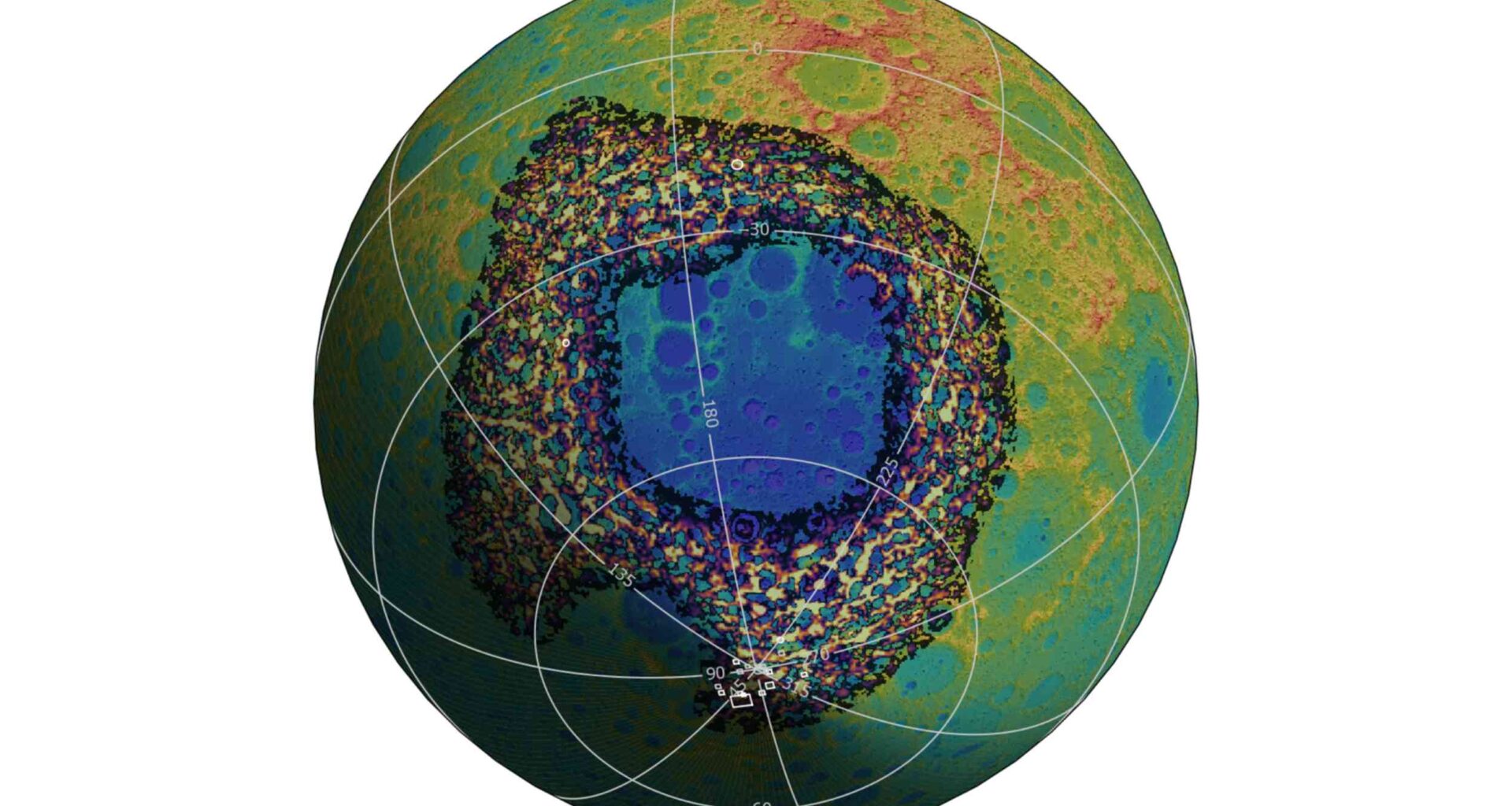
NASA is preparing to land astronauts near the Moon’s south pole, a region no crewed mission has ever reached.
The ground there looks like the same pale, dusty crust that blankets most of the lunar surface.

New computer modeling hints that some rocks in those landing zones came from far beneath the crust.
Lifted from hundreds of miles down, they are from a part of the Moon no one has sampled. That would put pieces of its deep interior within a short walk of a boot print.
The Moon’s oldest scar
On the far side of the Moon, hidden from anyone on Earth, sits the largest and oldest impact crater we know of.
Scientists call it the South Pole-Aitken basin, a bruise more than 1,200 miles wide, gouged out around four billion years ago. Because the strike dug so deep, the far side has stayed quiet ever since.
The basin preserves a record of the Moon’s infancy that the restless near side erased long ago. It is a time capsule from the early solar system.
A blow that big should have punched through the crust and flung up rock from the lunar mantle. Reaching that buried rock has been a goal for decades.
Rebuilding the collision
To work out how the crater formed, a team rebuilt the collision inside a computer, replaying the giant impact at different speeds and angles until the simulated basin matched the real one.
Dr. Shigeru Wakita, a planetary scientist at Purdue University, led that work. The winning scenario was no gentle, head-on hit.
Reproducing it took an object roughly 160 miles wide slamming in at a low angle, traveling from the Moon’s north toward its south.
That direction is the twist. Earlier thinking assumed the impactor arrived heading north.
However, the basin’s lopsided outline, an ellipse that narrows toward the south pole, fits a southward strike much better.
A lopsided iron core
The collision also exposed the nature of the object. A plain, uniform rock could not carve the basin we see.
Only a layered body produced a matching basin, a heavy iron core sealed inside a rocky shell.
The object may have been a small protoplanet, a planet that never finished forming, or a large asteroid.
Hitting at a low angle, the body’s outer rock sheared away while the dense core kept plowing forward, digging a long, tapered cavity in its path.
When a single uniform rock was swapped in, the basin came out too round.
An earlier study had argued that the strike came from the north. The new simulations put that idea to a physical test and challenged it.
Reading the gravity
Knowing how the rock flew is one thing, but finding where it landed is another. A companion study traced the buried debris through the Moon’s gravity, using a pair of NASA orbiters.
The mission, called GRAIL, mapped the faint tugs in its pull from above. Dr. Gabriel Gowman of the University of Arizona led the research.
Where buried rock is denser than its surroundings, it pulls a little harder on a passing spacecraft.
Those extra tugs map where heavy material hides underground. Gowman’s team found a band of dense patches ringing the basin’s rim, hidden in the rubble the impact threw out.
Their density fits buried rock from the mantle. Roughly 250 miles across, the ring runs through the south polar region.
“The precise distribution of mantle material has been a big unknown,” said Gowman.
Rocks within reach
Buried mantle rock is not helpful on its own. The picture changes because smaller, later impacts appear to have punched into those deposits long after the basin formed.
The impacts could have brought some of the deep material back to the surface where it could be lifted by hand. That carries the discovery to NASA’s doorstep.
The agency’s Artemis program aims to land astronauts near the lunar south pole around 2028, and several sites fall inside or beside that ring of mantle-rich debris.
Older models placed the deepest debris far from the proposed exploration zones, out of reach.
The new study reverses that picture, suggesting mantle rock piled as much as two miles thick in spots may lie scattered across ground the first crews could walk.
Where to look next
Before this work, the impactor’s path and the spread of its deepest debris were open questions.
Now scientists have a physical model of the strike and a gravity map of where the deep rock settled, with reason to expect real samples within reach.
Gravity alone cannot prove what the dense rock is. It could be heavy mantle rock or leftover metal from the impactor’s core.
A 2019 measurement had already flagged a huge, buried mass under the basin, its origin still debated.
Only a returned sample would settle the question and pin down one of the Moon’s oldest dates.
Futuristic Moon study
For the crews bound for the south pole, that could mean gathering rock from a layer of the Moon no human has touched, during humanity’s first visits to the region.
The far side’s oldest wound may prove its most generous, offering pieces of the deep interior to whoever lands in the right spot.
The study is published in Science Advances.
—–
Like what you read? Subscribe to our newsletter for engaging articles, exclusive content, and the latest updates.
Check us out on EarthSnap, a free app brought to you by Eric Ralls and Earth.com.
—–