
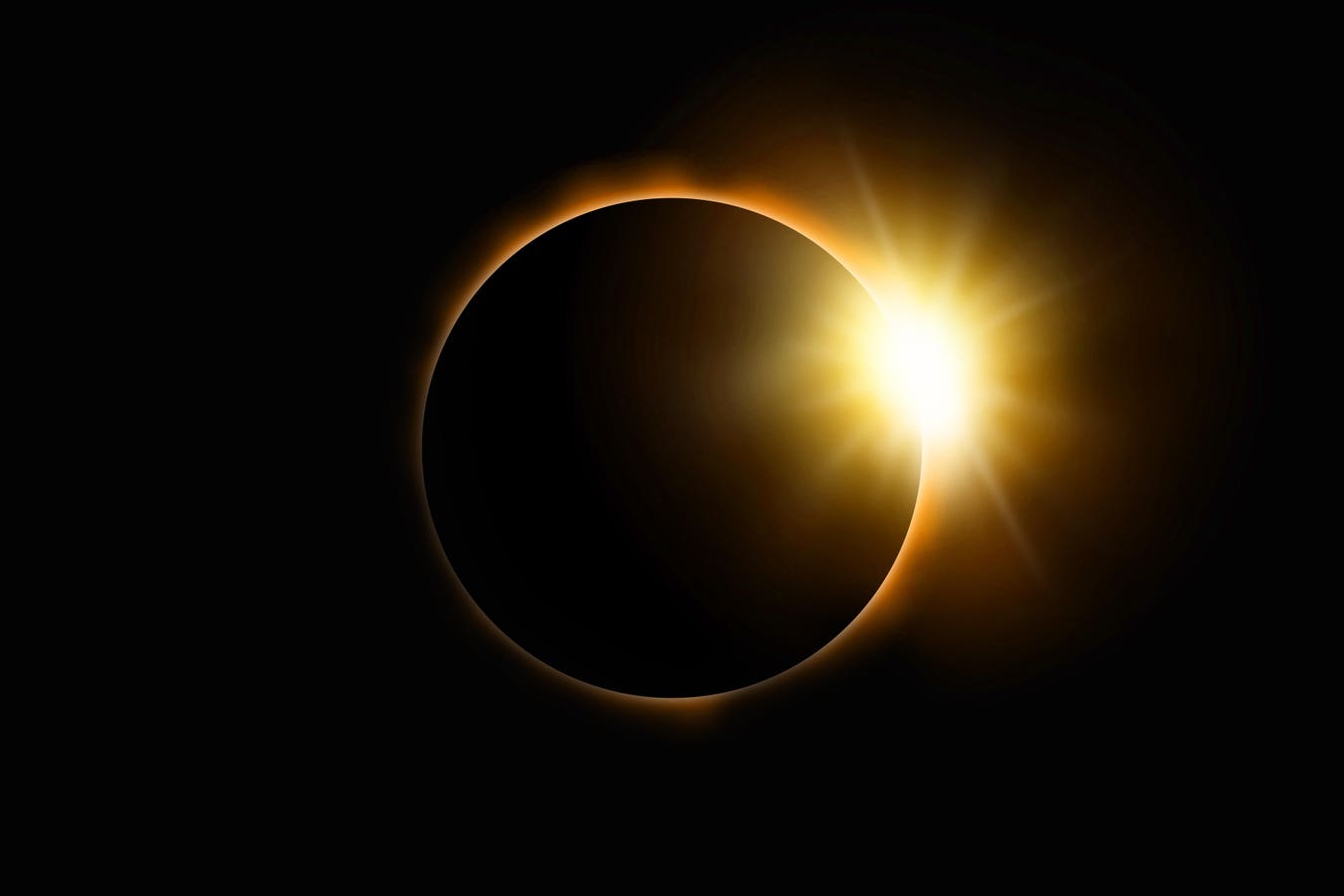
Capturing a solar eclipse takes planning, the right equipment, and proper eye protection.
getty
The next total solar eclipse is just weeks away, giving travelers one of the best opportunities in years to witness one of nature’s most spectacular events. On August 12, 2026, the moon’s shadow will sweep across Greenland, Iceland, northern Spain, and a small corner of Portugal, plunging those locations into daytime darkness for a few fleeting minutes. Travelers across much of Europe, northwestern Africa, Canada, and the northern United States will still be treated to a partial eclipse, though only those within the narrow path of totality will experience the sun’s glowing corona and the surreal transition from day to twilight.
Whether you’re traveling across the Atlantic to chase totality or simply stepping outside to catch a partial eclipse closer to home, photographing the event takes more preparation than pointing your camera at the sky. Award-winning astrophotographer David Wright will be photographing the eclipse from the waters off Greenland aboard a weeklong polar expedition with EYOS Expeditions aboard the Aqua Lares, where he’ll also help guests capture the rare celestial event in one of the world’s most remote environments.
We asked Wright, whose work has been included in publications ranging from BBC to National Geographic, for his best advice on capturing the eclipse safely—and without missing the experience itself. Here’s what he had to say.
Safety Comes Before the Shot
Before thinking about camera settings, Wright says protecting your eyesight and your equipment has to come first.
“Safety is non-negotiable,” Wright says. “You can damage your eyes or fry your camera sensor in a heartbeat. No exceptions.”
He recommends using only ISO-certified eclipse glasses (never regular sunglasses) for viewing the eclipse and stresses that a dedicated solar filter should always be placed over the front of a camera lens during the partial phases. Smartphone photographers can either use a dedicated phone solar filter or hold certified eclipse glasses flat against the camera lens.
His most important rule: “Never look directly at the sun through any lens without protection during partial phases.”
Don’t Forget to Photograph the Experience
Many first-time eclipse photographers make the same mistake, Wright says.
“The biggest mistake is treating the eclipse like a distant wildlife subject,” Wright says. “This is a world-changing event.”
Instead of focusing exclusively on close-up images of the sun, he recommends photographing the eclipse in two completely different ways. A telephoto lens in the 400-600mm range (or longer) is ideal for capturing detailed views of the corona, while a wide-angle lens can tell the bigger story by including the changing landscape, the glow along the horizon, and people’s reactions. And be sure to use a sturdy tripod.
“The eclipse isn’t only about tight shots of the corona,” he says. “It’s about the experience—the eerie dimming of daylight, the 360° twilight horizon, friends reacting with pure awe, strange crescent shadows dancing under the stars, and the sudden silence of nature.”
Practice Before Eclipse Day
Unlike photographing a sunset or landscape, an eclipse isn’t the time to experiment with camera settings.
“Practice your exposure settings in advance of the event and before you leave home,” Wright says.
His recommendation is to photograph the midday sun on a clear day using your solar filter to dial in your settings before eclipse day. As a starting point, he suggests setting your camera to Manual mode with an ISO of 200, an aperture between f/5.6 and f/8, and a shutter speed around 1/1500 second, adjusting from there as conditions change.
He also recommends shooting in RAW format and exposure bracketing your images to maximize your chances of capturing the rapidly changing light.
Manual Focus Is Your Friend
Autofocus often struggles when photographing the sun through a solar filter, so Wright recommends switching to manual focus before the eclipse begins.
“Manually focusing your lens and getting it set to infinity is going to be the best way to grab accurate focus,” Wright says.
After attaching your solar filter, focus on visible sunspots. If none are present, use the edge of the sun to fine-tune your focus before the eclipse progresses.
Your Smartphone Is More Powerful Than You Think
You don’t need a backpack full of expensive gear to come home with meaningful eclipse photos.
“Not every great eclipse photo needs a massive telephoto lens and tripod rig,” Wright says. “Sometimes the most memorable images come from the simplest tool in your pocket: your smartphone.”
While a dedicated camera will produce sharper close-ups of the corona, phones excel at documenting the atmosphere of the event. Wright suggests using your camera for still photography while simultaneously recording video on your phone to capture people’s reactions and the changing light.
During totality, he recommends slightly underexposing your phone’s image for richer skies or using HDR mode to balance the bright corona against the darker landscape.
Remember to Look Up
Perhaps Wright’s most valuable advice has nothing to do with photography at all.
“Set up so you don’t have to think,” he says. “Then step back and experience it.”
The total phase of a solar eclipse lasts only a couple of minutes in most locations, making preparation essential. By programming your camera ahead of time, he says, you’ll be free to enjoy the moment instead of fumbling with settings.
“When totality hits, you’ll be free to look up, feel the chill, hear the silence—and still get the shot.”