
Picture a bird of prey and your mind goes big. Eagles riding the thermals high over a ridge. Buzzards working a wide stretch of open country below.
The hunters we conjure up tend to own the sky for miles.

Hardly anyone pictures the small ones. A new study on one of the tiniest hawks alive shows exactly what that blind spot has been costing us.
Why home range matters
How much ground does a raptor actually need to raise a brood? Scientists have a name for that ground.
They call it a home range, and it covers everywhere that a bird forages. It also takes in where the animal rests and handles the remainder of its daily business.
For years, only the big birds gave up that answer easily. Trackers were heavy. They sat fine on an eagle or a vulture, but nothing small enough to perch on your finger stood a chance.
Pygmy falcons borrows homes
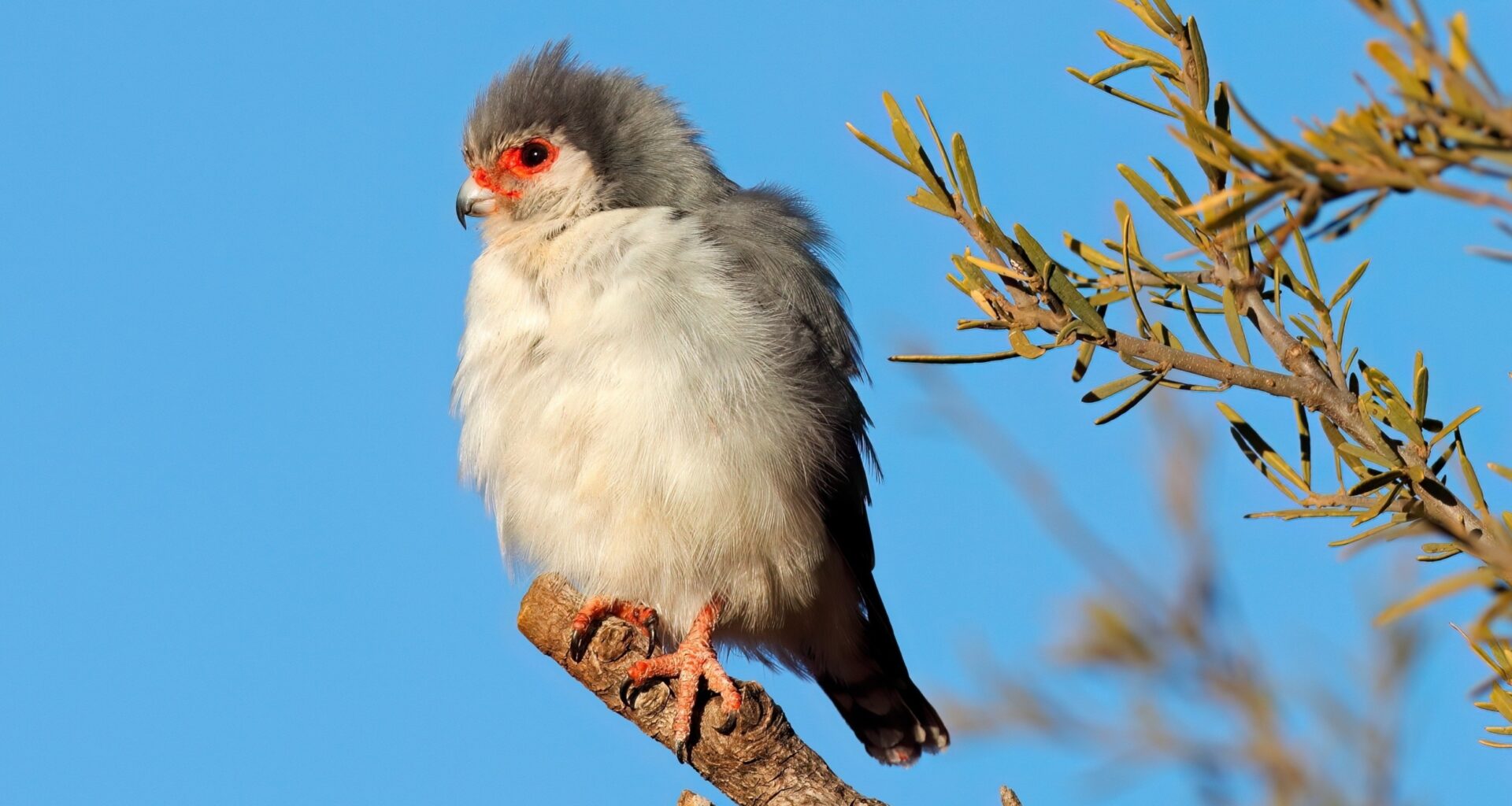
Which brings us to the pygmy falcon, Polihierax semitorquatus. It is Africa’s smallest daytime raptor, a desert bird from the dry savannas down south. It weighs only about two ounces, give or take, which works out to roughly 57 grams.
Its nesting habit is strange for a predator. The falcon never builds a thing for itself. Instead it moves into the enormous communal haystacks that a little songbird, the sociable weaver, piles up over generations.
Those nests are massive. Inside, they split into dozens of separate chambers. The falcon roosts in one much of the year and breeds there too, tying its whole existence to a single weaver colony.
Tracking a bird this small
A team out of the University of Cape Town wanted the pygmy falcon’s map. They spent four breeding seasons at Tswalu Kalahari Reserve in South Africa, mostly watching and waiting.
The trick was the gear. Researchers at the FitzPatrick Institute of African Ornithology (Fitz) fitted 13 adult birds with GPS tags weighing under two grams. A company called Pathtrack builds them.
Every half hour, through the frantic stretch of feeding chicks, a tag dropped a pin. By the time the loggers came off the birds, they held close to 4,000 fixes.
Less than one square kilometer
Then came the part that made people sit up. During chick season, the average falcon used just 0.93 square kilometers (0.36 square miles).
One bird got by on a mere 0.19 square kilometers (0.07 square miles), which is barely a sliver of desert.
You could stroll across that in a couple of minutes. For a hunting raptor, it is almost absurdly small.
Smaller than any tracked raptor
So how rare is that? The team held it up against other small raptors. The pygmy falcon’s range came out about 14 times smaller than the lesser kestrel’s, the bird that used to hold the record among GPS-tracked daytime raptors.
Set beside Dickinson’s kestrel, an African bird that nests in much the same way, the falcon’s range shrank to something like 27 times smaller. Some of that is due to plain body size. The falcon is far lighter than either kestrel.
“This study provides a crucial baseline for understanding the spatial requirements of small raptors, which have been largely overlooked due to technological limitations,” said lead author Dr. Olufemi Olubodun, a Carnegie Postdoctoral Fellow at the FitzPatrick Institute.
“While wide-ranging raptors are often used as surrogates for broad-scale conservation plans, species with smaller home ranges may complement this role by reflecting ecological processes operating at finer spatial scales,” he explained.
Males and females share work
A second surprise had nothing to do with the size of the range. It had everything to do with who did the work. In most raptors the female is the larger sex, and she tends to move through the breeding season on her own pattern.
Pygmy falcons skipped that rulebook. Males and females covered nearly the same patch of ground. The females’ ranges ran a touch smaller, and that was about all the difference there was.
“A high degree of shared parental responsibility during the critical period of chick-rearing” is how senior author Associate Professor Robert Thomson, also from the Fitz, read that result. Both parents pull their weight while the chicks are growing.
What this means for conservation
There is a practical lesson tucked inside all this. Conservation planners love a big, far-roaming species. Eagles get used as stand-ins for whole ecosystems, the idea being that whatever shelters them shelters everything underneath.
That logic has its uses, but it carries a blind spot. A plan pitched at eagle scale can sail right past a predator this small.
A falcon that lives out its days inside one square kilometer reads the land at a resolution no eagle ever bothers with.
What still needs study
One caveat hangs over the whole thing. The trackers caught a single chapter only, the hectic run of feeding nestlings. The authors are upfront that the rest of the year probably looks nothing like it.
Once the young fledge, the pygmy falcons cut loose from their weaver colony, and the range could widen out. Mapping that fuller life will take lighter tags and a longer leash on the tracking.
“Small raptors have been underrepresented in movement ecology, now with advances in technology, we can begin to understand their ecology in the same detail as larger species,” said Thomson.
Not bad for a hunter you could cup in one hand.
The study was published in the Journal of Raptor Research.
—–
Like what you read? Subscribe to our newsletter for engaging articles, exclusive content, and the latest updates.
Check us out on EarthSnap, a free app brought to you by Eric Ralls and Earth.com.
—–