
Back to Article List
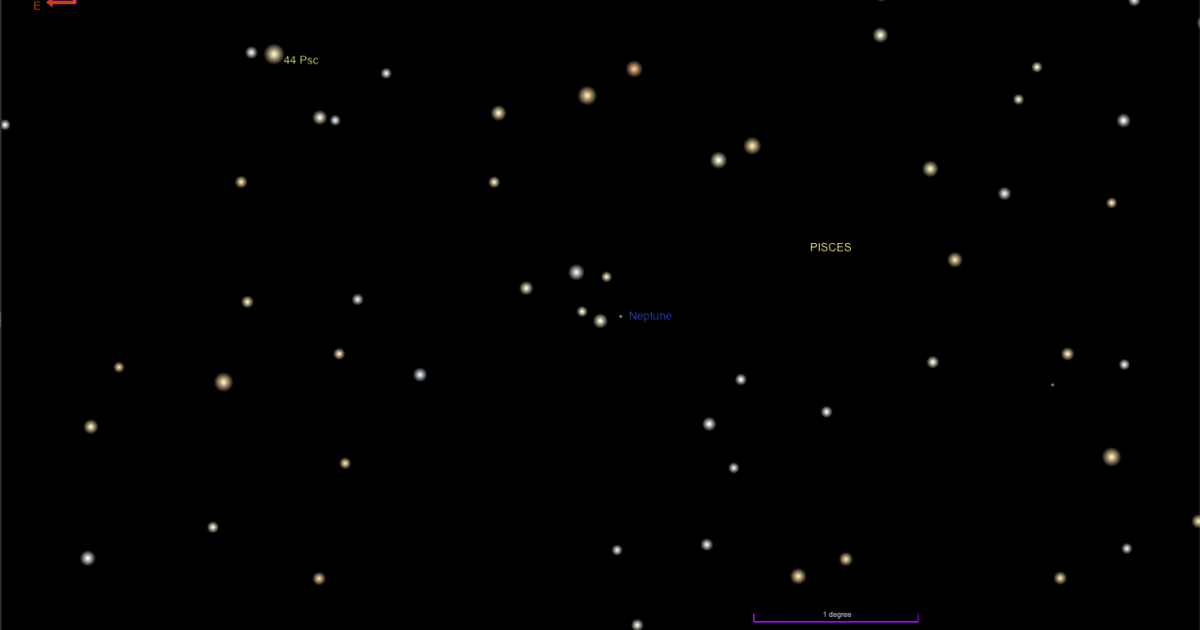
Visible in the early-morning sky before dawn grows too bright, Neptune glows near a grouping of background stars in Pisces.
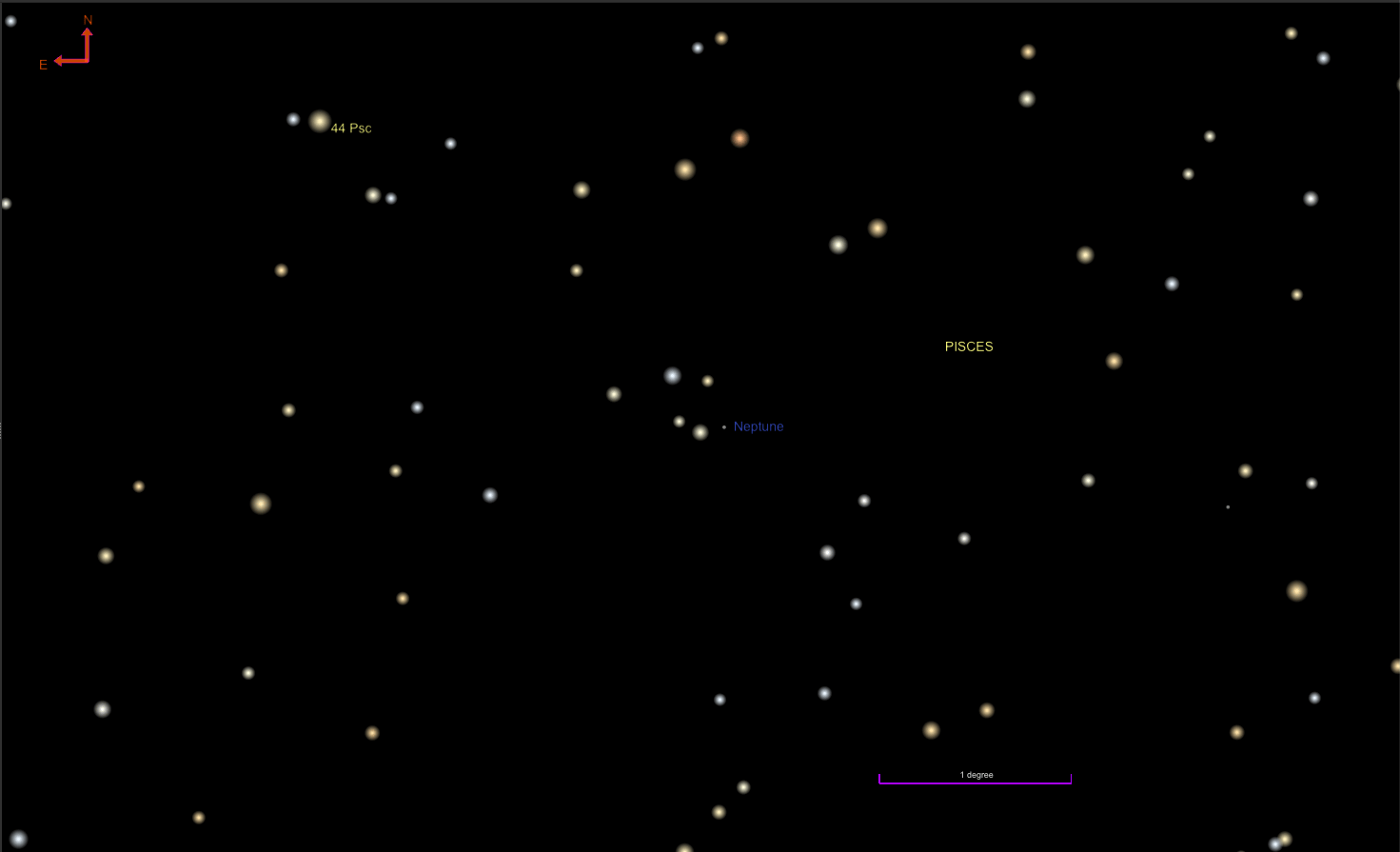
This chart shows the location of Neptune on June 30. Use 44 Piscium to guide you southwest toward a grouping of several background stars that stand just east of the ice giant’s position. Credit: Alison Klesman (via TheSkyX)
Looking for a sky event this week? Check out our full Sky This Week column.
June 29: June’s Strawberry Moon shines
Rising around 12:30 A.M. local daylight time, the distant planet Neptune lies in the constellation Pisces, not far from Saturn. By 3:30 A.M., the ice giant has reached an altitude of some 30° in the southeast, offering excellent views in a still-dark sky.
First, find Saturn, the brightest point of light in this region. From there, slide your gaze (through binoculars or a telescope, needed to see Neptune) about 7.4° west, which will land you on the 6th-magnitude star 44 Piscium. Then look about 2° southwest of this star, which will bring a group of some five stars into view, shaped like a carat pointing east. The brightest of the group is a 7th-magnitude sun; this morning Neptune is located some 20’ southwest of this star, and about 8’ from a fainter, 8th-magnitude field star. Shining at magnitude 7.8, Neptune fits right in with this grouping, but lies farther west than any of the stars. Its tiny disk spans 2” and glows a grayish-blue — see if you can separate it from the pinprick lights of the stars.
Sunrise: 5:35 A.M.
Sunset: 8:33 P.M.
Moonrise: 9:31 P.M.
Moonset: 5:47 A.M.
Moon Phase: Waning gibbous (99%)
*Times for sunrise, sunset, moonrise, and moonset are given in local time from 40° N 90° W. The Moon’s illumination is given at 10 P.M. local time from the same location.
Alison Klesman is senior editor of Astronomy magazine. She holds a Ph.D. in astronomy and has studied a variety of topics, from minor planets to supermassive black holes.