
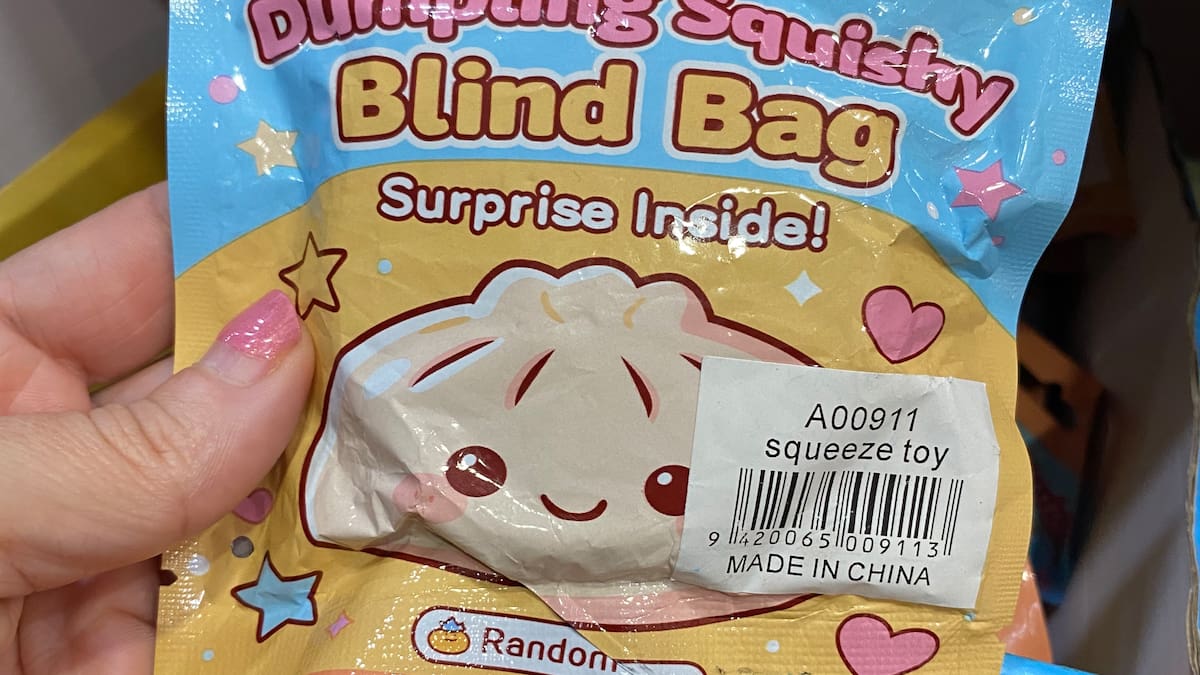
Simon Gallagher, manager consumer services at the Ministry of Business, Innovation and Employment (MBIE) said it had received 15 complaints regarding “several dumpling squishy-style toys”.
“We regularly monitor overseas product recalls and engage with businesses in New Zealand if we see the same branded products being sold.
“We can confirm we have received 15 complaints regarding several squishy-style dumpling toys, ranging from consumers addressing that these products may be part of overseas recalls to notifying MBIE of specific product safety concerns they have experienced.”
Gallagher said the complaints came from 11 different retailers.
“We have already contacted many of these businesses and are in the process of contacting the remainder and will be informing them that we expect a recall is to be issued if these products are not safe and reminding them of their obligations to supply safe products.”
He said all businesses and individuals that made or sold products, including retailers, online sellers, and manufacturers, were responsible for product safety.
“If they supply a product, they should be aware of any legal requirements relating to that product, whether they’re importing, wholesaling or retailing it,” he said.
“If a product recall is issued by the business, they are required to notify the Ministry of Business, Innovation and Employment within two working days.”
He said MBIE encouraged consumers to check the labels on the products before they bought to ensure it follows any safety standards and ask the retailer for more information if they were still unsure.
“If a consumer has bought something they suspect could be unsafe, we encourage them to stop using it and reach out to the retailer they bought it from.”
A version of the toys is being sold in New Zealand.
Gemma Rasmussen, head of research and advocacy at Consumer New Zealand, said the organisation was aware of the products’ recall in the UK.
“A quick search on Temu and AliExpress shows it’s very easy for a New Zealand shopper to order a Squishy Dumpling toy,” she said.
“Our advice to shoppers is not to buy any toys or electrical products eg chargers from low-cost online platforms like Temu, Aliexpress or Shein, given the risk that a product could be unsafe.”
Rasmussen said the same advice applied to discount stores across New Zealand.
She said consumer organisations in Germany, France, Denmark and Belgium recently tested 162 products purchased from Temu and Shein.
“[They] found a failure rate of around 60%. Toys in particular had a high failure rate,” she said.
Consumer NZ head of research and advocacy Gemma Rasmussen. Photo / Supplied
Rasmussen said cost-of-living pressures had driven households to seek cheaper ways to shop, but warned that “low-cost can come with increased risk”.
“New Zealand, like many countries, is experiencing sustained cost-of-living pressure.
“Households are actively seeking cheaper ways to shop, and increasingly that means buying online.
“But sometimes, low cost can come with increased risk.”
Rasmussen said research from NZ Post found that 35% of New Zealand shoppers said their most recent online purchase was from Temu while Tearfund research shows that about one in four New Zealanders have shopped on Temu.
“This highlights a growing challenge for regulators and consumer advocates worldwide. The modern shopping basket increasingly crosses borders, but product safety enforcement often does not,” she said.
“International product safety co-operation is key to successful product safety, because dangerous products do not stop at national borders. Product safety can no longer be treated as a purely domestic issue.”
Rasmussen said New Zealand was “lagging” when it came to product safety protection.
“Compared to other countries, we are lagging behind in product safety protection, and we would like to see government prioritise this,” she said.
“Our product safety laws that are designed around traditional retail markets are being tested by a digital marketplace where a product can be bought from overseas in seconds, shipped directly to a household, and reach a child’s bedroom before any domestic safety authority has visibility of it.
“Unsafe products now move globally at the same speed as online demand, and our regulatory responses need to evolve just as quickly.”
Rasmussen said product safety was a priority area for Consumer New Zealand and the organisation planned to undertake product safety testing this year, but could not yet confirm whether it would include squishy dumpling toys.