
On August 13, 2024, Methanex suspended production at its Motunui plant, which converts natural gas into methanol for export, because it was more profitable to sell its gas to Genesis and Contact Energy.
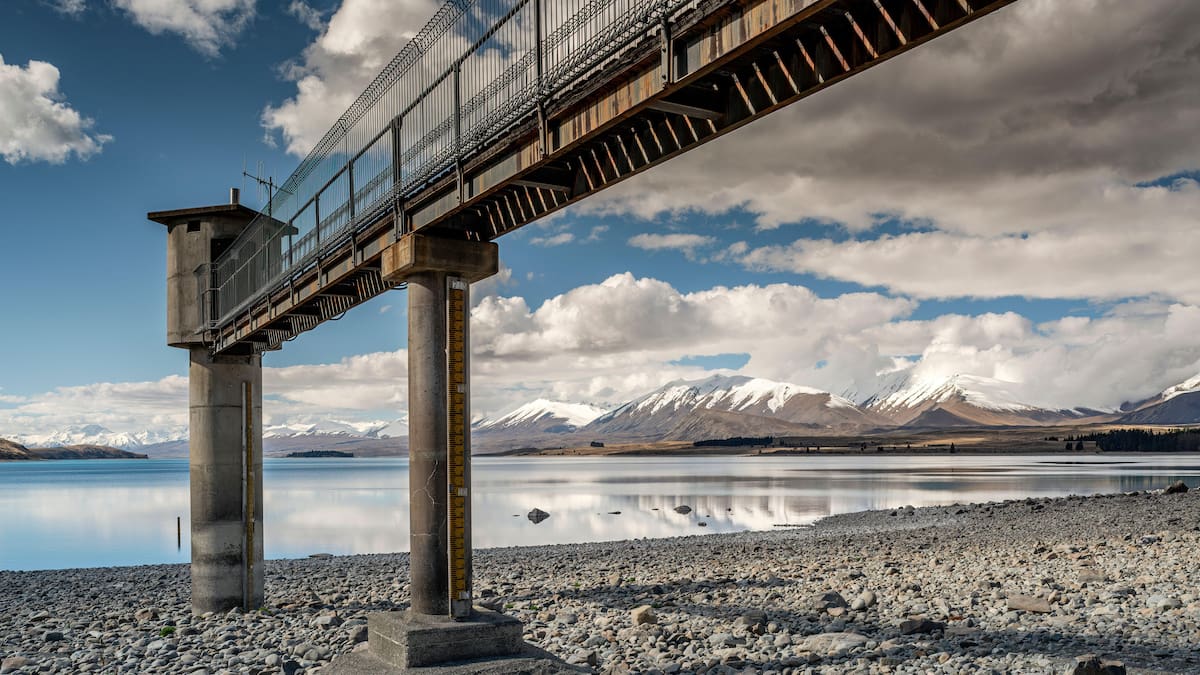
It was a dry year: New Zealand’s hydro lakes were at a six-year low; Lake
Pūkaki, the largest, was at its lowest level since 1997. Wind generation was also down and the dwindling coal stockpile at Huntly could run only one of its ageing thermal generation units for about a month.
Wholesale electricity prices, which had averaged about $180 per megawatt-hour (MWh) over the previous six winters, hit a daily average of $820. The country’s largest single electricity user, the Tiwai Point aluminium smelter, had powered down 185 megawatts of its production, saving energy equivalent to 7% of the nation’s entire hydro storage.
Methanex’s sales of the gas it normally takes (it’s the country’s largest natural gas user) lowered spot prices. Then, in September, the rains came – but the country had come uncomfortably close to widespread blackouts.
Gas fizzles out
New Zealand is running out of gas. For 40 years, the fields off the Taranaki coast played two vital roles in our energy sector: they powered heavy manufacturing and kept the lights on when the lakes were low – a backup known in the sector as “firming”. From around the turn of the century, the gas fields began to decline. The government and industry spent approximately $2 billion surveying for more reserves but there were no significant finds. In 2017-18, wholesale electricity doubled in price over less than 12 months. Manufacturers began to close. One report found the decline and subsequent energy scarcity has already cost the nation $5.2b in lost GDP and lowered wages, employment and trade.
There are many proposed schemes and solutions to our energy woes: the coalition government has landed on building an LNG terminal in Taranaki. This has been criticised from many directions: environmentalists don’t like the dependence on fossil fuels; economists and energy experts question the economic logic. Perhaps the most salient question is, why is the government exposing our economy to global energy markets when the Middle East is in chaos?
For decades, the eventual decline of the gas fields was a long-term concern beyond the three-year timeline of New Zealand politics. In 2008, the Key government contemplated an LNG terminal but decided against it – the numbers didn’t add up. But the 2020s have seen a succession of energy shocks: the winter energy crisis of 2021, the global spike in energy costs after Russia’s invasion of Ukraine in 2022, the dry year of 2024 and this year’s closure of the Strait of Hormuz.
In 2025, the nation’s proven and probable remaining gas reserves were revised down 27% from the previous year, and this year they’re lower still: 731 petajoules left: the lowest since records began.
Exploration ban
In March 2018, climate protesters met then-prime minister Jacinda Ardern on Parliament’s lawn and presented her with a petition to end exploration for oil and gas in New Zealand. Ardern replied she was “actively considering” the policy. Ardern had made climate a key issue – at Labour’s August 2017 campaign launch she famously declared climate change “our generation’s nuclear-free moment”. In April 2018, she announced the Labour-led government would end offshore oil and gas exploration and in November that year a law was passed banning the issue of permits. The energy sector complained it hadn’t been consulted, and subsequent reporting revealed there hadn’t been a cabinet paper to consider the proposal before Ardern’s announcement.
Why is the government exposing our economy to global energy markets when the Middle East is in chaos?
Danyl McLauchlan
The exploration ban became a flash point for the National-New Zealand First-Act government: a wanton act in which Ardern personally destroyed the economy. The Ministry of Business, Innovation and Employment’s regulatory impact statement put the ban’s cost to the crown at somewhere between $1.2b and $23.5b with a midpoint of $7.9b. But it won praise internationally: a 2019 report by a Swedish-based climate action lobby group held New Zealand up as a role model for winding down fossil fuel production.
Defenders of the legislation note exploration was still allowed under the 27 permits that were valid until 2030.
The ban was repealed in 2025. At an energy conference in Singapore, Resources Minister Shane Jones announced “all acreage” of New Zealand would reopen to fossil fuel explorers. Labour, the Greens and Te Pāti Māori have all pledged to reinstate the ban if they are in power after the November election.
Pumped-storage hydro
Labour’s solution to the nation’s energy woes proposed in 2020 was Lake Onslow. The brainchild of Waikato University hydrologist Earl Bardsley, it involved the construction of a landscape-sized hydro-powered battery. It would use surplus hydro power during wet years to pump water from the Clutha up 600m to a massively enlarged Lake Onslow on the Central Otago plateau. In a dry year, you’d run it back down through the turbines. The reservoir would store roughly 5 terawatt-hours (TWh) – enough to cover a worst-case scenario several times over – making it the only single project that could fully solve New Zealand’s dry-year problem, and in theory unlock 100% renewable electricity.
When Labour launched the NZ Battery Project, the estimated cost was about $4b, but two years of feasibility studies pushed the estimate to roughly $15.7b. The electricity sector loathed the project – dry years are wildly profitable for the big gentailers – and when the government changed, cancelling it was an explicit coalition agreement. After about $36m was spent on investigations, nothing was ever built. Former Labour MP David Parker and business leader Keith Turner are exploring a scaled-down version to be funded by the private sector.
Huntly Power Station’s use as a firming option is threatened by dwindling gas supplies. Photo / Greenpeace
Importing gas
This will sound weird but the theory behind the coalition government’s proposed solution – a $1b-plus LNG terminal in Taranaki that sources gas on the international market – is that we hope we never use it. The logic here is that when lake levels are high our power is reasonably cheap: about $100 per MWh. But during the 2024 energy crisis, prices on the wholesale market soared to $820/MWh. So, when a business negotiates prices for an upcoming year, or number of years, the supplier needs to factor in the possibility of a spike.
Analysts estimate this “dry-year risk premium” adds $30-$50 to every MWh of electricity, every year, whether a dry year happens or not, and that this cost filters out across the entire economy. Once the LNG terminal is operational, we will have the option to supplement the dry year with imported gas, so the maximum price will be the international market price, traditionally about $200-$250 per MWh. So the risk will be lower. Electricity will be cheaper even if we never use the terminal!
This is known as firming power – electricity that can be called on at short notice when renewables run down because the rain doesn’t fall and the wind doesn’t blow. Historically, we’ve used gas and coal at Huntly as firming, but with gas declining and Huntly ageing, it’s becoming more expensive.
The government’s bet is that simply having an LNG terminal able to supply firming fuel will itself cap the price spikes, even if we don’t use the gas.
Among those who love the elegant simplicity of this solution is Prime Minister Christopher Luxon. And it’ll be quick to build! The government hopes to have it running by 2028.
Environmentalists don’t like the dependence on fossil fuels; economists and energy experts question the economic logic.
But there are many critics. Environmentalists argue it not only locks us into fossil fuel dependency, but we’re spending $1b – on the terminal alone, there will be ongoing operational and maintenance costs and a multi-decade gas supply contract– to build something we might never use instead of lifting domestic renewable capacity.
The government is unmoved. With gas supplies dwindling and the Māui field expected to close later this year, “the need for back-up ‘insurance’ is critical,” a spokesperson for Energy Minister Simeon Brown told the Listener. “LNG is the best available option to keep the lights on and people in jobs in a dry-year scenario.”
Energy economist Basil Sharp argues the terminal “has not been well thought out”, labelling it a decision driven by fear rather than rigorous analysis. He also points to the government’s modelling and its assumption that international gas prices are stable. He described Iran’s closure of the Strait of Hormuz as “a policy gift”: a chance for the government to reverse course.
Instead, in a speech to the Auckland Business Chamber on June 9, Brown confirmed the terminal would go ahead, afterwards pledging that a contract will be signed “absolutely before the election”.
The levy on power bills that was supposed to fund it – which the opposition had branded a “gas tax”– was scrapped. Brown says the gentailers will pay instead, through a funding model still being negotiated. It will be backed by a new “winter energy reliability obligation” – with power companies that fail to secure enough supply to keep the lights on through a dry winter risking a fine of up to $10m.
The obvious objection, raised by virtually everyone outside the Beehive, is that gentailers are vertically integrated monopolists who will simply pass the cost on to consumers anyway – folding the levy into higher prices where no one can see it.
OECD says no
An OECD report released in May strongly advised against the LNG terminal. It pointed to Germany early this decade as an object lesson: when Russia’s invasion of Ukraine cut pipeline supply and Europe’s energy sector switched to reliance on maritime imports, the cost of electricity exploded – even though most German generation (renewables, lignite, nuclear until its 2023 phase-out) hadn’t changed. The international markets set the price for everything.
If a similar scenario played out in New Zealand, the terminal would expose all electricity to global gas prices permanently, whether we use the gas or not, because setting the marginal price doesn’t require dispatch. The report advised New Zealand to abandon the LNG terminal and reform our energy markets, noting we have far higher wholesale prices than Nordic countries with similar renewables-dominated systems.
It also found gentailers had paid out $11.8b in dividends over the decade to 2025 – $4.5b more than they earned in net profit – calling payout ratios that high unsustainable for companies with major investment needs. Capital that should have been invested into security of supply was distributed to shareholders (the largest of which is the government, which holds a 51% stake in Mercury, Meridian and Genesis). It described the Electricity Authority’s enforcement powers as weak compared with other OECD nations, and noted the vertical integration of the sector gave the gentailers market power unlike more separated electricity sectors elsewhere.
Luxon’s response was that the report was “a load of rubbish”, adding his government would not tolerate “bumper sticker” policies or the sort of “kumbaya and mush” that Labour pursued while in power.
Diesel, even?
There are other schemes. After the 2024 crisis, the government commissioned Australian consultancy Frontier Economics to review the electricity market. Its report was brutally critical of the Ardern government’s oil and gas ban and the Lake Onslow proposal – but it also warned an LNG terminal was the least desirable option. The consultants’ favoured solution was “New Co”: a state-owned company that would buy up Huntly’s capacity, own the coal and gas itself, and sell firming to the market. The economists who peer-reviewed the report were unenthusiastic and the government quietly shelved it.
The most detailed counterproposal comes from Rewiring Aotearoa, a sustainable energy lobby group which commissioned research firm Sapere to model an alternative. Its answer is the least glamorous fuel imaginable: diesel. Does Rewiring Aotearoa actually like diesel? “The answer is ‘no’, but the answer is ‘yes’ if we have to do something,” says CEO Mike Casey.
His thesis is that the rapid take-up of renewable energy makes most of the concerns about firming power redundant. “But 2024 sent energy ministers’ blood pressures through the roof.”
Casey doesn’t believe any new backup is needed, “but if the minister wants to lower their blood pressure, and that’s the sole reason for doing this, then diesel is a far better option for New Zealanders”. He says existing gas peaker plants in Taranaki could be converted to run on either gas or diesel for $100m-$170m before winter 2028, with $270m-$580m of storage, possibly in the disused tanks at Marsden Point.
The storage does double duty: “We’ve been caught out by the Middle Eastern conflict and we don’t have enough diesel storage to run our trucks and our tractors.” The tanks back up the unelectrified economy whether or not the lakes run dry.
Diesel is expensive and high in greenhouse gas emissions, but it fills the same insurance role as the terminal. It bridges to the mid-2030s, when a dedicated wind farm held in reserve could take over dry-year duty.
Sapere estimated the full package would cost $365m less than the LNG pathway.
Pulling the plug
Winstone Pulp International permanently closed its central North Island mills at Tangiwai and Karioi after halting production during the 2024 crisis, citing high electricity prices as a major factor. Oji Fibre Solutions closed its Penrose paper recycling plant. Two small electricity retailers – Comtricity and Raw Energy – left the market.
Methanex had previously mothballed its Waitara Valley plant, in 2021, freeing up gas for electricity supply. It did the same again this year under a $46m, one-year supply deal with the government.
Last August, the BusinessNZ Energy Council warned: “If we do nothing, a major de-industrialisation crisis could escalate in the next two years.”
One of the few Labour-Green schemes that met with approval from major energy users was the investment in decarbonising industry (Gidi) fund. This co-financed industrial decarbonisation, replacing coal and gas boilers at dairy factories and meatworks, half-funding the electric arc furnace at NZ Steel.
National campaigned against it as corporate welfare and cancelled it within weeks of taking office.
In this year’s Budget, Finance Minister Nicola Willis, Resources Minister Jones and Energy Minister Brown unveiled the gas transition loan guarantee scheme: up to $1.2b of crown-backed bank lending to help businesses transition from gas, with the government guaranteeing 80% of each loan.
Casey estimates a third of major gas users have no alternate form of energy to transition to.
“We’ve got enough gas to last to about 2032. But if we electrify everything we can, we’ll have enough to last through to about 2042, which gives us more time to figure out that final third.”
These policy decisions are critical to the nation’s future, and the impacts will resonate long after the current government is gone – so naturally there is no political consensus.
LNG import terminals need long-term supply contracts, typically 20-25 years; agreements, Basil Sharp warns, that expose New Zealand to contractual risk if the world changes. Which feels likely.
The Green Party’s Chlöe Swarbrick calls the LNG project “utter insanity”. Labour leader Chris Hipkins says if his party is in a position to scrap the terminal, it will, with the caveat: “I don’t want another Interislander debacle, where it costs us more to get out of something than if we’d just gone ahead with it.”
The terminal is supposed to ensure us against a dry year. Nothing can insure us against the whims of our politicians.
The Harapaki wind farm near Napier can power up to 70,000 homes. Photo / NZME
Solar and wind power offer a cleaner alternative to hydro than gas, but investment is not keeping pace.
The summer and early autumn of 2026 brought a lot of rain: the hydro lakes are at 120% average levels. Renewables are supplying about 96% of our electricity and prices on the wholesale market have fallen.
We may not be in for a repeat of the 2024 dry-year price spikes, but we’ve had near-record-low rainfall in May, and June brought similar weather to much of the country. Earth Sciences New Zealand’s June-August climate outlook puts the odds of El Niño conditions forming this winter at 95% – and there’s a real chance it could be one of the strongest on record, bringing low rainfall to the North Island and the east of the South Island.
Since 2020, major electricity generators have invested much in reducing our dependence on hydro to cope with climate change. But the gap between renewable generating capacity and demand is only growing over time as gentailers grapple with climate change targets and electrification of industry and vehicles.
Five years ago, the largest solar farm in the country was a two-megawatt array on a paddock in Kapuni. Today, there are a dozen large-scale solar farms operating or under construction.
The Turitea and Harapaki wind farms – the largest in the country – are fully online. Contact’s $1 billion Southland Wind Farm, consented this year, will be even bigger.
There are grid-scale battery facilities and rapid takeup of rooftop solar – 43,000 home systems and counting.
For Rewiring Aotearoa, this direction of travel makes it more economic for New Zealand households to run all electric appliances and an electric vehicle. The challenge is the upfront capital to make the switch, which is where it sees a role for government.
But the problem is, if the nation electrifies everything it can, it becomes more vulnerable to the dry-year phenomenon.
Meridian’s $186 million Ruakākā grid battery facility can store enough power to run 60,000 homes for two hours. If the gas runs out and the lake levels fall, we may need to power hundreds of thousands of homes for days or weeks.
But if we are to cope with climate change, the transition to renewables, and rising demand from population growth and industry needs, a lot more is needed. In 2022, a Boston Consulting Group report estimated the country needed to add about 500MW of new generation every year until 2040 to decarbonise the economy. This would require “investment of $42 billion in the 2020s, including increased spend across generation, transmission, and distribution”.
But although projects adding 4400MW in capacity were in the pipeline by last October, the Electricity Authority noted most were awaiting a final investment commitment.
SaveShare this article
Reminder, this is a Premium article and requires a subscription to read.
Copy LinkEmailFacebookTwitter/XLinkedInReddit