
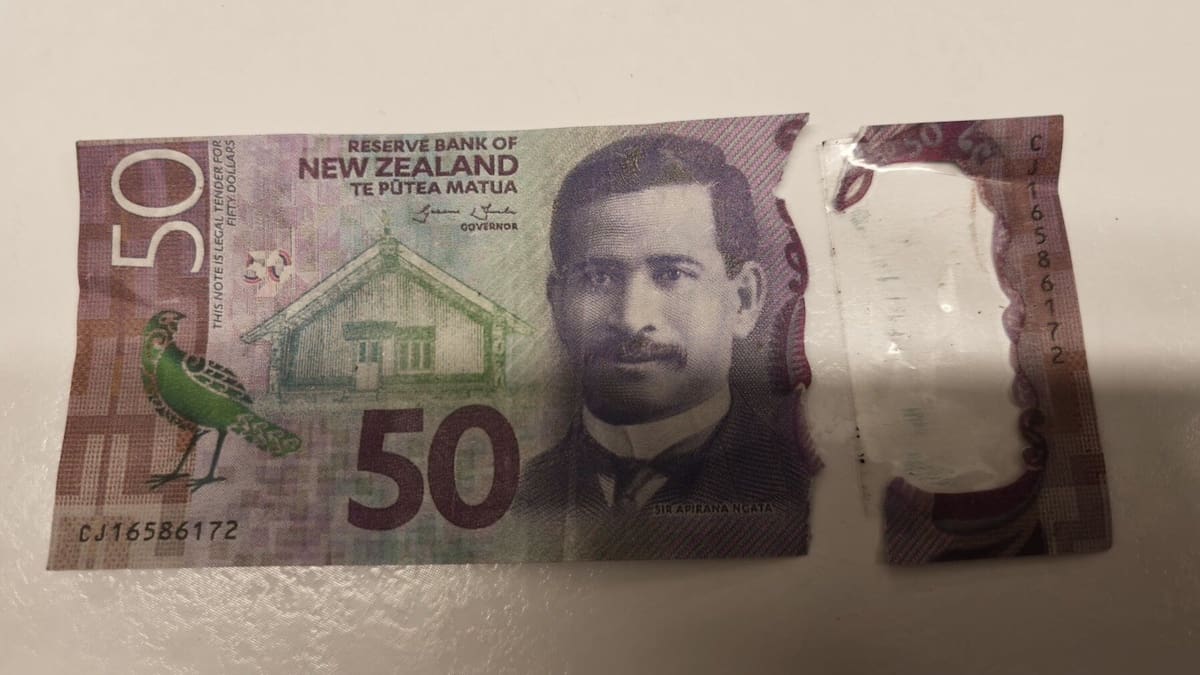
Belinda – not her real name – said she was aware of several incidents she believed involved the same man targeting multiple family-run businesses over at least a week in June.
When someone tried to use a fake $50 note at her family’s business, the shop assistant noticed and challenged him. He acted surprised and left without confrontation.
Challenged at another store where the owners had been warned via a social media post, the man acted shocked and said he’d just been given it as change at a service station.
Some stores had unknowingly accepted the money, Belinda said.
She said the counterfeit notes were hard to detect for staff who did not regularly handle cash – which is increasingly common as most payments are electronic and many younger workers were not raised handling physical money.
The fakes “actually look very real”.
“If you don’t have a real one to make a comparison, you could easily miss it,” she said.
One of the main giveaways is the feel of the notes. Unlike genuine New Zealand currency printed on polymer, counterfeits are usually printed on paper.
“It just felt off straight away,” Belinda said.
“Money has a specific feel to it – once you know it, you can tell something’s not right.”
The fake $50 note was slightly smaller, closer in size to a $20, making the text appear more cramped near the edges. However, the difference was subtle enough to go unnoticed in a busy environment.
“At a glance you just see the colour and think, that’s a $50. If you’re not looking carefully, it’s easy to accept it.”
The high-quality printing added to the deception, with clear serial numbers and detailed graphics that could pass a quick visual check, Belinda said.
“Everything else looks legitimate – the printing, the layout – so your eye doesn’t immediately pick it up as fake.
“And signs of wear could mislead staff,” she said.
Older notes often appear dull or worn, so it’s easy to assume they’ve simply been in circulation.
It’s much easier to spot a fake $50 when you can compare it directly with a real one.
The way the notes were presented also played a role. Belinda said the man at her family’s store handed over the cash casually, without drawing attention.
“It’s very quick, very casual – just kind of slid across the counter. You’re not necessarily stopping to inspect it closely.
“That’s the scary part: the notes are good enough that if you’re distracted or in a rush, you could absolutely accept one without realising.”
NorthChamber chairman Tim Robinson said the organisation hadn’t yet been informed about the latest incidents of counterfeit cash being circulated but recognised it remained an ongoing risk.
Last October, the organisation held a workshop where the NZ Police National Retail Investigation Unit manager spoke with local retailers about counterfeit fraud prevention, theft patterns and warning signs.
In New Zealand, counterfeiting and knowingly passing fake money are serious offences under the Crimes Act 1961. Using or attempting to pass counterfeit notes can lead to up to 10 years’ imprisonment, while possessing fake currency with intent to use it is punishable by up to seven years. Producing counterfeit money or possessing equipment to make it also carries a maximum of 10 years.
Police had not yet responded to a request for comment but have previously said anyone who thinks they might have accepted a counterfeit note should limit handling of it and call 105 to report it.
Sarah Curtis is a news reporter for the Northern Advocate. She has nearly 20 years’ experience in journalism, most of which she spent reporting on the courts in Gisborne and the East Coast.