
Wotton focuses on the spaces workers inhabit: the smoko and tea rooms, fish and chip shops and backstages. He gives mana to the in-between spaces Whanganui remains full of. He makes them monuments to the quirks of the human spirit.
Even formal portraits of people in the exhibition give nobility to the common tattoo and head. His “selective eye” finds fineness in the people and buildings you pass daily on the street.
Like Whanganui, photography does weird things with the flow of time. It recognises that the past lives with us. Wotton also has an eye for how much has changed or been altered. And in that lies another interest of this city – how its history remains but is changed.
Wotton’s photographs of interiors of the 80s and 90s are among my favourites. Places where objects stand in for people. Like in an old smoko room – it’s a biscuit tin, a pack of cards and an iconic early 80s portrait of Charles and Di.
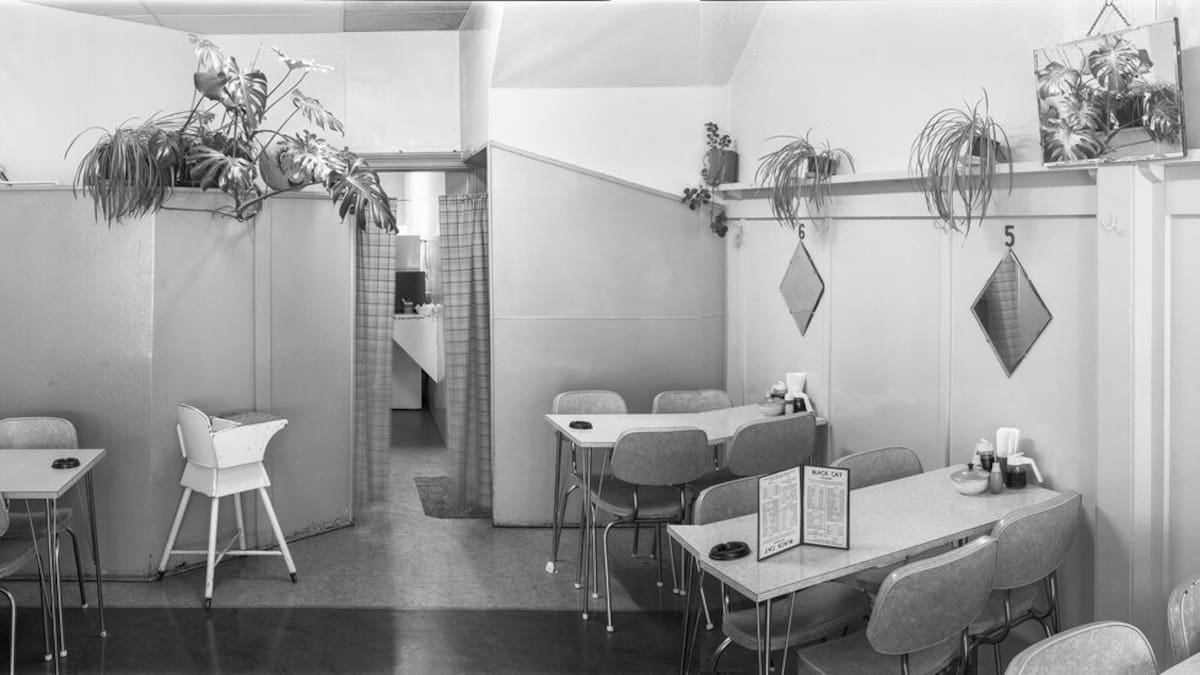
Or take my favourite: the Black Cat Restaurant, 166 Victoria Ave. The interior Wotton documents is long gone. He photographed the Black Cat in 1992, yet it looks still caught in the 60s.
As an image, this photograph is a fascinating tease or puzzle.
In black and white, it almost resembles a folded collage of repeated objects: tables, chairs, condiments, disturbingly animated pot plants and, above each table, diamond-shaped mirrors and large numerals. All cast at different angles. Your eye wants it to be symmetrical, the lines folding in like origami, but everything is delightfully just off – with rogue elements like an empty baby’s high chair providing human charge.
Then you realise there are actual folds; it’s a panorama composed of three images, leading to spooky spatial effects with perspective. I’m reminded of the kooky nostalgic delight of the interiors in Wes Anderson films. Designing spaces for a camera like an architect.
Wotton thinks of the image not as a flat plane but more like the camera’s three-dimensional chamber – capturing the city’s volumes and shapes in dynamic angles. And sometimes there’s witty visual poetry in how different elements play off each other.
In a 2011 image, a towering yet slender contemporary street lamp stands guard over the squat, closed-off mid-century facade of the former funeral directors’ factory. Like a giant triffid, it curves its neck to survey us through its one big eye.
“Former Funeral Director’s Factory, 6 Glasgow Street, Whanganui 2011” in Richard Wotton’s exhibition at Te Whare o Rehua Sarjeant Gallery. Photo / Richard Wotton
Wotton’s attention to composition is stressed by an exhibition bay devoted to colour and abstract images. Up-close studies of objects, packaging tape and industrial surfaces show his interest in patterns.
But most will be here for the local history and there are some great recent works, including of Fordell Hall, Ian Jackson’s Transport Building, Ridgway St and – on a recurring fish-and-chip theme – Somme Parade Takeaways.
Wotton was the Sarjeant Gallery’s collection photographer for 31 years, retiring in 2018. Before then he was a compositor at Wanganui Newspapers (a job which, in its arrangement of visual elements, fits his photographic approach to a tee).
Wotton’s last photographic project was documenting the Sarjeant Gallery’s restoration and reopening. This is quietly marked here. Yet rather than depict worker activity, Wotton lets the light hitting the empty gallery speak for a history past, present and future.