
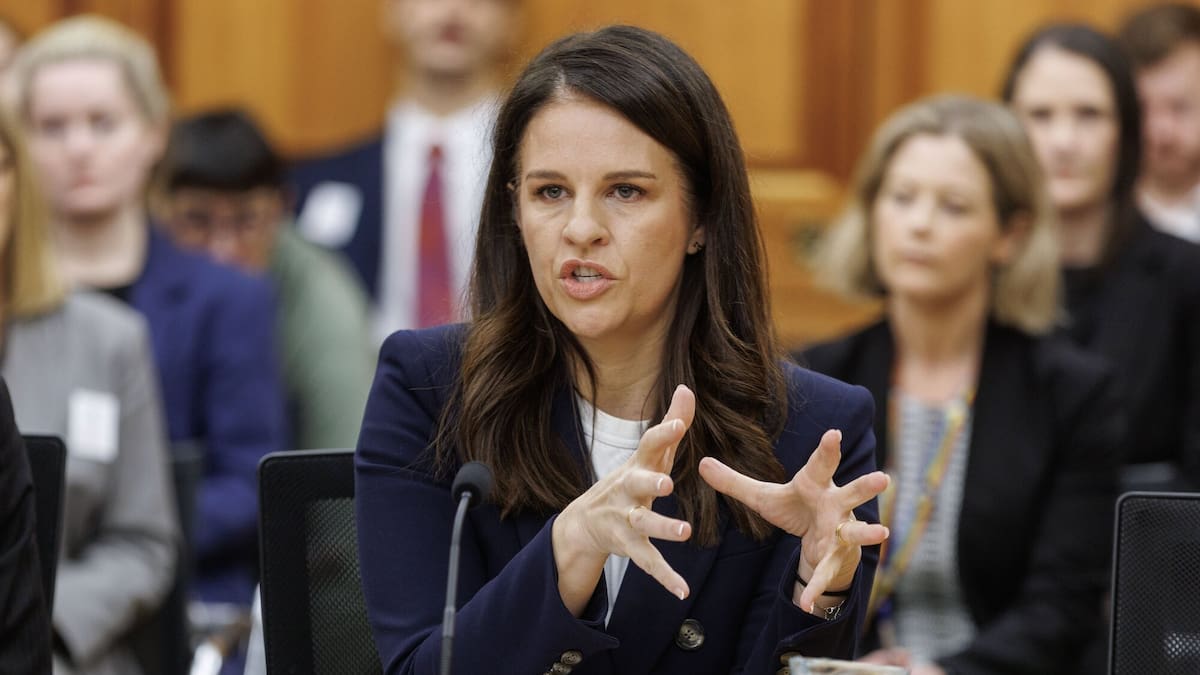
From before primary school, she wants education to start levelling what is an increasingly uneven playing field.
“In this country, your means determine your destiny. It matters what your parents do, and it matters where you live,” Stanford told the Herald.
“Education’s the great equaliser – but it’s not.”
Her blunt admission follows a Herald analysis of maths, reading and writing assessment data in 2025, according to the latest Curriculum Insights and Progress Study (CIPS).
It showed almost all socio-economically disadvantaged children fell behind in maths by Year 3, with 95% below curriculum level and 70% more than a year behind.
The proportion for this cohort of disadvantaged kids was almost as high for writing: 91% were already below curriculum level in Year 3, with 80% already more than a year in arrears.
The inequity gap is also widening in reading, where two out of three disadvantaged kids in Year 3 were more than a year behind.
This indicates that socially disadvantaged kids appear to fall behind before they even get to their first school day, which Stanford said was “absolutely” the case.
Her upcoming school readiness programme will complement the Engage and Enrich programmes that are already helping 136 ECE centres with oral language and self-regulation.
But any new ECE-based programme doesn’t help those who are not in ECE, who are more likely to need help the most.
In 2025, 36% of children aged 0-4 were in ECE, with participation rising with age; 83% of 4-year-olds attended ECE for 10 hours or more, with 43% attending for 20 hours or more.
“That is one of the most difficult policy problems,” Stanford said.
“How do you influence parenting to make sure that you’re doing the single most important thing? Speaking to your child, using rich language, inviting a response, not using baby language, talking to them all the time.
“The more language that young people are exposed to, the more words they hear, the better their oral language skills will be, and they don’t even have to be able to talk yet.”
But there is no Minister for Parenting, nor is Stanford suggesting one.
“Every single mother and every single father wants the best for their children. They just don’t always know [how].
“How do we get that into homes is a tough one. I’ve got the compulsory education system, and what we’re doing with these reforms is the very best we can do when they walk in that front door at age 5.”
Worsening inequity
Stanford noted the groupings of smaller numbers in the CIPS data when broken down by socio-economic bands, which makes them inherently less robust.
But this doesn’t mean the inequity gap isn’t widening. It is, and has been, for more than a decade.
International assessment results from 2018, she said, showed New Zealand with “the strongest relationship between socio-economic background and educational performance of all of the English comparative-speaking countries – more than the US, more than Australia, more than Canada, more than the UK”.
“Things have been getting worse. That’s what we’re trying to address. But it’s going to take many, many years to turn this enormous ship around.”
The widening gap in the CIPS data over recent years was not an indication of a negative impact of her reforms, she added.
“Our reforms have only been in place, by the time they did this last assessment, for three-and-a-half terms. So there were no reforms in 2024.”
The results by whole year groups rather equity bands within those groups were still low:
Maths had seen the most improvement, but only a quarter of students in Year 3 and Year 8 were at curriculum level or above in 2025.Only 41% of Year 3 students reached the curriculum benchmark in writing in 2025, while for Year 8 students it was 28%.Just over half of the students in Years 3 and 6 were at or above curriculum level in reading in 2025, while for Year 8 students it was 45%.
Stanford said the small improvements in maths and writing over recent years were a surprise.
“I was told by NZCER [Council for Educational Research] to expect, at best, stagnation, but probably overall a slight decline when you are introducing such massive changes to the sector.”
It was hard to know how many kids made up the long tail of underachievement. More than half of our most deprived children are not regularly attending school, which could be as many as 50,000 kids.
Stanford said the Government has “flooded the system” with support for those struggling the most, for example with full-time structured literacy support staff.
“But that all relies on working out who the kids are, and which schools need support. This year, for the first time, we can now measure progress over time and accurately pinpoint who these kids are, where they are, and which schools have the highest level of needs.
“That’s why we’ve moved CIPS to every year. That’s why we’ve introduced twice-yearly checks in reading, writing, and maths.”
Similar to the challenges with ECE-based support, this only helps those who are in school. Stanford said this underlines the importance of increasing attendance, which Associate Education Minister David Seymour is responsible for, and which has seen some improvement.
In Term 1 2026, 68.8% of students attended school regularly (defined as 90% of the term), up from 65.9% in Term 1 2025.
For students facing higher socio-economic barriers, only 53.8% attended school regularly in Term 1 this year.
This means that many of those who are struggling the most will miss out on any benefits Stanford’s education reforms will bring.
Her six main pillars of reform are:
a knowledge-rich curriculum grounded in the science of learningevidence-based instruction for early literacy and mathsmonitoring student progressworkforce developmentmore learning support for students with additional needsgreater use of data
These have not been without controversy.
Many in the sector, including parents, have welcomed them, but teacher unions in particular, and some academics, have been critical of Stanford’s departure from progressive education, saying she’s too reliant on a few key advisers.
Inequity is not inevitable
Stanford said the goal of the reforms as a package is to have consistency across schools and classrooms, including interventions to help those falling through the gaps.
“If you turn up to a school that has had an amazing teacher who’s taken on board structured literacy, and they’ve got all the math resources in the classroom, and they’ve got high-impact teaching and a whole lot of maths catch-up, then your chances of success are much higher, even if your starting point was behind,” she said.
“That is what I am trying to do with these reforms … get that consistency – the same curriculum, the same internationally benchmarked world-leading knowledge-rich curriculum, access to the maths textbooks, workbooks, teacher guides that are helping to build teacher capability.
“Before only the wealthy schools could afford it. We have created a level playing field so that your means will not determine your destiny.”
Saying some kids are a lost cause before they step into a classroom was making excuses, she said.
“That has been the excuse of the failed experiment that we’ve had for the last 25 years. ‘It’s beyond our control. Our child-centred, child-led, sit-on-a-beanbag and pick-a-path education system would have worked if it was not for societal factors.’
“Guess what? Societal factors are always there. They always have been. Why is it that, in the last 20 years, we have taken a complete nosedive? It’s because of those failed pedagogical approaches or the teaching practice approaches. It should not matter their level of disadvantage, or their home situation when they turn up to school. No matter their starting point, they should have the same finish point.”
The phonics checks across terms in 2025 for kids in the first year of school who face higher socio-economic barriers. The check is against curriculum expectations. Source: Education Ministry
She pointed to phonics checks results between Terms 1 and 3 last year, with all ethnicities and all school Equity Index (EQI) bands showing significant improvement.
In Term 1, almost three-quarters (73%) of kids from poorer backgrounds needed support at the 20-week check during their first year of school, while 7% exceeded the curriculum benchmark. In Term 3, the proportion needing support had dropped to 55%, while 24% were exceeding expectations.
Across four terms, the proportion of disadvantaged kids at or above curriculum level after 20 weeks more than doubled, from 19% in Term 1 to 40% in Term 4.
“The kids who were from … high [deprivation] equity index schools made massive gains. The Pasifika kids, the Māori kids all made huge gains,” she said.
“That’s the whole purpose of education. It can be the great equaliser, and those young people can go on to live amazing lives. But we have to have all those consistent things across every school, and then you have to identify who they are [who need support] so that you can then put the interventions in place.”
Education Minister Erica Stanford with students before announcing a $131 million funding boost for primary and intermediate schools. Photo / Mark Mitchell
Equity funding can be improved
A school that has a lower EQI, and therefore students with higher socio-economic barriers, will receive more funding to rebalance the playing field.
But Stanford said there is no data on how the extra funding is being used, or whether it’s being used effectively.
“We don’t really have any understanding of how it’s used or what the impact is,” she said.
“It is very high trust. But essentially it doesn’t provide us with any data on what is or is not working when it comes to equity funding.
“How is it that some schools use the equity funding really well and have great results and others are still struggling? What more wrap-around support do they need? Is it more funding or is it help with what they’re funding? I don’t know.”
Asking schools to track how the funding is being used is not something she’s asked for advice on.
But there should be less pressure on a school’s finances if her reforms are successful in providing consistent provisions across all schools. Socio-economic background should also be less determinant of a child’s life path.
“We have young people who have had a difficult start in life. It’s so important that when they turn up to school, no matter the background, we’re giving them the very best education from day one.”
Derek Cheng is a senior journalist who started at the Herald in 2004. He has worked several stints in the press gallery team and is a former deputy political editor.