
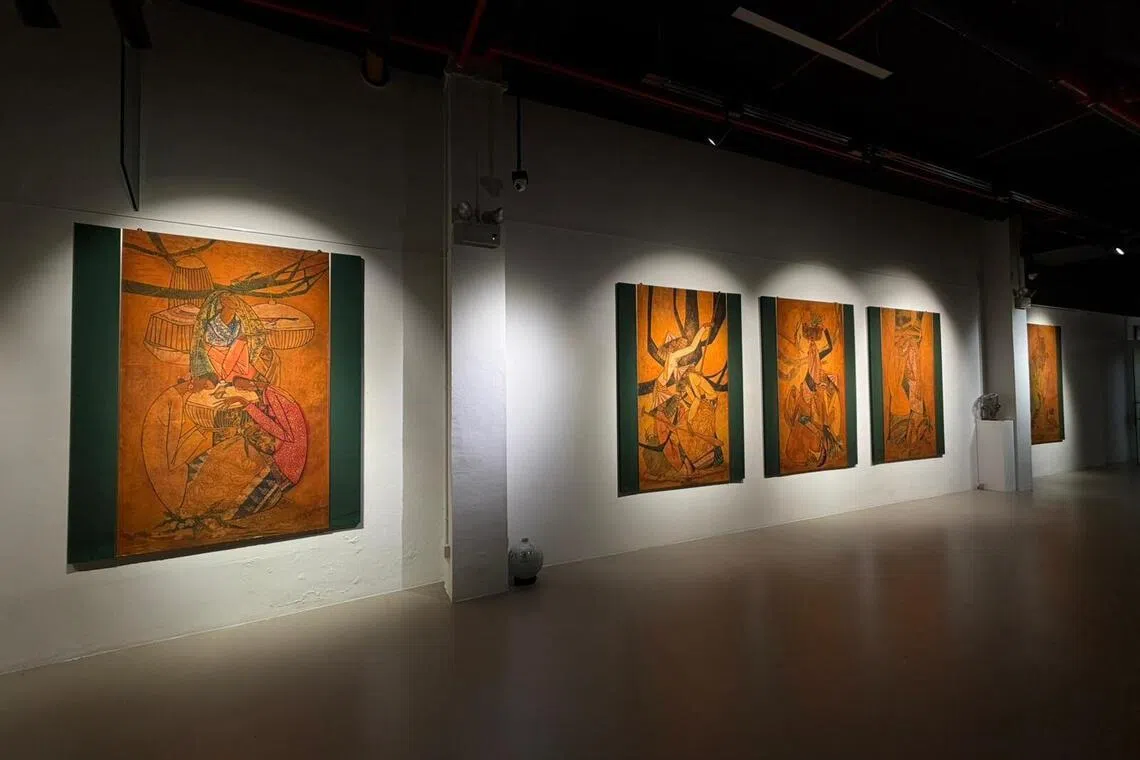
SINGAPORE – Five batik panels making up an oversized mural dominate one wall at artcommune gallery’s new show, Romanticisation Of The Tropics: Batik Paintings By Chuah Thean Teng, Choo Keng Kwang And Seah Kim Joo.
Despite fading to an almost uniform orange sienna tone thanks to age and exposure, Choo Keng Kwang’s Tropical Charms I to V (1969) are a captivating sight, depicting batik-draped women and men in scenes of daily lives, from playing with pet birds to pounding rice.
The works once decorated the lobby of Hotel Negara in Orchard Road and this show might be art lovers’ last chance to see the complete set. The works are being offered for sale and, unless purchased in its entirety by an institution, likely to be split up if bought by private collectors, given their size. Each panel measures 1.98m by 1.11m. The works are priced from $9,000 to $62,000.
Choo’s work is exhibited alongside batik works by Singaporean Seah Kim Joo and Malaysian Chuah Thean Teng – three Chinese painters working in the Nanyang style who learnt a uniquely South-east Asian technique and experimented with it in a fine art setting.
The show’s Taiwanese curator Yang Jye-ru says that, as a foreigner, he was intrigued by the technique of wax resist dyeing and the subject matter of these artists’ works. “Batik is common in Indonesia and Malaysia, but in Singapore, a lot of Chinese artists in the 1960s and 1970s used the technique of wax resist dyeing. This sets them apart from Indonesia and Malaysia.”
He points out that China-born Chuah, who migrated to Penang with his family at the age of 14, is generally acknowledged as the first artist to turn the craft of batik into a fine art technique.
While his sarong factory venture might have failed, the business sparked Chuah’s experimentations with batik painting. He would go on to found Yahong Art Gallery, which became a hub for experiments in the medium.
His works in the show, from the family collection, are still vibrantly coloured. Mother’s Legacy (1983) juxtaposes warm reds with cool blues in a quiet domestic scene of women grinding rice, while A Moment Of Stillness (1980s) showcases his rich colour range, the dark forest and artichoke greens of the woman’s outfit set against lighter greens of the banana leaves behind her.
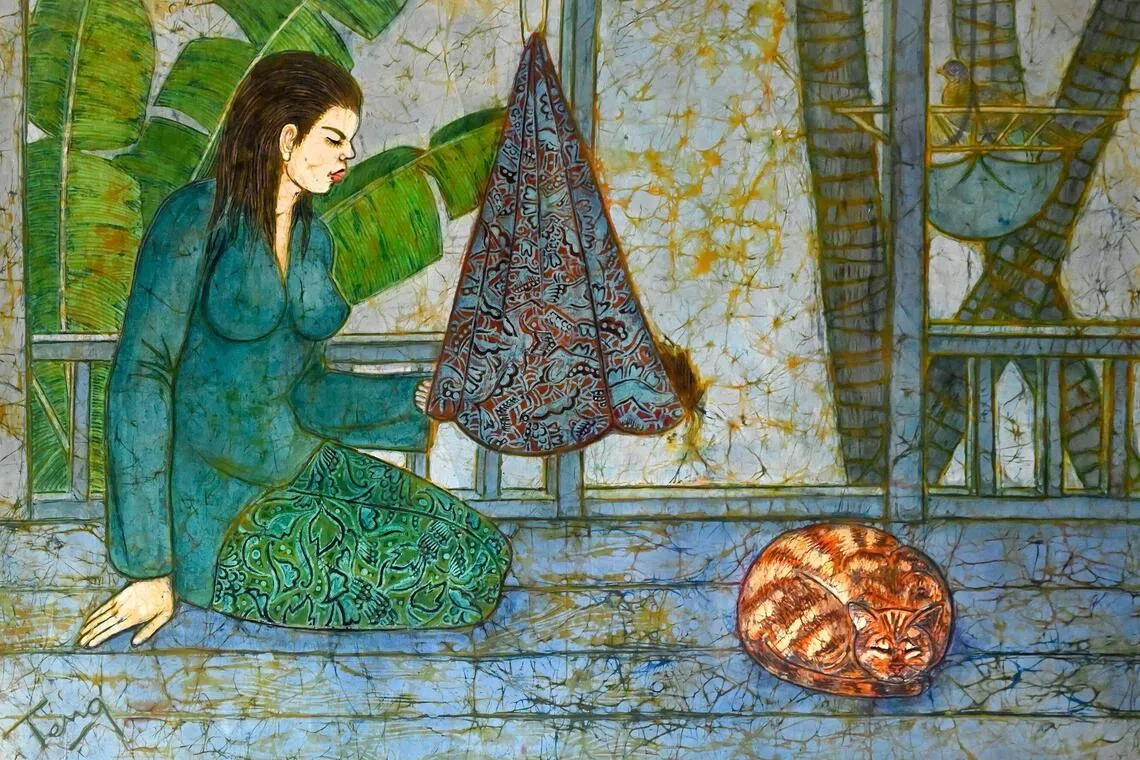
Chuah Thean Teng’s A Moment Of Stillness, 1980s, Batik, 59 x 92 cm.
PHOTO: ARTCOMMUNE GALLERY
Yang notes that while South-east Asia was racked by political unrest and even war when these artists were actively producing batik works in the 1960s and 1970s, “their works depict a harmonious, peaceful, multicultural world. They try to tell us that different cultures can come together”.
The contrast inspired him to dig deeper in his research and proffer the context that these works were produced under particular commercial and political conditions.
The artists worked at a time when new nations looked to culture to help forge identities and rapid urbanisation created spaces for public art.
Yang observes that Choo’s idyllic scenes were probably also created with tourists in mind, as the commissioned work would hang in a hotel: “These so-called Malayan and South-east Asian landscapes are actually constructed to promote the nation.”
As more works were created in this vein so characteristic of the Nanyang school of painters who captured sleepy kampungs and fishing villages, bustling river scenes and marketplaces, Yang points out that, inevitably, the artists created a regional spiritus mundi, “a collective imagination of this tropical region”.
He acknowledges that the artists in this exhibition possess a Sinitic lens and there is an element of exoticisation in their bucolic representations of South-east Asian life, hence his contextualising the show with the title which concedes to the constructed reality in these works.
In today’s world where people have become more attuned to the issue of cultural appropriation, questions might also be raised about Chinese artists using a technique native to the region. Yet, there is no denying that these artists regarded batik as a legitimate media for their fine art practice. So much so that Choo, better known for his oil painting and woodblock prints, also employed the technique in his practice.
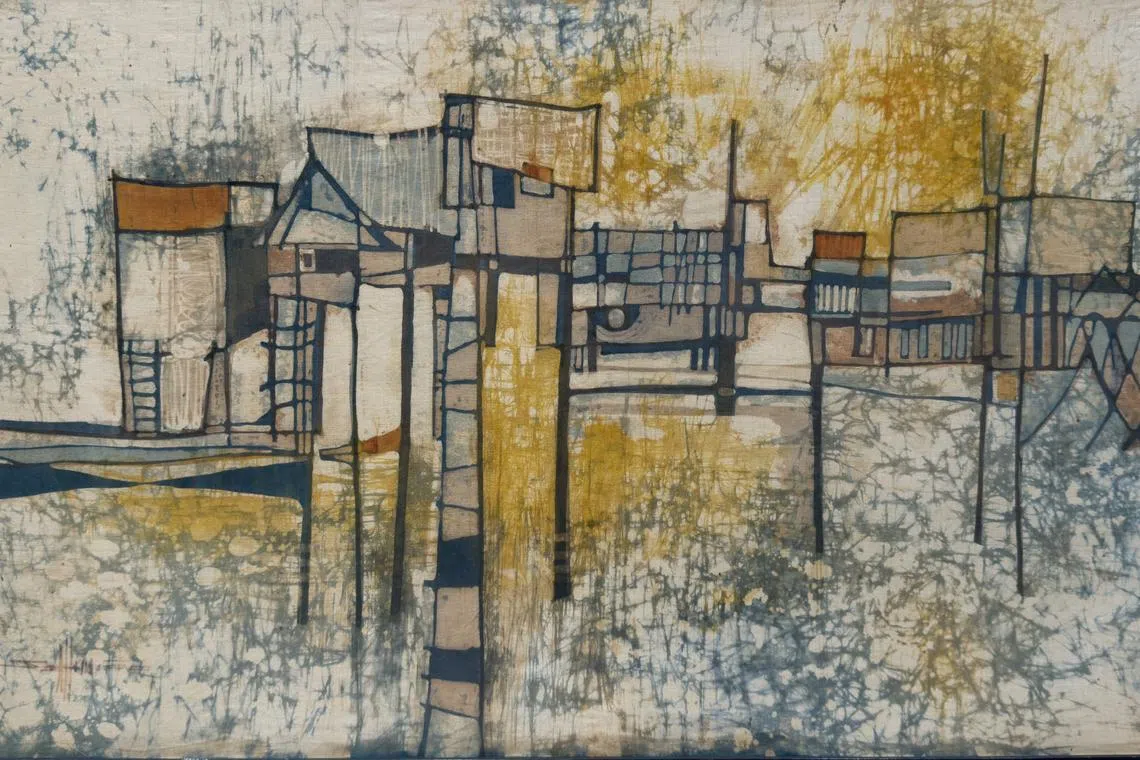
Seah Kim Joo’s Fishing Village.
PHOTO: ARTCOMMUNE GALLERY
Singapore-born Seah, who spent his childhood in Terengganu where he first learnt to wield the tjanting used to create batik patterns, trained at the Nanyang Academy of Fine Arts with Nanyang pioneer artist Cheong Soo Pieng.
He turned to batik as a primary medium and, like Chuah, he pushed the craft, developing techniques including airbrushing and sand dyeing.
Today, the popularity of batik as a fine art technique has waned in Singapore, although it is still practised in Malaysia and Indonesia. Yang points out that batik techniques are both time-consuming and labour-intensive, making it less popular with young Singapore artists.
But shows like artcommune gallery’s remind visitors of a time when batik art was at the cutting edge of fine art practice in Singapore.
Where: artcommune gallery, 01-01 Carlton Hotel, 76 Bras Basah Road
When: July 4 to 19, noon to 7pm daily
Admission: Free
Info: www.artcommune.com.sg