
About $500,000 of the $4.4 million debt the Upper Hutt City Council is about to take on will go towards embracing AI.
Councillors approved borrowing $4.4m from the Local Government Funding Agency (LGFA) for new projects during Tuesday’s meeting, of which $2.8m was to repave the city centre’s footpaths and $513,000 was destined for “adopting AI, and risk mitigation”.
A council spokesperson said its plans were to adopt AI and work to make sure the council was legally compliant.

The council was in the operation planning phase and did not have confirmed total costs “at this stage”.
The plan was to use AI to enhance “internal capabilities and efficiencies” and purchase software licences, which cost $60 a month for each user.
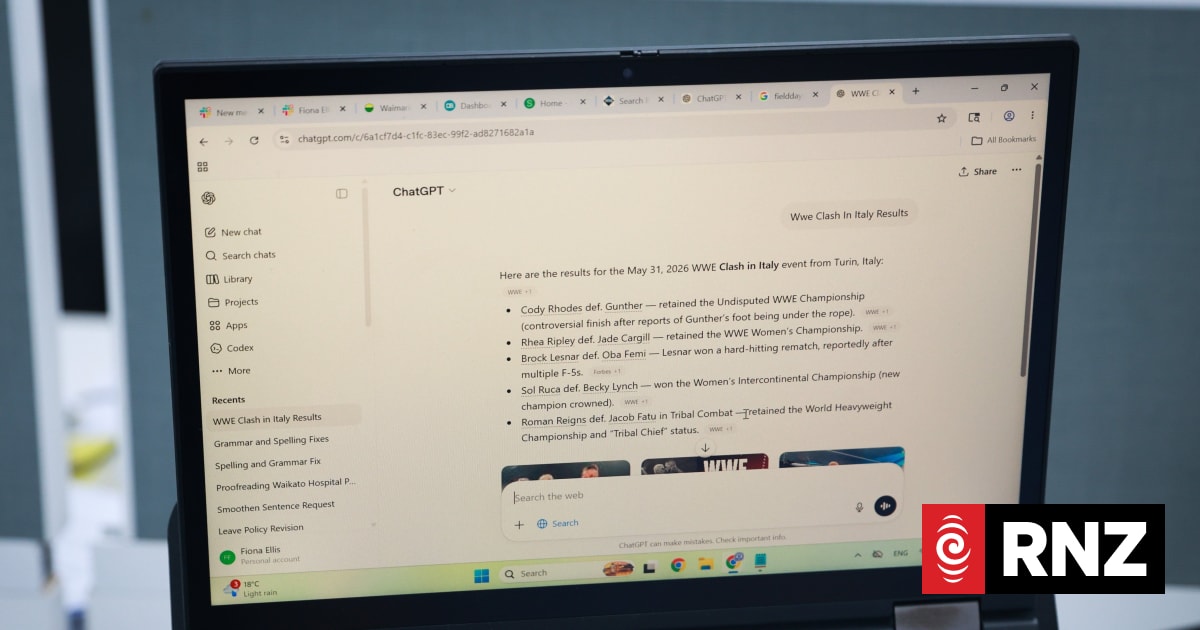
The council currently uses ChatGPT and Microsoft’s CoPilot across all parts “as appropriate”, the spokesperson said.
The council’s corporate services acting group manager, Sarah Tunnicliffe, told councillors they had to borrow money for AI because that was classified as new IT equipment, which its financial strategy dictated needed to be funded through loans.
Out of the remaining new borrowing, $224,000 was set aside for safety upgrades on rural roads, almost $29,000 was to replace old CCTV cameras in the central city and $31,000 was for new road sealing.
Since 2024 its neighbour, the Hutt City Council, had been using AI to improve productivity and council services, turning handwritten submissions into detailed reports in days rather than weeks.
The council spends about $180,000 a year for 300 licences to use generative AI like ChatGPT and Copilot, according to a Hutt City Council spokesperson, and it saved $900,000 and 44,000 staff hours a year.
“We have custom-built ‘AI assistants’ where we found opportunities for routine tasks to become more efficient, freeing up staff to focus on other parts of their work.”
Hutt City Council teams were testing new AI tools to cut manual work in searching for Land Information Memorandums (LIMs), or automating invoices for resource consents to save three to five minutes each invoice, the spokesperson said.
Each invoice takes up to 10 minutes to generate and the council could process up to 100 invoices a week on busy days.
LDR is local body journalism co-funded by RNZ and NZ On Air