
“I was living the dream, honestly.”
Then, while celebrating Aurora’s birthday with family, Kerrison found a small but painful lump in her abdomen.
Having spent months recovering physically from pregnancy, she instinctively knew something had changed.
“It was new, and it hadn’t been there for very long.
“I just had this gut feeling that something wasn’t right.”
The lump that changed everything
The lump appeared to be growing quickly, prompting her to seek medical advice as soon as she returned home.
What followed was weeks of scans, referrals, biopsies and uncertainty.
An initial ultrasound suggested the lump was likely a haematoma rather than cancer.
“We went out and celebrated for dinner.”
Days later, a senior radiologist reviewed the scan and raised concerns that it could be sarcoma, a rare group of cancers that develop in bone and soft tissue.
About six weeks after first finding the lump, Kerrison received the news that changed everything.
“I had that sit-down talk and was told, ‘You have sarcoma. You have cancer’.”
Doctors did not yet know the tumour’s exact subtype or prognosis, with tissue samples requiring analysis in laboratories across New Zealand and Australia before a diagnosis could be confirmed.
“It was shattering.”
Kerrison said sarcoma was one of New Zealand’s deadliest cancers, with almost one in three patients not surviving beyond five years.
Despite disproportionately affecting children, teenagers and young adults, it receives less than 1% of cancer research funding across Australia and New Zealand, Kerrison said.
For Kerrison, however, there was only one thought that mattered.
“The thought of my daughter growing up without her mother.
“She had just turned 1, and she wouldn’t even remember me.”
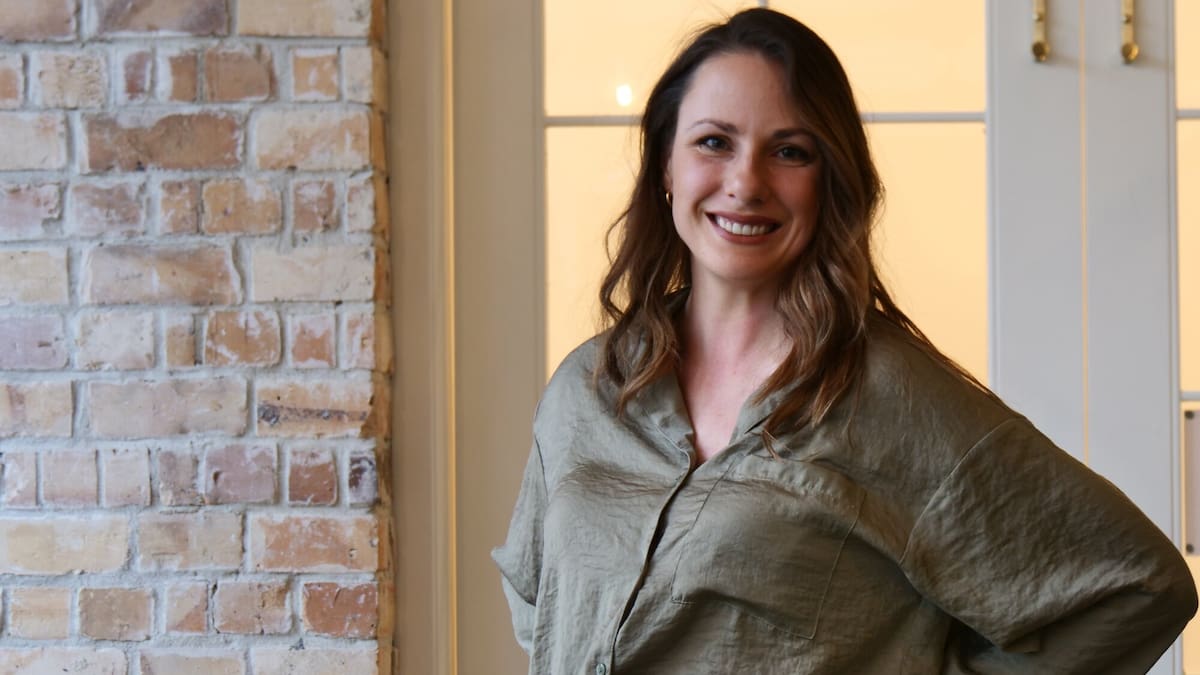
Kerrison said early detection could make a significant difference to outcomes. Photo / Tom Eley
Fighting for the future
That fear became her motivation.
“Every waking second was spent researching studies, exploring treatment options, changing my diet and learning everything I could.
“I was going to give it everything.”
The couple moved back to Cambridge after the diagnosis to be close to family, she said.
Kerrison was eventually diagnosed with a desmoid tumour, a subtype treated through sarcoma services. Although technically classified as benign, it behaved aggressively.
Within months, it had tripled in size.
“It became life-threatening.”
The tumour left her in constant pain and increasingly disabled.
“By the end of it I couldn’t really bend or move without extreme amounts of pain.”
After exhausting other options, Kerrison underwent urgent surgery.
She credits her surgical team with saving both her life and her future.
“I thought I was going to lose my career.
“I thought I might not be able to get down on the floor and play with my daughter.”
A message that could save lives
Today, Kerrison has no evidence of disease and is advocating for the Australia and New Zealand Sarcoma Association (Anzsa) to raise awareness of the disease, which she says many New Zealanders are unaware of.
Anzsa chief executive Dr Denise Caruso said progress in sarcoma treatment was being made, but it was hard work.
“Every advance in sarcoma treatment represents years of work, millions of dollars in investment and the determination of patients, clinicians and researchers who refuse to give up,” Caruso said.
Medical oncologist Dr Joanna Connor said awareness remained one of the biggest challenges.
“Sarcoma is uncommon, which means it’s not always front-of-mind for clinicians or the community.
“Too often, sarcoma is mistaken for a sports injury or growing pains. That rarity creates a dangerous gap – one where symptoms are overlooked and diagnosis is delayed. Awareness is not just helpful; it’s lifesaving.”
Health New Zealand’s director of the National Clinical Networks, Mary Cleary-Lyons, said sarcoma required highly specialised multidisciplinary care.
“We are working hard to provide better care for all patients with cancer, including sarcoma,” she said.
“We know that due to capacity constraints, we sometimes fall short of the level of care we would aspire to deliver. We always prioritise based on clinical need and work hard to minimise adverse impacts on patients that might arise from delays.”
Cleary-Lyons said sending tissue samples overseas for analysis was standard practice when New Zealand lacked the specialist expertise or laboratory capacity.
For Kerrison, the message she hoped people would take away from her story was simple.
“No one knows your body better than yourself.
“If something doesn’t feel right, get it checked. If you’re not being listened to, get a second opinion. If you need a third, fourth or fifth opinion, do it.
“Sarcoma is one of our deadliest cancers, yet most people have never heard of it.
“If sharing my story helps one person get checked earlier, then it’s worth it.”
Tom Eley is a multimedia journalist at the Waikato Herald. Before he joined the Hamilton-based team, he worked for the Weekend Sun and Sunlive. He previously worked as a journalist at Black Press Media in Canada and won a fellowship with the Vancouver Sun.