
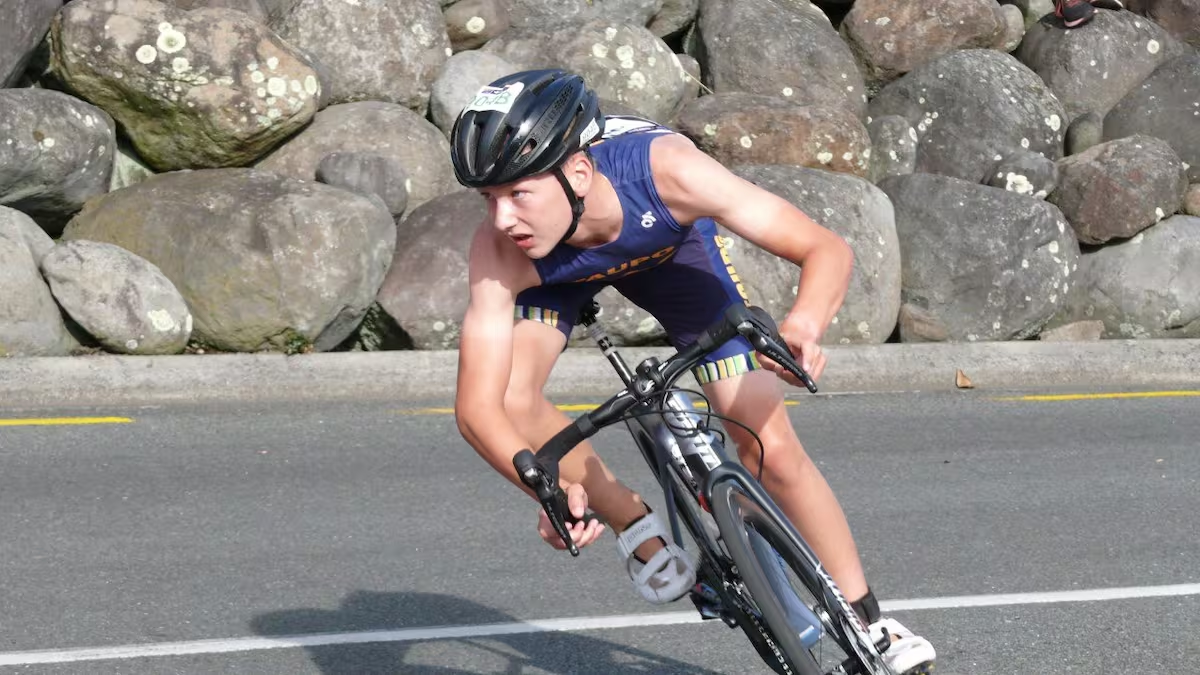
He was among the lead group of triathletes who deviated from the prescribed course by following the lead motorbike through a roundabout, instead of making a left turn as they should have.
Time penalties were imposed on Abele and the other lead riders, which he ultimately appealed to the tribunal, according to a just-released decision.
According to the evidence, the lead group, including Abele, did not make the left turn because the street was blocked off by course markings, being an orange “No Entry” sign and cones.
The group continued to follow the lead motorbike for a distance, taking a shorter route and encountering live traffic, before re-entering the course.
The rest of the field followed the prescribed course, the road closure having been corrected shortly after the lead group had passed through.
Abele finished the race in second place, followed just over a minute later by Michael Phillips, who followed the prescribed course behind the lead group and finished third.
Phillips lodged a protest against the lead group for not following the prescribed bike course.
The competition jury dismissed the protest because the lead motorbike had taken a different course, and the athletes had followed believing the course had changed.
The Sports Tribunal, made up of chair John Macdonald, deputy chair Andrea Twaddle and tribunal member Dame Ruth Aitken, said the jury did not feel the deviation justified disqualification.
Phillips was not happy with the outcome and appealed to the Tri NZ Board under a section of the Triathlon NZ competition rules.
The board allowed the appeal in January this year, having heard from Phillips but not from Abele or any of the other lead riders, and referred the matter back to the competition jury to impose a penalty.
Additional data obtained showed the lead riders had gained an advantage of somewhere between 76 and 96 seconds by taking a shorter route, the tribunal said.
However, the competition jury refused to impose a penalty.
In February this year, the board issued a decision of its own and imposed an 86-second penalty on the lead riders with an additional 60-second penalty for the course deviation.
It resulted in Abele being relegated from second place to third place behind Phillips.
Abele was notified by email of the decision, despite being “totally unaware” of the appeal filed by Phillips.
Abele made a formal complaint under the Tri NZ Constitution seeking an internal resolution, but was advised by Tri NZ that the matter was closed.
Abele then filed a notice of appeal with the tribunal, on grounds of a breach of natural justice and procedural unfairness, substantial new evidence, and that the 60-second penalty was excessive or inappropriate.
At a pre-hearing conference in March, Tri NZ made clear that the tribunal had no jurisdiction to hear the appeal, as there was no explicit right of appeal to the tribunal under the competition rules.
However, once the chair pointed out that the procedure adopted in relation to Phillips’ appeal appeared to involve “clear breaches of natural justice”, Tri NZ confirmed it would reconsider and start the process afresh, including Abele and the other lead riders.
Ultimately, after considerable analysis as to what had occurred, Abele remained in third place behind Phillips, this time by a mere three seconds.
Disappointed with that outcome, Abele refiled his appeal with the tribunal, which was heard last month, with each party addressing issues of jurisdiction and the substantive merits of the appeal.
Ivan Abele, pictured at an earlier triathlon event, has had his appeal over the Tauranga Half Marathon dismissed.
Tri NZ submitted that the tribunal lacked jurisdiction to hear the appeal because the level two decision and reconsideration decision were not disciplinary matters.
Instead, they were decisions determined by the Tri NZ Board pursuant to the competition rules.
Phillips supported and adopted Tri NZ’s position.
Among Abele’s heavily legally termed argument was that the competition rules did not explicitly exclude an appeal to the tribunal.
The tribunal was sympathetic to Abele’s argument that there was jurisdiction because of the ambiguity in the language of the constitution, but in the end it dismissed the appeal on the grounds it had no jurisdiction to hear it.
Tracy Neal is a Nelson-based Open Justice reporter at NZME. She was previously RNZ’s regional reporter in Nelson-Marlborough and has covered general news, including court and local government, for the Nelson Mail.