
Whangārei truffiere Steve Karl with a 69g black truffle found at one of the trees on his property.
Recent large-scale investment, including a reported $10 million development in Canterbury, signals growing confidence and is helping build capability, scale and international credibility.
Whalley said the opportunity for the sector is clear.
“We’re seeing strong global demand in markets willing to pay for premium New Zealand–grown goods, with interest from Canada, Asia, Europe and the USA for truffles in the hundreds of kilograms.”
Whalley said exports were expected to drive the industry’s biggest growth in the years ahead, while demand within New Zealand continued to strengthen.
“In New Zealand, top-grade black truffles can fetch up to $2500 per kilogram, but average about $1000 a kilogram across the grades, reflecting the time, care and patience required to grow them, with further room to grow as more New Zealanders discover fresh truffle.“
Whalley said growing production volumes and consistently high quality gave the industry confidence in its ability to compete internationally.
For Hato Hone St John paramedic Karl, truffles are almost a sideline hobby after becoming interested about 16 years ago.
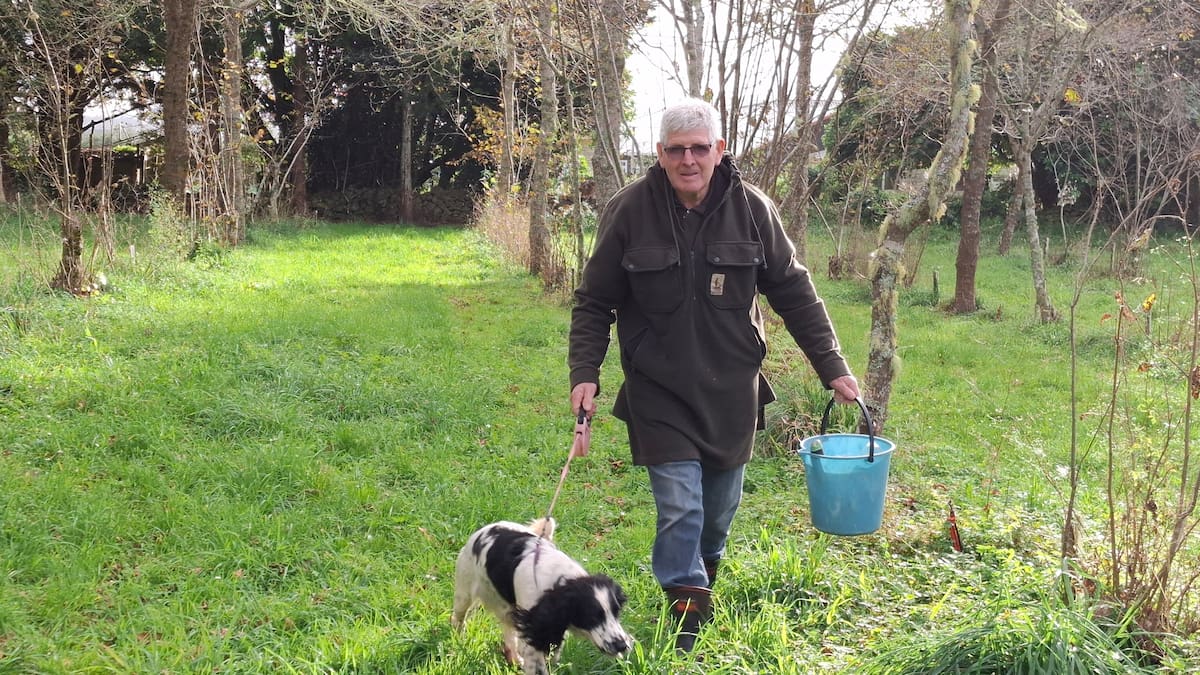
Sally the spaniel points to where she has sniffed out a truffle among the oak and hazelnut trees in Steve Karl’s truffle paddock.
He bought the Maungatapere lifestyle block to convert part of it for truffles, first getting the soil right, with his first crop three or four years ago.
He said truffles could be grown on land that was not necessarily prime farmland, but success depended on maintaining a higher soil pH than is typically required for conventional farming.
“We added about 10 tonnes of lime to get the pH up. And it needs regular lime added to keep up the pH levels, or you won’t get any truffles.”
Steve Karl with a small black truffle his spaniel Sally sniffed out.
A black truffle from Whangārei truffiere Steve Karl’s lifestyle block.
He planted 1ha of the property in oak and hazelnut trees – the best for truffles – which have truffle spores in the roots.
After several years, he began harvesting truffles with the help of Sally, his spaniel, whose keen sense of smell allows her to locate them underground. When she detects a truffle, she lies down and points her nose at the spot, which Karl marks before returning later to carefully dig it up.
Sally gets her reward after another successful truffle hunt.
Most of his truffles go to a Northland restaurateur, so he has no problems finding a market.
Karl said the growing global interest in New Zealand truffles was good news for the sector.
His advice for anybody looking to get into truffles is simple – do your homework, don’t expect to get rich quick as it can take several years from planting the trees to harvesting the fungi beneath, and get plenty of truffle spore.
“And don’t go in with too high an expectation.”
Good dog! Sally points to another buried truffle.