
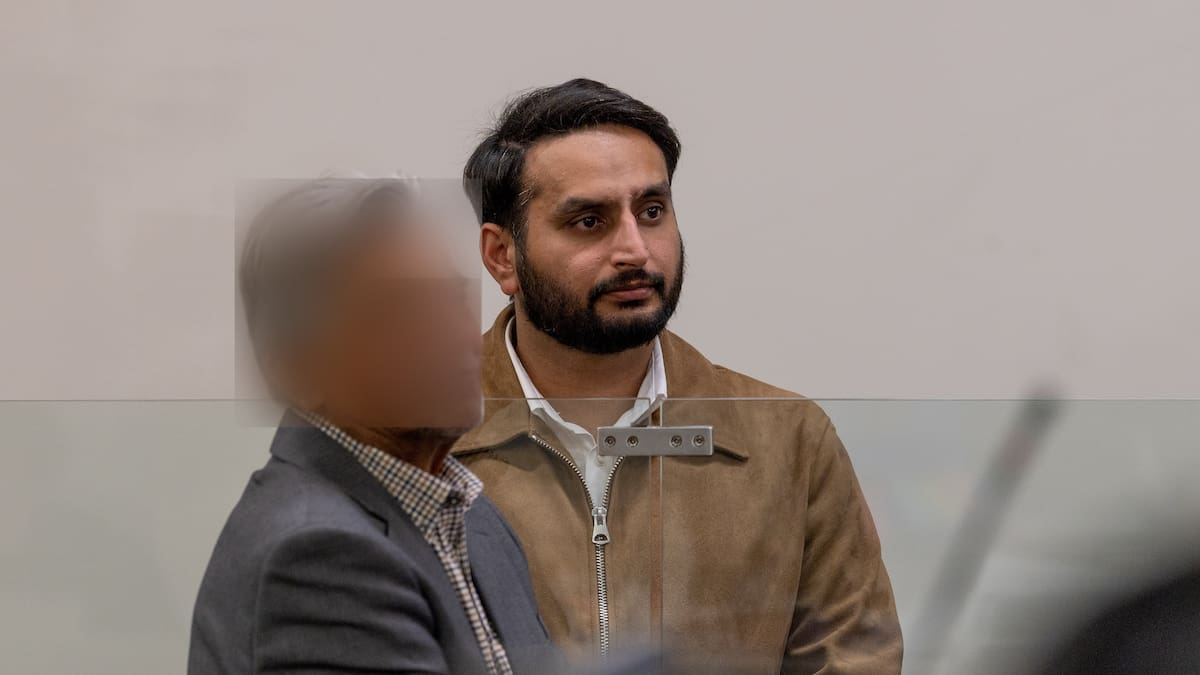
At his sentencing in the Auckland District Court today, the victim said she still blamed herself for getting into the front seat.
“I know, rationally, that no seat in that car made what happened acceptable,” she said. “But that is what this kind of violation does to a person.”
That night was not the end of the victim’s ordeal.
She had to go through a trial in 2025 that resulted in a hung jury, that she said betrayed her “faith in people”.
She persevered, however, and after a retrial in May a jury found Singh, now aged 33, guilty on four counts of indecent assault.
In court today, Judge Brooke Gibson laid out the facts of what happened on the night of July 14, 2024.
The woman got into the back of the Uber about 1.20am in Grey Lynn, Auckland, to take what the judge said should have been a short trip to Mount Eden.
She was upset when she got into the vehicle but, he said, that was not Singh’s “concern”.
Singh invited the woman into the front passenger seat and “unfortunately” she obliged, leaving some of her belongings in the back.
He placed his hand on her thigh, moving it higher up her lap.
The victim made it clear she didn’t want it to happen, Judge Gibson stated, but Singh insisted on a kiss and a hug and trying to get her to agree to drive elsewhere.
The victim felt trapped as Singh again hugged and kissed her and put his hands near her bottom.
When they eventually reached her destination, and they got out of the car, Singh hugged the woman again and this time put his hand on her bottom and grabbed her.
Once he let her go, the victim walked away, the judge said.
A car with the word ‘devil’ in the numberplate
This morning in court, she read out her victim impact statement.
She told the court that two weeks before the Uber trip, she had just finished four years of therapy to process past sexual abuse.
Before the Uber trip, she had finally felt healed.
“I was okay, I was happy, I was in a good place,” she said. “That was taken from me.”
She said she had never been more scared than she was in that Uber.
Fearing that she would be raped or murdered, she began to think of ways to leave evidence for police if it “came to that”.
“Break a nail, pull out hair … wipe blood somewhere.”
She recalled that Singh’s number plate had the word ‘devil’ in it.
“Your Honour, I’m not religious, but during my moments in Mr Singh’s car I found myself praying to any and all gods that a car with the word ‘DEVIL’ in the number plate wouldn’t be the reason I didn’t get to tell my boyfriend I loved him again.”
The week after the incident, she was running late to an exam and had no choice but to take an Uber.
However, the resulting stress caused a panic attack so severe that she had to walk out in the middle of the test – and failed.
At one of her first shifts back at work, a man came into the office that looked like Singh and she again had a panic attack, so intense she said she thought she was having a heart attack.
She struggles with eating, sleeping and had to go back to therapy and increase her anxiety medication.
She said the first trial was one of the most traumatic experiences of her life and the hung jury harmed her in ways she didn’t expect.
Believing that if you told the truth, society would protect you, betrayed her “faith in people”.
She was scared that Singh knew where she lived.
That fear had only grown, particularly with the idea of what he might do once he was sentenced, she said.
‘Gutted’
The woman, who is now 24, spoke to NZME this week ahead of Singh’s sentencing.
In that conversation, she said a ride that should have taken only four minutes, took 20 and felt like 40.
“Time felt very warped.”
She said she complied with what Singh wanted in the car, because she felt it could be “dangerous” if she tried to make a scene.
When she retold how Singh kept touching her thigh in the car, moving higher up her leg each time, she became emotional.
“Sorry, it’s been so long, you’d think I’d be able to say it without crying,” she told NZME.
She gave evidence in the first trial and said she was cross-examined for about two days, which was a “pretty gnarly process”.
When the officer in charge told her about the non-verdict over the phone, she was “gutted”, but immediately said she wanted to go for a retrial.
Her history of sexual abuse was part of the reason she “so immediately” wanted a second shot, to stand up for herself in a way she felt she hadn’t in the past.
Singh had multiple opportunities to tell the truth, but did not take them, which delayed her ability to heal.
When she got the text that he was found guilty on four counts, she told NZME she was in shock.
“I think I just started sobbing and laughing at the same time.”
She also remembered Singh telling her that he only worked late night, weekend shifts – that worried her as she thought about the women, some of whom intoxicated, that would have ended up in his vehicle.
That was another reason she pursued justice.
A ‘real risk’ of deportation
In court, Singh was supported by about 10 of his family members, including his wife and baby, in the public gallery.
His lawyer Andy Wei said the majority of Singh’s family lived in New Zealand.
On that note, he attempted to get Singh discharged without conviction as Singh would face a “real risk” of being deported if convicted.
Singh’s wife’s visa was attached to her husband’s, so she would also have to leave the country if he was deported, the court heard.
On top of that, Wei claimed that India did not allow dual citizenship, and the baby, born in NZ, would have to live in India without the protection of Indian citizenship.
“The deportation and the family harm would be permanent,” Wei argued.
Crown lawyer Mohammed Chiraagh said the consequences of deportation for Singh would not outweigh the gravity of the offending.
In deciding whether he would convict Singh, Judge Gibson spoke of the effects the indecent assaults had on the victim.
“Clearly what you did to her will be with her in terms of psychological damage for some time well into the future.”
He also spoke to a Corrections and psychological report before the court highlighting that Singh had a clean record, history of working hard in this country and was assessed as at a low risk of reoffending.
“I can accept that this was … a one-off.”
As Singh’s wife’s visa was tied to her husband’s, the judge said there was no real “risk” their family would be separated if he was convicted.
On the balance of those reasons, he declined the application, convicting him on the four charges.
He ordered Singh to pay $10,000 in emotional harm to the victim and sentenced him to five months’ home detention.
Ella Scott-Fleming has been a journalist for three years and previously worked at the Otago Daily Times, Gore Ensign and Metro Magazine. She has an interest in court and general reporting. She’s currently based in Auckland covering justice-related stories.