
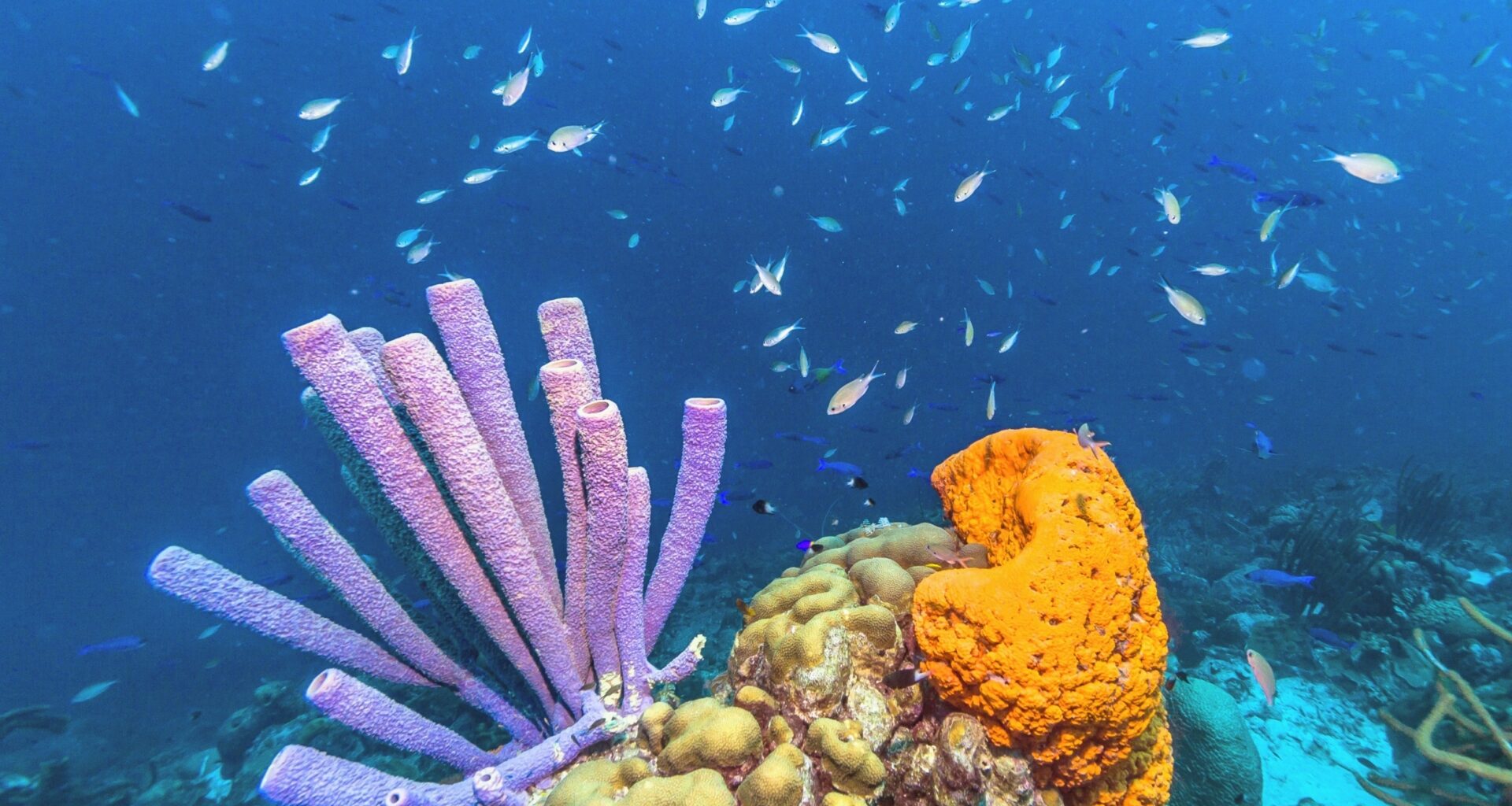
For a long time, sponges had a simple reputation on coral reefs. They sat in one spot and fed on whatever the water carried past them.
That picture now looks incomplete. A new study from the reefs of Curaçao shows that many sponges also make their own food from sunlight, the same basic process that powers plants.
The animal that behaves like a plant

Michelle Achlatis studies the life that stays stuck to the seafloor rather than the life swimming above it. Sponges have sat at the center of her work for years.
“We call them a textbook example of filter feeding and suspension feeding, because they are not only filtering, but also absorbing all sorts of edible material from the seawater,” Achlatis said.
She carried out this work as a postdoctoral researcher at the University of Amsterdam’s Institute for Biodiversity and Ecosystem Dynamics (IBED).
Specialized cells pump seawater through the body and trap anything edible along the way.
For years, that filtering role defined how biologists saw the entire group. It framed the sponge as a mouth with no other job to do.
Not just a consumer
The plant-like ability comes from tiny lodgers.
Some sponges host photosynthetic microbes in their tissue, mostly cyanobacteria that turn sunlight into food and release oxygen.
“Together with their symbiotic microbes, sponges can photosynthesize, just like a plant,” said Jasper de Goeij, associate professor of marine benthic ecology at IBED and a co-author of the study.
The ability itself was not brand new to science. Earlier work had confirmed it, but only in a small number of species.
A range of light responses
Achlatis and her colleagues examined 24 of the most common sponge species around Curaçao. They ran their most detailed measurements on eight of these.
The team tracked oxygen and light responses in the lab and out on the reef.
Then, the researchers scaled those numbers up to the level of the whole ecosystem, so the sponges could be weighed against other reef organisms that build food from light.
The eight species studied in detail ranged from barely responding to light to relying on it heavily.
Pairing oxygen readings with chlorophyll fluorescence showed how hard each sponge worked as the light rose.
Sponges contribute to the food supply
The outcome caught the team off guard. Half of the tested species responded to light and photosynthesized.
Achlatis had guessed that maybe a quarter or a third would qualify. She also had not expected such a large contribution to the reef’s food supply.
“It’s a group that in previous food web studies or big coral reef modeling were always put aside as pure consumers and not producers,” she said.
Most of these sponges still consume more than they produce. Sunlight covers a real slice of their daily energy, running from about 10 percent in some species to 40 percent in others.
“But they are quite flexible feeders and can supplement with photosynthesis,” said Achlatis.
Sponges hidden in a reef’s framework
The reef itself explains part of the surprise. Older surveys counted sponges from flat photographs taken above the seafloor.
That approach leaves a great deal out. Close to half of a reef’s living material hides inside cracks, caves and the framework beneath the coral.
“A previous study found that when you look at the three-dimensional reef, there are so many more sponges there than you expect,” Achlatis noted.
“By doing more detailed measurements, you can calculate their volumes.”
Measuring productivity by biomass
With this fuller count, sponges rose sharply up the ranking of reef producers.
Half of the tested species accounted for about 11 percent of the reef’s gross primary production. That result puts them in fourth place overall.
Only large seaweeds, hard corals and gorgonians make more, and sponges even edge out crustose coralline algae, a group long celebrated for making food from light.
How you measure productivity makes a big difference. Measured by flat surface area, sponges appear to contribute very little.
But measured by biomass, which better reflects their true size, their contribution increases many times over.
Why carbon budgets should shift
The measurements came from about 33 feet down, roughly 10 meters.
Some photosynthetic sponges live far deeper, in dim water reaching close to 490 feet, or about 150 meters, and they still carry their light-catching partners.
This has real weight for how we tally ocean carbon. The authors argue that sponge-rich habitats deserve a place in assessments of how reefs capture and hold it.
On the leeward reefs of Curaçao alone, these sponges may fix carbon at nearly half the rate of the whole island’s mangrove forests.
“The case we are trying to make with this paper is really that people should be aware that sponges are not only recycling carbon and nutrients that they find on the reef, they also have their own ways of making them, even if they’re small amounts, comparatively,” Achlatis said.
A new look at ocean life
The work covered a single tropical region. Yet sponges in comparable places often carry the same partners, so the pattern may reach well past Curaçao.
Professor de Goeij believes the findings reveal something bigger about life in the ocean.
“We need to look differently at many organisms living in the ocean, as they do not follow the strict plant-animal distinction as most organisms on land,” he said.
Sponges have endured hundreds of millions of years of change in the ocean. Records of light-feeding species already stretch across most of the world’s coastlines, from the tropics to cold polar water.
Treating them as simple consumers, this study suggests, has sold them short all along.
The study is published in the journal Functional Ecology.
—–
Like what you read? Subscribe to our newsletter for engaging articles, exclusive content, and the latest updates.
Check us out on EarthSnap, a free app brought to you by Eric Ralls and Earth.com.
—–