
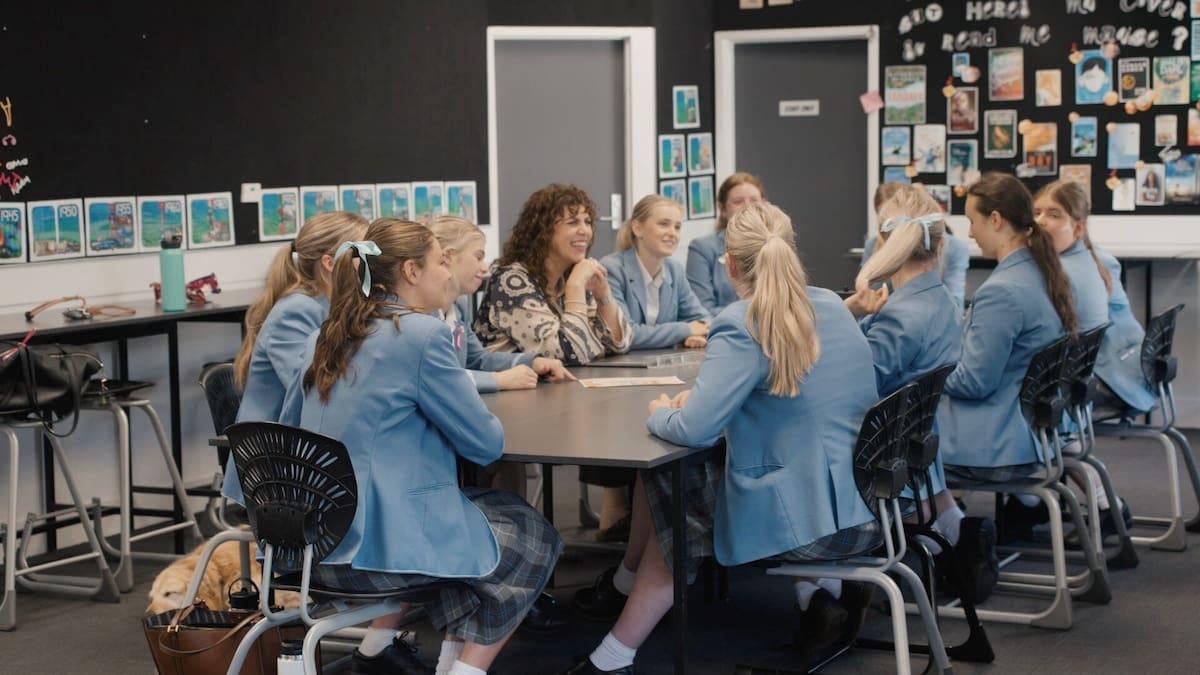
The questions are then put to a group of around 20 Year 12 students, led by Nader-Turner, for discussion.
The scheme was designed to go beyond just answering questions from curious teens, but to also encourage the older students answering to examine the origins of social expectations and beliefs.
“For example, where does the idea of shaving before sex come from? That’s a norm introduced by the porn industry,” Nader-Turner said.
“Let’s look at where these pressures actually come from, what they mean, and now that you know that, what decision would you like to make? You can still make one, but it’s a more informed decision.”
Nader-Turner said the inspiration for Ask Aunty Hilda came after she discovered many young women had never had open conversations about the pressures they faced.
While working with a group of student cultural advisers for a research paper in 2022, Nader-Turner said they spent two hours discussing what it was like to be a 17-year-old girl, including the sexual expectations placed on them.
At the end of the discussion, the students told her: “We’ve never done that before. That was amazing. Could we do that again?”
“The first ‘wow’ piece in my research was realising young women actually weren’t talking to one another, and I was quite surprised by that,” she said.
The group later explored ways to promote those conversations more widely before deciding to create something specifically for young women.
“One of the girls said, ‘Why don’t we do something just for us? Why don’t we do something that will help the young women in the school rather than trying to change other people?’
Despite expecting criticism when launching the initiative, Nader-Turner said the response had been overwhelmingly positive.
“I had my response prepared for when all the complaints came through. There has been nothing but support,” she said.
Nader-Turner said she had contacted girls’ schools around New Zealand, offering workshops for staff, parents and students.
She had also approached boys’ schools, but they were less interested in running the workshops.
“I wanted to help the boys’ schools and change the way young men were negatively impacting the young women at my school. I’ve come to realise that’s actually out of my control.”
“The thing I can do is help young women be strong, confident, have a voice and be able to articulate that well.”
Nader-Turner said she understood why boys’ schools had not always recognised the issue.
“Sexual assault, or what I would call sexual assault but what girls might call normal things that happen at parties, is something I hear about every day.”
“I know that’s not what counsellors in boys’ schools are hearing about every day. Those things are reported differently.”
The language associated with the online “manosphere” had become increasingly visible among young women, Nader-Turner said, and many young women were so immersed in online culture they struggled to recognise the messages shaping their beliefs.
Dr Marcelle Nader-Turner, a counsellor and neuropsychotherapist at St Hilda’s Collegiate in Dunedin, talks about the harm caused by social media for the online video series Under the Influence.
“What felt like it was on the horizon a year ago is now right in the room with us all the time,” she said.
“The way girls are talking about themselves has shifted. They’re using much more of that manosphere kind of language.”
She said that was why regular conversations were so important.
“As an outsider, I can say, ‘Have you noticed what these things on Instagram or TikTok are actually saying about women?’ Then we get those moments where they realise what’s underneath the message.”
Alongside Ask Aunty Hilda, Nader-Turner runs a discussion group called Unsubscribe, where students examine trends on social media and the messages they send about women, sex and self-worth.
“We talk about what TikTok and Instagram are saying about women and young people and sex, who you should be, how to be relevant, what that actually says about your worth and what you have to do to be worthy.”
One of the greatest barriers facing young women was the fear of speaking out, she said.
“To speak up as a young woman, and to speak up against these mainstream narratives, is really scary and can be really dangerous.”
“When you have to do that by yourself, it is terrifying. But when you can do it holding hands with 10, or 20, or 2,000 other people, it becomes so much more possible.”
“The solidarity and united strength of women’s voices is where positive change will happen.”
Sign up to The Daily H, a free newsletter curated by our editors and delivered straight to your inbox every weekday.