
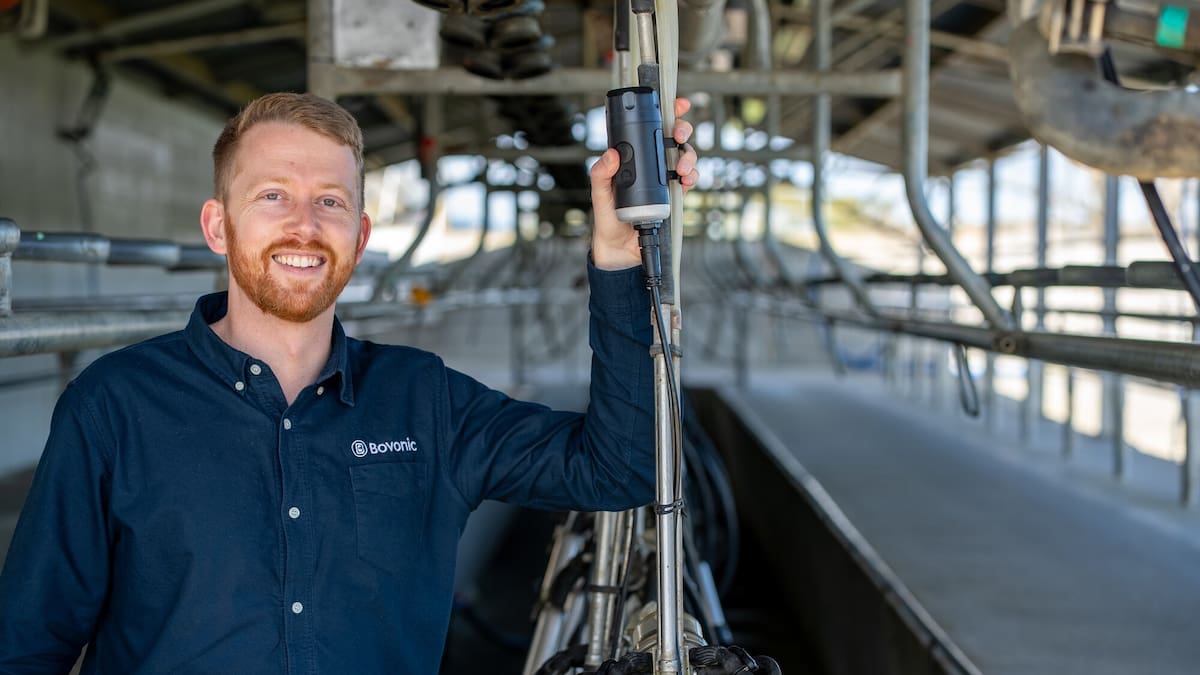
Bovonic pioneered QuadSense, a mastitis detection technology that incorporates a milking sensor in each cup liner, enabling individual testing of each quarter of a cow’s udder rather than the entire cluster.
Chief executive and founder Liam Kampshof said the system starts measuring milk as soon as the cups are attached, delivering results after just a minute.
“It can be installed by farmers into any milking cup liner and gives a red-light alert when mastitis is present.”
Mastitis – inflammation of the mammary gland (udder) in dairy cows – is the costliest disease in the industry, estimated at $180 million per year.
From a dairy farming background in the Bay of Plenty, Kampshof set up Bovonic in 2021 and launched the product in 2024.
Since then, he said, nearly 6000 units had been installed on around 250 farms across New Zealand, including the Bay of Plenty, Waikato, Taranaki, Palmerston North and Southland.
The sensors measure milk conductivity, detecting an increase in salt (sodium and chloride) concentration that occurs with infection, enabling early identification of both clinical and subclinical mastitis.
In a recent survey of 33 early users, 75% of farmers reportedly used fewer antibiotics, reported a 37% reduction in bulk SCC (somatic cell count) and saved more than 3.5 hours per week stripping cows.
Kampshof said early sales had now been secured in Britain and Ireland, and the company will look to ramp up sales throughout the rest of the year.
He has been based there since the end of last year and said the same conversations on mastitis detection had arisen as back in New Zealand.
“Same problem, same solution.”
While QuadSense is focusing on herringbone milking sheds for now, Kampshof said it was looking to develop a purpose-built version of the sensor for rotary sheds.
He said most dairy operations in Britain and Ireland use herringbone milking sheds.
The company is now being promoted by Farm Source, dairy giant Fonterra’s retail arm in New Zealand.
Helical
Meanwhile, Rotorua-based Helical is applying advanced mathematics, genomic science and cloud computing to modernise livestock breeding systems globally.
Led by chief executive Dr Dan Garrick, an aerospace engineer, the company has developed technology capable of processing billions of genomic data points to predict the genetic merit of animals.
Samples collected from livestock are analysed in laboratories and uploaded to Helical’s integrated database system.
Originally developed at Colorado State University in the United States, the technology was introduced to New Zealand as growing volumes of DNA data outpaced existing systems.
Helical business development manager Paul Charteris said the platform provided a single system for breeders, researchers and breed societies to manage animal records, DNA data and breeding performance.
The technology is now used across multiple sectors, including beef and dairy cattle, sheep, deer, pigs, aquaculture and forestry genetics, in countries such as Australia, the US, Canada and Britain.
Charteris said the system enabled faster and more accurate identification of desirable traits, including health, fertility, growth, environmental performance and product quality.
In the past 18 months, Helical has experienced a significant increase in global demand, driven by growing volumes of genomic data.
“This has positioned Helical as a next-generation solution for the global livestock industry,” he said.