
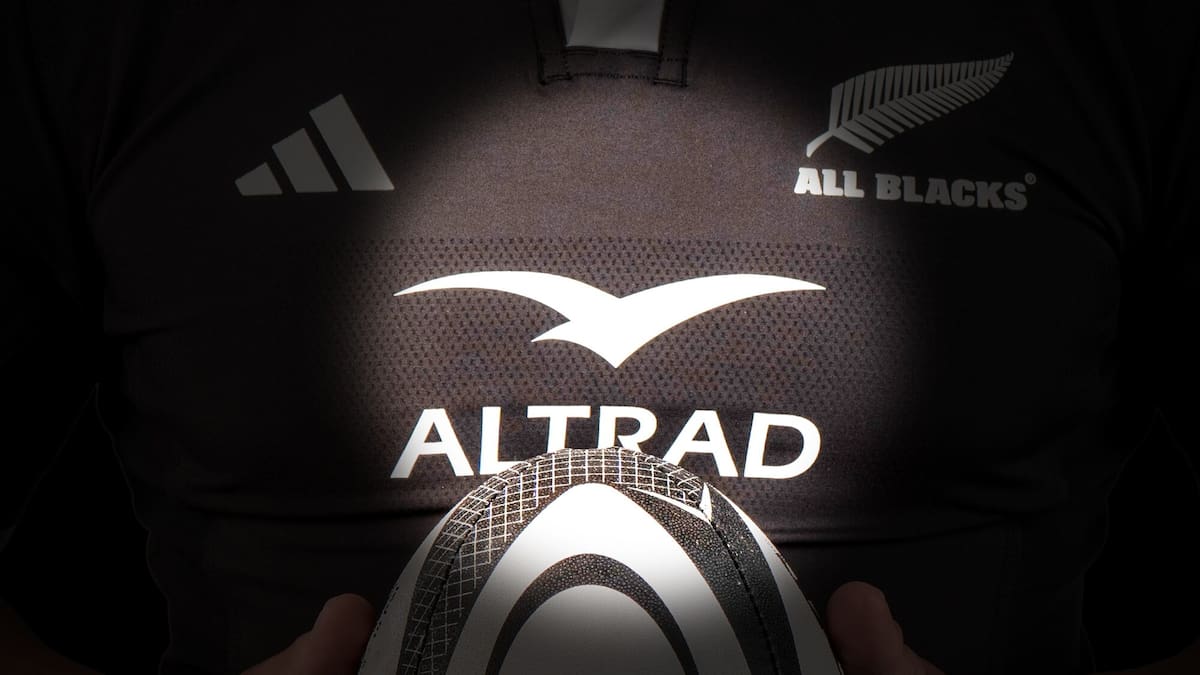
And it’s a saga that seemingly has no end, as last week French authorities announced they have opened an investigation into Mohed Altrad, the billionaire owner of the family of building service companies that take his name, over a suspected $700m-$800m tax fraud.
Ardie Savea will captain the All Blacks against France on Saturday night. Photo / SmartFrame
In France, the National Financial Prosecutor’s Office is investigating Altrad Group for suspected aggravated tax fraud and money laundering within an organised network.
The accusation extends to a belief that Altrad effectively used unpaid tax revenue to fund the company’s front-of-jersey sponsorship with the French national team.
This latest round of investigations comes after Altrad was found guilty of bribery and corruption charges in 2022, a decision he will appeal in court in March 2027.
And it also comes at a delicate stage in the process of NZR negotiating the future of the All Blacks’ front-of-jersey sponsorship.
A decision on whether to extend the deal with Altrad beyond the existing arrangement (which ends at the end of 2027) or sign with a new partner, has to be made no later than the end of this year.
Typically, a six-year, high-value contract (it’s worth $300m in total) such as the one Altrad signed, comes with a first-right, exclusive window to extend, and it’s likely that this period has either expired or is close to expiring.
NZR’s board will, therefore, likely soon have to make a call on whether to take the process to the open market or stay talking with Altrad – but with the danger that he loses his appeal hearing next year and/or faces more charges from the latest investigation.
The answer to this question seems entirely obvious – the reputational risk of an extension is too high to possibly contemplate, and that NZR’s board, unlike their predecessors, need to be less transactionally focused and more considerate of the long-term value of the All Blacks brand.
The All Blacks perform the haka before a 2025 match. Photo / Photosport
And it’s perhaps pertinent that Altrad is back in the headlines just as the All Blacks prepare to take on France in Christchurch.
Having France in Christchurch places the scandal in the heart of the country’s newest rugby citadel and makes it impossible to ignore, as the accusations of wrongdoing relate to the way Altrad acquired the naming rights to their jersey and now, how that agreement has been funded.
It is strange to see the same name appear on the jerseys of two top-tier nations, as most agreements tend to be exclusive, but it’s stranger still that both nations have steadfastly refused to end their association with Altrad.
NZR hasn’t said anything publicly to distance itself from Altrad or cast any kind of shade on the relationship – citing the ongoing appeal of the 2022 bribery and corruption case as the reason for its silence.
But the latest development has made it doubtful for how much longer NZR can hide behind the slow-moving wheels of the French justice system, without facing accusations of hypocrisy for continuing to take the money, and promote the association as one which pairs two like-minded and aligned partners with shared values.
Pious marketing statements to try to upsell the nature of sponsorship agreements have become standard fare in the sports business world and are hard enough to take seriously at the best of times.
In the case of Altrad’s $50m-a-year deal with the All Blacks, in my opinion there is no amount of re-imagining that should persuade anyone from thinking that NZR simply made an egregious money grab, and doesn’t want to let anything as inexpensive as ethics and principles disrupt the cashflow.
This is the cancel-culture age, where people are cut from public life for one misguided post about a celebrity’s outfit, and yet NZR hasn’t managed to raise so much as an eyebrow in response to Altrad’s continued legal escapades.
There has been no righteous indignation, because NZR can’t afford to be without the $50m.
It’s easy enough to tell the world that the All Blacks sweep the sheds and don’t tolerate dickheads, but a bit harder to take a truly empowering ethical stand and walk away from a cash pile of that magnitude.
Altrad, it is understood, offered considerably more than any other bidder in 2021 and NZR has been prepared to turn a blind eye to all the various legal investigations.
It’s possible that France’s grinding bureaucracy will prevent any of this spectacularly blowing up publicly during their six-year agreement.
The problem with failing to take a stand is that it becomes corrosive, because potential investors in the All Blacks inevitably start to wonder if the sales pitch is a long way removed from the reality of what they will be buying.
It has been a fine and uncomfortable line for NZR to walk – but ultimately a lucrative one – and perhaps they have been able to keep banking the cash in relative silence because there has been little ire from the New Zealand public.
This is the other strange part of this saga – the All Blacks jersey is supposedly a sacred, national icon.
But it has been tainted without a peep, and it doesn’t stack up that the country could agonise about whether to add another white stripe to the socks (when Adidas became the apparel partner in 1999) and stand mute while criminal investigations play out with Altrad.
It is hard to know whether the lack of outrage is ignorance, apathy, or an acceptance that with commercialisation comes an inevitable lowering of moral standards.
If it wasn’t the name of a billionaire being investigated for suspected tax fraud while appealing a bribery and corruption conviction on the jersey, it could be a fast food outlet making children fat or a bank funding the endless search for more fossil fuels.
The passive tolerance of Altrad’s name on the jersey has effectively made fans complicit in allowing the sponsorship to continue, and likely see out its full six-year tenure.
Gregor Paul is one of New Zealand’s most respected rugby writers and columnists. He has won multiple awards for journalism and written several books about sport.