

The passing of a comet from another star system gives scientists an opportunity to peer back into ancient history. Called 3I/ATLAS, the interstellar comet contains chemical signatures that originated in a distant star system, which might be older than our solar system itself.
During its passage through our solar system in December 2025, scientists made full use of a limited time window to analyze 3I/ATLAS.

As the Sun heated the comet’s ancient ice, it formed a coma, a bright cloud of gas surrounding the comet. Scientists then used their instruments to analyze the comet’s chemical makeup with great precision.
Surprisingly, the results reveal something remarkable. Scientists believe that 3I/ATLAS is possibly one of the oldest objects ever analyzed at such close range.
A messenger from another star system
Interstellar comets are exceptionally rare. Unlike ordinary comets that orbit the Sun, these objects come from outside our solar system. Scientists have confirmed only three such visitors so far, and 3I/ATLAS is the third.
The comet was first detected by the NASA-funded Asteroid Terrestrial-impact Last Alert System, or ATLAS.
After its discovery, researchers quickly arranged for the James Webb Space Telescope to observe it while conditions remained favorable.
Strange chemistry tells an ancient story
Researchers used Webb’s Near-Infrared Spectrograph, known as NIRSpec, to analyze the comet’s gases. What they found came as a surprise.
The instrument detected exceptionally high levels of deuterium, a heavier form of hydrogen. The amount was about 30 times greater than what scientists usually see in comets that formed around our Sun.
“This was a unique opportunity to study an ancient object from the distant galaxy, probably predating our Sun and solar system,” said the study’s lead author Martin Cordiner, an astrochemist at NASA’s Goddard Space Flight Center.
“On the one hand, we get direct insight into that distant time and place, and on the other, we learn something about how unusual our own solar system may be.”
Deuterium often serves as a record of the conditions under which ice formed. High concentrations usually point to extremely cold environments.
The measurements suggest that 3I/ATLAS likely formed in a deeply frozen region and remained cold for a very long time.
Born during a busy era of the universe
The comet’s carbon chemistry offered another clue.
Scientists found only small amounts of carbon-13 compared with the more common carbon-12. That matters because galaxies gradually accumulate more carbon-13 as generations of stars form, age, and die.
Lower levels of carbon-13 suggest that 3I/ATLAS formed very early in the history of the Milky Way. Based on the evidence, researchers estimate the comet could be between 10 and 12 billion years old.
That would place its birth during a period known as cosmic noon, when star formation across the universe was reaching its peak. During that era, galaxies were producing stars at much higher rates than they do today.
The evidence also points to a young star system surrounded by a cold, dense cloud of gas and dust. Conditions there may have preserved the comet’s original chemistry for billions of years.
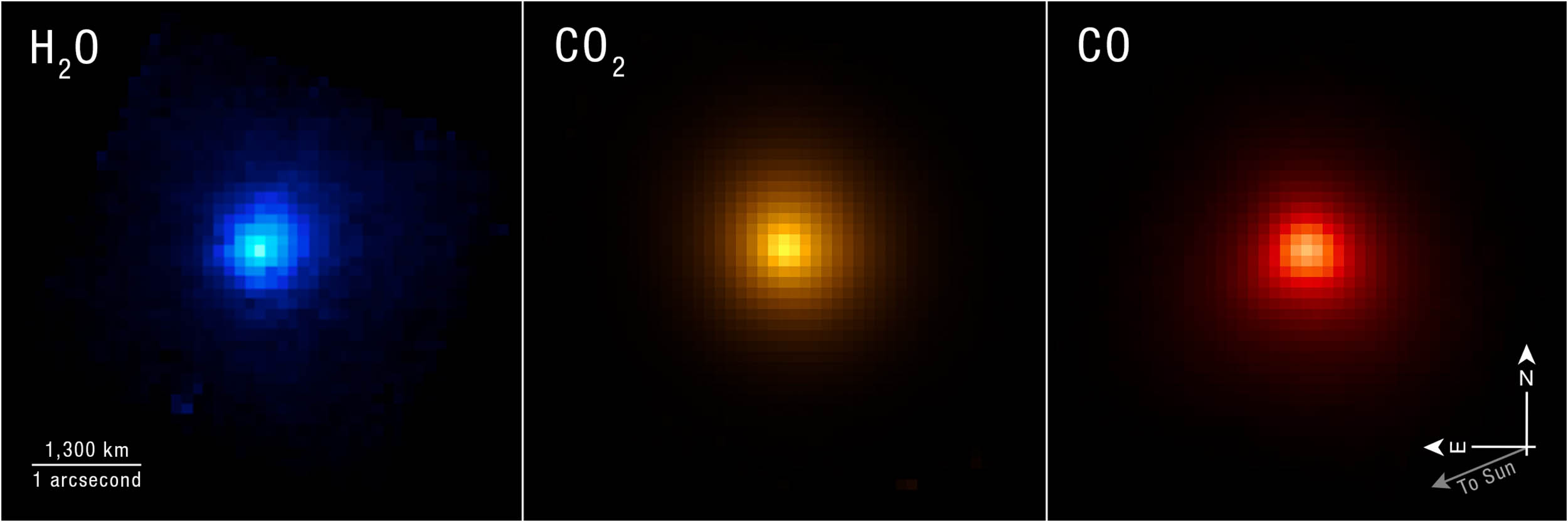 Researchers used the NIRSpec (Near-Infrared Spectrograph) instrument on NASA’s James Webb Space Telescope to map specific chemical contents of comet 3I/ATLAS as it moved away from the Sun. Credit: NASA, ESA, CSA, STScI, Martin Cordiner (CUA, NASA-GSFC); Image Processing: Alyssa Pagan (STScI). Click image to enlarge.Looking for the ingredients of life
The Webb observations are not the only effort to understand this unusual visitor.
A separate study led by astronomer Cyrielle Opitom of the University of Edinburgh used the European Southern Observatory’s Very Large Telescope to examine carbon and nitrogen isotopes found in cyanide within the comet.
Together, these studies are helping researchers understand how chemistry developed across different regions of the galaxy.
“For us as scientists, finding these rare isotopes is fascinating, but the bigger picture here is looking at the possibilities of prebiotic chemistry elsewhere in the galaxy,” said study co-author Dr. Stefanie Milam, a 9lanetary scientist at NASA.
“So far, we know of only one place in the vast cosmos where chemical ingredients led to life – our solar system, our Earth.”
“Analysis of these interstellar objects is a major step towards learning how common, or uncommon, the conditions for the evolution of life are in the universe.”
A rare chance that may not come again soon
Most comets studied by astronomers formed alongside the Sun about 4.5 billion years ago. 3I/ATLAS appears to come from a far older generation of stars and planets.
That makes it more than a passing visitor. It is a surviving piece of galactic history. Scientists may never know exactly which star system launched this ancient traveler into interstellar space.
Yet the chemical fingerprints it carried across billions of years have already revealed something remarkable. Parts of the galaxy were forming icy bodies long before our solar system existed, and some of those objects are still wander through space today.
—–
Like what you read? Subscribe to our newsletter for engaging articles, exclusive content, and the latest updates.
Check us out on EarthSnap, a free app brought to you by Eric Ralls and Earth.com.
—–