
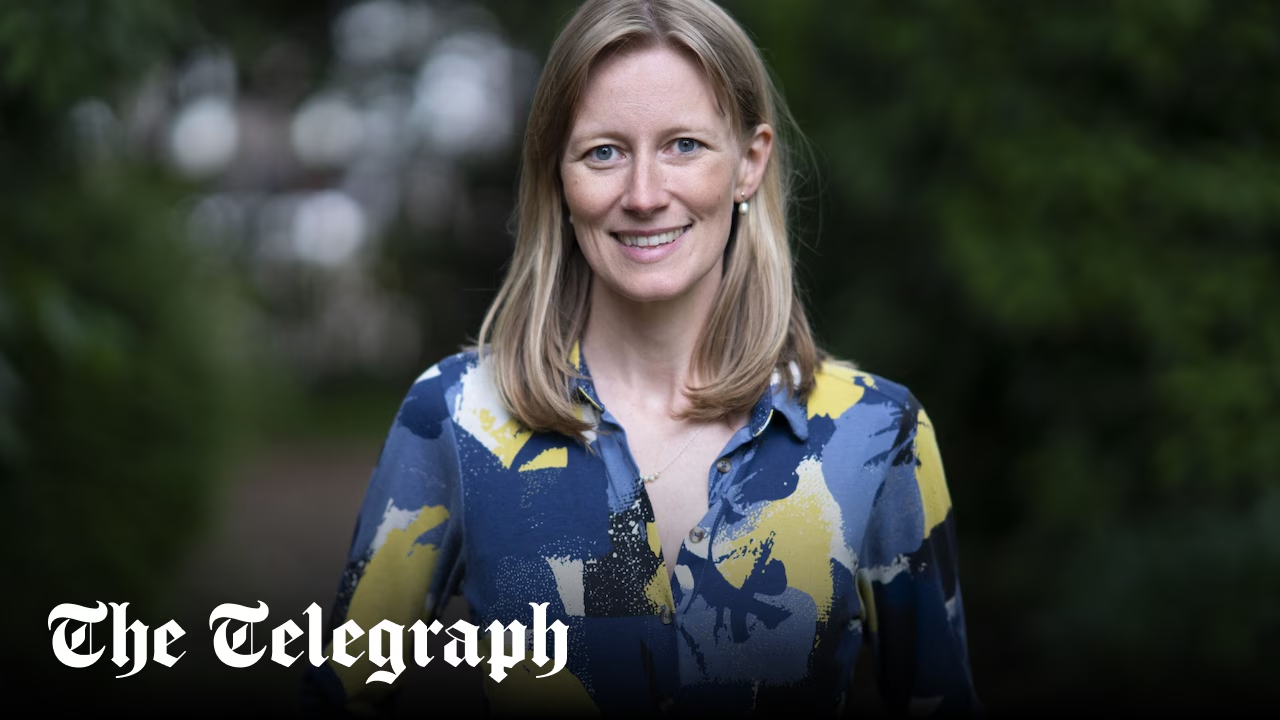
Daily participation in the arts is as important to health as getting five-a-day or 10,000 steps, one of Britain’s most influential scientists has said.
Prof Daisy Fancourt, of University College London, recently became the first ever associate scientist for the Royal Albert Hall, and is determined to prove that the arts are vital for well-being.
She recently published a paper showing that reading, listening to music or visiting a gallery or museum may slow the pace of ageing, but the effects of art engagement are vast, ranging from boosting mental health to lowering blood pressure.
“The message is that we need do something artistic or creative every day, even it’s only for a few minutes,” she told The Telegraph.
“When we regularly engage in the arts it’s actually a low-intensity psychological therapy, it increases neurotransmitters like dopamine that are involved in happiness, and reduces stress hormones like cortisol.
“Whilst we treat them like a luxury, my research over the last 15 years has just been consistently showing me that they are much more than that – it’s a human necessity.
“We’ve seen the effects of big campaigns like your five-a-day of fruit and veg and get your 30 minutes of activity and your 10,000 steps, but we’ve not had those same conversations about art.
“There’s not been the same idea that actually 15 or 20 minutes a day of doing something creative and artistic has benefits.”
Royal Albert Hall’s roots in science and arts
The Royal Albert Hall has teamed up with Prof Fancourt because it is keen to get back to its roots of promoting science as well as the arts.
It was originally intended to be called the Central Hall of Arts and Science, but the name was changed by Queen Victoria in memory of her husband, Prince Albert, who died six years before its completion.
Its full name is still the Royal Albert Hall of Arts and Science, and in the early years it hosted the first ever sci-fi convention, the Vril-Ya Bazaar and Fete, celebrating Edward Bulwer-Lytton’s novel The Coming Race.
The event introduced Londoners to Bovril, which was named after the Vril-ya in the novel, a subterranean race who draw life-giving energy from a substance called Vril.
Sir Ernest Shackleton and Albert Einstein both spoke at the hall, while doctors and scientists pushed the latest inventions of the time, from the electric light to Dr Macaura’s egg-whisk-shaped blood vibrator.
In 1930, the hall staged a centenary exhibition dedicated to Michael Faraday’s discovery of electromagnetic induction.
Closing the divide
Prof Fancourt said she hoped that, in her three-year tenure, she would be able to close the divide between arts and sciences.
“I don’t think anyone saw a divide until much more recently,” she added. “In early universities, people would study maths alongside music and astronomy, and that was Albert’s vision to have the two co-existing together.
“By the end of that three years, I want people to realise that science is part of that mission of the Royal Albert Hall. It’s making sure that programme notes are not just talking about the arts, but actually bringing in the science or the medicine, or whatever that’s relevant to the programming.
Prof Fancourt added that even if people cannot make it to the Royal Albert Hall there are small changes they can make to everyday life to boost their well-being through engaging with the arts.
“It can be anything you are interested in, and the science shows that you don’t even have to be very good at something to get the benefits, it seems to be about the participation.
“It’s finding those micro-moments across the day where you can be more present and creative.
“Instead of just meeting up with friends and going for a drink, perhaps you meet up and look at an art exhibition. It’s about being exposed to a lot of different experiences. That’s where the benefit lies.”