
Some families have made financial sacrifices or moved across the city to make sure their children can keep attending classes here, so what makes it worth doing that?
It’s the change they’ve seen in their children, parents say.
‘He’s a different kid’
Andrew Kingstone enrolled his 13-year-old son Jensen, who is dyslexic, at Summit Point because he had become “a number in the classroom” at his previous school.
“He’s become more actively engaged and I guess his outward confidence has grown since he’s been at the school here,” Kingstone says.
“He wasn’t able to hide behind 32 children in a classroom with the other four or five kids that didn’t want to learn. Jensen wanted to learn, but he was unable to because of his learning needs.”
Now, Kingstone says, “he’s a different kid”.
“He’s not in his shell, not nervous … it’s really good to see his confidence develop, engagement with the other students as well.”
While his sister Anya attends Hobsonville Point Secondary School, Jensen takes the bus to Summit from the family’s home in West Harbour. It’s an hour-long journey, but his dad says that’s helped build his confidence too.
It comes at a cost. The school accepts enrolments from Years 2 to 8, with annual fees of $17,000, while Year 9 costs $18,000 and Year 10 $19,000.
“Financially it’s tough. Certainly the other school was cheaper, but he wasn’t getting what he needed,“ Kingstone says.
“So yes, there’s a sacrifice in all of this to make the budget meet what’s required, but it’s certainly been beneficial for him and for us as a family. We can see he’s doing better and that was always the goal.”
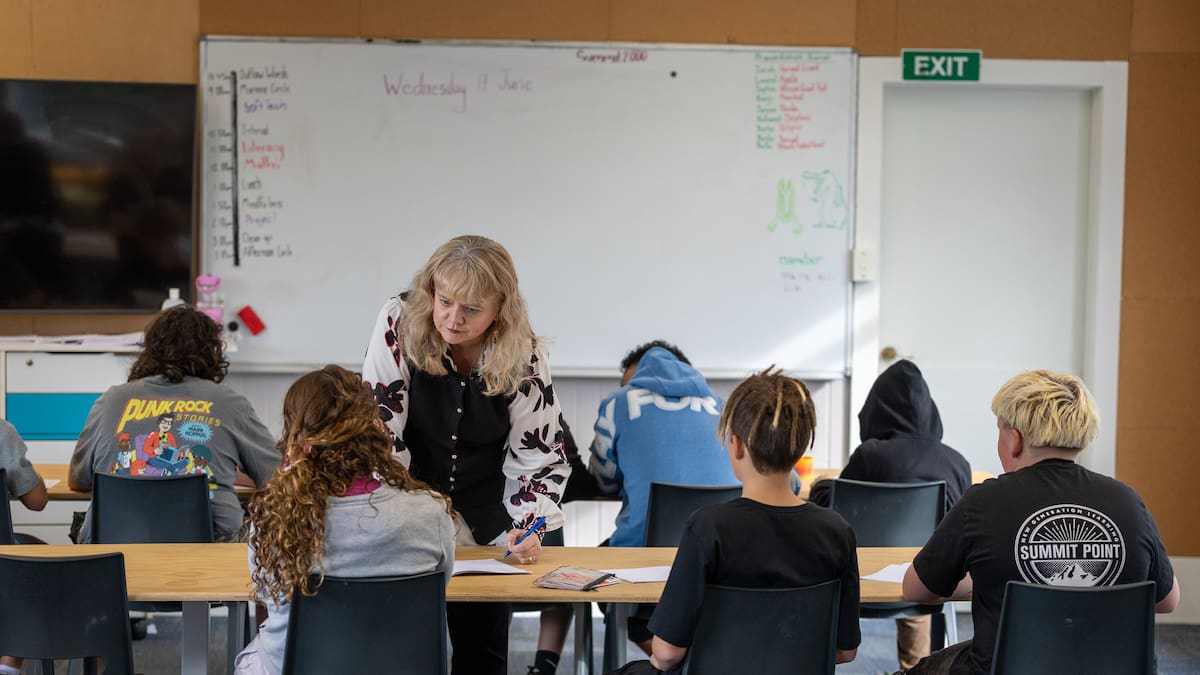
Inside a classroom at Summit Point School in Takapuna. Photo / Michael Craig
‘We wanted her to have the best chance’
Cara Willmoth says her family has “given up a lot” for her 12-year-old daughter Sophia to attend the school.
Sophia, who has dyslexia and auditory processing disorder, attended Summit’s day school before the family decided to completely change their lives so she could go there full time.
“In the beginning when I was driving her to [Summit’s] day school, it was about four hours of driving there and back in the morning,” Willmoth says.
“We decided to make it a bit more permanent. We were living out west and we pulled our big girls out of a West Auckland school and moved them to Takapuna so we could [all] be [in] Takapuna for Sophia’s school.”
Willmoth says the decision was a big one, but well worth it.
“We wanted her to have the best chance to address her learning differences and give her the best chance to go through her schooling and life.
“The fees are high, and it’s a shame [for] a school that is so important to her learning needs, that you need to pay essentially private school prices and I just wish that it was available to any child because the need is really, really high.”
She says like Jensen, Sophia’s confidence has also grown during her time there.
“The [teachers] take their time to make sure she understands things, and she definitely comes away feeling more positive and a bit more excited about school.”
Parents say they’ve made sacrifices to ensure their children can attend the school. Photo / Michael Craig
‘He’s not afraid to fail’
Thirteen-year-old Jacob’s dad says it felt like his previous school “sort of forgot about him”.
“Because he wasn’t on the same level as everyone else, he was quite far behind,” Matthew Northwood says.
Jacob, who is dyslexic and has ADHD, had some Kip McGrath tutoring sessions to support his learning, before the family discovered Summit three years ago.
“There’s no other school like Summit,” Northwood says.
“It’s interesting what you learn from the kids along the way, about how if they’re lacking in one area, how much that affects the overall child; how they feel about themselves, their confidence to pursue anything, because they don’t want to be wrong.
“If they think they’re stupid and they’re going to do it wrong, they won’t even try … these kids get this label of ‘they’re bad, they’re naughty’. No, they just learn differently and they can’t adapt if they don’t know [how].”
The biggest change he’s seen in his son is a new willingness to give things a go. Now, he will sit and read to his little sister.
“He’s not afraid to fail, that negative self-talk isn’t there. He wouldn’t be where he is now without Rebecca and all the teachers and what she’s done.”
The Education Review Office’s (ERO) Bridging the Gap report released on June 23 foundthe number of children leaving mainstream schools has doubled in the past decade, with many of them going into alternative education.
The ERO is calling for reform, both to strengthen mainstream schooling and to develop a new model of alternative provision, as the quality of non-mainstream schooling options can vary.
Parents say their children’s skills and confidence have grown since they have been attending the school. Photo / Michael Craig
What Summit Point does differently
In state schools, class sizes can vary, though the Ministry of Education has set entitlement staffing ratios, meaning schools are funded for one teacher per 15-28 students, depending on year level.
At Summit Point, class sizes are capped, with one teacher per 10-14 kids.
Here, kids are grouped according to ability, meaning each class spans different ages, and the classes are named after the maunga, such as Mt Tongariro or Mt Ruapehu, rather than for traditional year levels.
This means no one feels like they’re behind because they’re the oldest in the room, while those who are learning ahead of their year level aren’t being held back or getting bored.
The curriculum is designed to allow children to explore their interests at the same time as furthering their academic progress.
Each year, lessons follow an overarching theme; in 2026, the theme is survival. Across the school terms, students learn about that concept in myriad ways, through science, literacy topics, practical projects and other lessons.
The Summit Point school day is three-stranded. The first part is experiential or hands-on: think music, arts, science, PE. The second block is instructional, focused on structured literacy and numeracy, while the afternoons are spent on projects in which the kids work on showing their knowledge through their chosen format.
Older or more independent learners will present an exhibition or project at the end of the term, while the younger or less independent kids will complete multiple smaller projects throughout the term.
The school day starts with experiential learning, before blocks of structured literacy and numeracy followed by practical projects. Photo / Michael Craig
There’s a focus on holistic wellbeing, too.
Summit uses the Zones of Regulation system, which categorises feelings into different colour-coded zones to help children learn how to identify and regulate emotions. And quiet time after lunch involves practising breathwork and mindfulness to reduce stress and improve focus.
Observing a literacy class of 10 kids, it’s clear to see how that approach can help create a calming atmosphere in the classroom. There are few visual distractions, with furniture and décor in muted, natural colours designed to help regulate rather than over-stimulate.
Slower pacing means teacher Marion Littin has time to go over questions and writing exercises with each student. If they get something wrong or need extra help, there’s encouragement to try again, or look at it in a new way.
The school’s approach to literacy is adapted from the Orton-Gillingham method, which breaks down reading, writing and spelling into letters and sounds and teaches the rules, patterns and different parts of language. It was designed primarily to teach children with dyslexia.
Similar techniques are employed in the structured literacy approach mandated by the Government as part of a wider curriculum overhaul for state schools; this took effect at the start of 2025.
Summit students practise Outlaw Words – those that don’t follow the rules – separately, at the start of the school day.
The classrooms are furnished in natural rather than bright colours to avoid over-stimulation. Photo / Michael Craig
“A lot of my children are twice-exceptional, which means although they may have learning difficulties, they also have amazing strengths,” Littin says.
“I think one of the great things about working here is the opportunity to really show those kids how to blossom with what they’re good at.”
The key is getting to know and spend time with each child, which she says can be difficult in a mainstream environment with bigger class sizes and less individualised support.
“A lot of the children benefit from you sitting with them and going, ‘let’s do the first part together’, or ‘let’s just talk about the first step’.”
Summit staff undergo professional development on executive functioning, ADHD, attentional and emotional regulation, and online professional development courses with mainly US-based specialist schools.
A teacher of 25 years, Littin has spent most of her career in mainstream primary schools.
“So there’s a lot of different teaching approaches that I get to use in this setting because we’ve got the time and the space to do it.”
She adds it’s important to keep the learning relevant to the kids you’re teaching.
“If they’re not into it, they will tell you, so you need to make it interesting and relevant. It raises the bar for you as a teacher because you can’t just do any old thing, it’s got to match their level and their interests and where they’re at in their learning.”
It’s not just the class sizes that can make a difference, principal Elias says. Environment plays a role, but it’s more about understanding each individual child’s needs and abilities.
“You can have a small class size in other schools and not adequately support kids like ours. It’s really looking at the strengths as opposed to what kids can’t do … nothing’s a barrier.
“There’s no, ‘You can’t do this, so we’ll dumb this down’. We look at their entire cognitive profile and go, ‘We can accelerate you in this area and we need to support you in this area’.”
At Summit Point, structured literacy is taught using the Orton-Gillingham approach. Photo / Michael Craig
Dr Karen Waldie is a neuropsychologist and professor of developmental neuropsychology at the University of Auckland whose research led to dyslexia being formally recognised by the Ministry of Education in 2007.
She says specialist schools can be beneficial for children with learning differences like dyslexia.
“From the perspectives of a brain researcher and a parent, the main pro would be that in a specialist school, kids can feel a sense of togetherness – which benefits self-esteem – that might not be available in a regular school if they have learning differences.”
Elias knows this from a personal perspective. She is dyslexic and has ADHD, and left school at 15, attending design school before studying teaching and going on to teach graphic design.
What she saw in her early years of teaching led her to study learning differences, and she went on to obtain her Master’s and to research and observe specialist schools in the US that use the Orton-Gillingham method.
Determined to bring this approach to New Zealand, she started a holiday programme that turned into a day school, trialling a new curriculum she’d written with a colleague.
Then came the search for a building to house the school. Turned down for government funding, she approached the Catholic Schools Office and leased a classroom in an unused building.
The Summit Point School buildings in Takapuna. Photo / Michael Craig
Previously, the Friedlander Foundation, a private philanthropic trust set up by Sir Michael Friedlander, funded 30% of the school’s roll. That funding ran out at the end of 2025, meaning there is no longer any financial support available to students who can’t afford the fees.
Earlier this year, the school was acquired by Crimson Education. It’s now managed by Crimson Academies, which runs the company’s online and physical schools – it also owns Future School in Takapuna, formerly known as the AGE (Academy for Gifted Education). Crimson plans to renovate Summit and to use some of its teaching methods in its other schools.
The acquisition means the school has a future, Elias says.
“It’s been quite an amazing process, just knowing that we’re not going to shut down, and being able to offer what we do and help support the wider Crimson network with our literacy support for neurodivergent children.”
Many past Summit students are now in their final year of university, she says, or have gone on to thrive in mainstream high schools.
Today, there are about 40 fulltime students on the roll, and Elias says the day school numbers are rising. She says it’s a viable option for parents balancing rising living costs with their children’s educational needs, and those needs are increasing.
“The commitments that the current Government’s making in terms of the landscape of educational support for kids with numeracy and literacy [are] amazing, because New Zealand needs it.”
Principal Rebecca Elias says Summit Point’s day school numbers are increasing. Photo / Michael Craig
But some children won’t cope with those changes without tailored support for neurodiversity, she says.
A spokesperson for The Education Hub, a registered charity connecting Kiwi teachers with education research, says, “While we are aware that a great deal of work is being done in this area, and we know that many teachers are working extremely hard to build their knowledge and understanding of how best to support neurodivergent students, there is still a lot of room for improvement.
“A comprehensive national strategy for supporting neurodivergent children and young people in schools and early childhood settings, and funding for targeted professional development, would be valuable.”
Elias says: “We’re seeing more kids than we ever have before with really intense anxiety and really complex behavioural profiles.
“I’m ADHD, I know exactly what it’s like to live as an ADHDer, and it is hard trying to fit in a world where you’re expected not to.
“I think we as a school serve the needs of those children really well in a holistic way, understanding there’s a difference between learned and pathological, what we can control and what we can’t.”
Therein lies the “real magic in what we do”, she says.
And it’s not about avoiding labels.
“Why not feel empowered to say, ‘I’ve got dyslexia and ADHD. I may do these things. It would be great if you learnt how to understand me a little bit more’? Because then people are more tolerant and patient.
“I don’t believe removing words that align with our profiles and behaviour and the way that we’re made is advantageous to anybody.”
Bethany Reitsma is a lifestyle writer who has been with the NZ Herald since 2019. She specialises in all things health and wellbeing and is passionate about telling Kiwis’ real-life stories.