
The couple’s property is among 240 that lie within the busway’s designated route and will likely be torn down to make way for the multibillion-dollar transport project.
The Herald reported last month on the plight of residents in nearby Ivanhoe Rd, where one side of an entire street is set to be bulldozed to make way for a busway interchange at Western Springs.
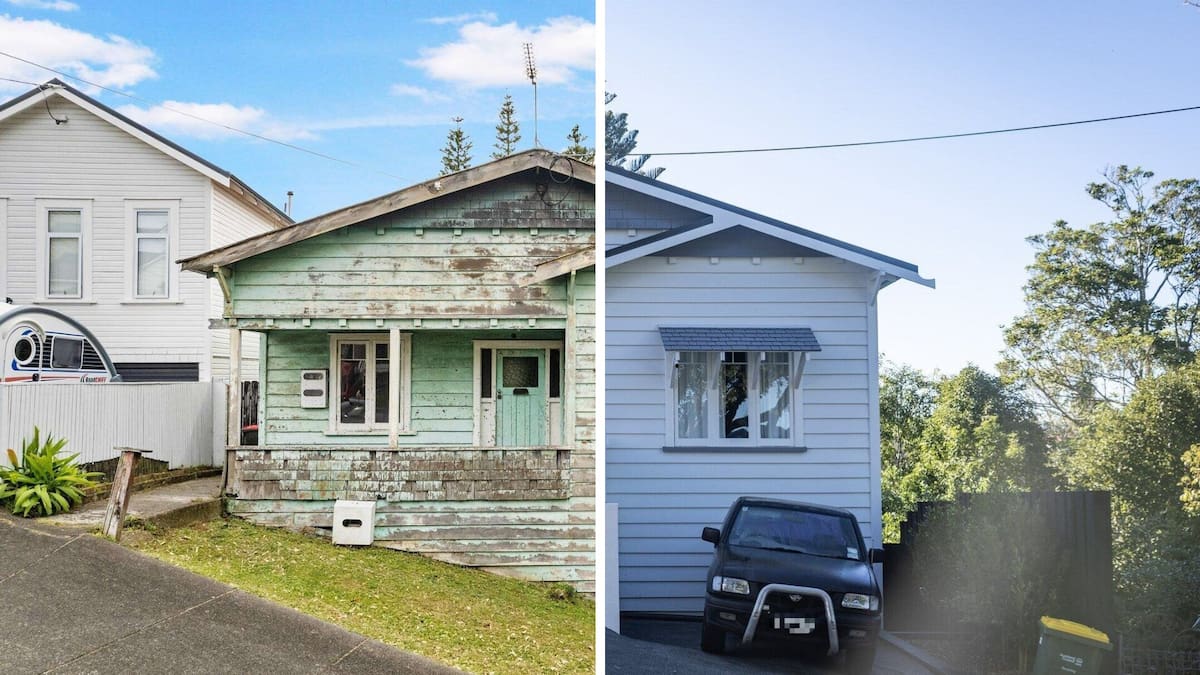
This house at 36 King St, Grey Lynn, was bought last year as a dump, but has since been extensively renovated. It is now on the market, but potential buyers are being warned it is required by NZTA for the Northwest Busway. Photo / Dean Purcell
Howard said the King St couple were faced with an unenviable choice: either wait up to 10 years to be bought out by Waka Kotahi – New Zealand Transport Agency (NZTA) when construction eventually begins, or get on with their lives by bringing the process forward and finding a new home.
They chose the latter.
But Herald inquiries have revealed curious features about the process, which one commentator has labelled an absurd waste of money for those already reeling at losing their homes.
Land owners who don’t wish to wait for the compulsory buyout process can ask the Crown agency that requires their property to expedite the purchase via the Environment Court.
But to do so, the owner must list the home for sale and market it as if its value was not “blighted” by the notice of requirement now attached to its title.
Howard said his clients had spent $5000 on a full marketing package, paid for professional photography, and listed the property on major real estate websites – all in the full knowledge that no one would buy it.
“Charm with old-world soul,” the listing reads.
“Character, comfort and location come together seamlessly in this classic Grey Lynn bungalow. Homes of this calibre, in such a tightly held position, are always in demand.”
The King St home was modernised before its current owners learned that it was required by NZTA to make way for the Northwest Busway. Photo / OneRoof
The listing ends with a note that the entire property is subject to an NZTA designation notice and potential buyers should seek legal advice.
“I’ve had a lot of inquiries,” Howard told the Herald.
“There’s been a lot of hits on the website. Everyone who hasn’t read the real estate ad fully rings me up and wants more information.”
But after being made aware of the busway notification, “there’s no further interest”.
Howard said the rules meant that vendors, despite facing forced Crown acquisition, “had to be seen” to actively market their homes.
“You can’t just put it on Trade Me for $198 and [say] ‘That’s all we’re going to do’, because you’re not exposing it to the wider market. It’s crazy.”
The dilapidated state of the house when it was bought last year for $900,000. Photo / OneRoof
Asked what would happen if clients didn’t bother with the “charade”, Howard said the Crown would say: “You haven’t tried to properly market it. You’ve just pretended to. We’re not going to buy it off you because you’re not being genuine.”
He said the situation was a requirement under the Resource Management Act (RMA) and a law change was needed.
Howard has represented several other owners in similar predicaments (see more on this below).
He was loath to charge the King St owners too heavily for his services given the likely buyer – NZTA – was effectively already known.
“What I do in that situation is I just charge an hourly rate. There’s no way I can honestly put my hand out and say, ‘You’ve got to pay me $45,000 commission’.”
‘Reasonable efforts to sell’ – NZTA responds
NZTA said the busway would be built in stages, with some properties not expected to be required for 10 years or more.
It was not feasible to buy every property as soon as it was identified for acquisition, with purchases usually occurring about two years out from construction.
“Early acquisition is typically limited to cases where there is compelling need driven by the land owner.”
There was no requirement for affected home owners to list their properties for sale or undertake a marketing campaign if the Crown was making the purchase approach.
If a land owner wanted to compel NZTA to buy their property earlier than required, they could do so through the Environment Court.
“The court must be satisfied that the land owner has made reasonable efforts to sell the property but has been unable to do so due to the designation.”
Owners whose properties were compulsorily acquired were compensated in line with the Public Works Act, which ensured they were “no worse off”.
This included paying market value, which is independently assessed as if the designation affecting the land was not in place.
The Crown would also pay reasonable legal, valuation and relocation costs, and one-off disturbance costs for things such as new school uniforms.
“These costs recognise both the financial and personal impacts of acquisition and help support land owners through the process,” NZTA said.
“We understand the uncertainty designations can create and are committed to working closely with affected land owners … and seeking fair, reasonable outcomes wherever possible.”
Kumeū couple spent thousands ‘tarting up’ house knowing NZTA planned to pull it down
Howard said he’d handled similar cases in Kumeū, where NZTA was acquiring properties for a State Highway 16 bypass.
One particularly sad case involved an older couple who bought a sprawling rural property on Pamona Rd.
They spent years building their dream home, which included a schist house, outdoor pool, spa and petanque court, before learning it would be taken by NZTA and “ripped down” to make way for a wetland.
An Auckland couple spent years building their dream home at Pomona Rd, Kumeū, before learning NZTA needed to compulsorily acquire it to make way for a wetland. Photo / OneRoof
Not wanting to wait for the compulsory buyout, the devastated couple spent tens of thousands of dollars “tarting up” a neighbouring house where they lived during the build.
They then listed both properties for sale, knowing the exercise was futile and that NZTA was the only viable buyer, Howard said.
“We renovated the house they used to be in to make it more saleable and had it dressed and everything. They spent a fortune. They repainted it, had gardeners in and extended the decks.”
The couple “didn’t want to take any shortcuts” and felt compelled to do the work to ensure NZTA brought forward the acquisition.
“They knew it was unsaleable, but they had to prove it was unsaleable.”
Inside the property on Pomona Rd, Kumeū, that was purchased by NZTA in 2024 to make way for a SH16 bypass. Photo / OneRoof
Howard said NZTA eventually paid out nearly $6m for the two properties, with the deal settling late 2024.
The man died eight months later, and his wife is now in a rest home.
“They were in there a couple of years, and then this came about and turned their life upside down.”
While the process was traumatic for people losing their properties, Howard said NZTA paid fair compensation, which included recognition of “distress”.
“So they’re not just ripping people off.”
Crown has ‘stacked deck’, advocate claims
Daniel Ratahi is director of Public Works Advisory, which assists owners whose properties are earmarked for Crown acquisition.
He said the process was “highly stressful” for affected land owners. His firm was currently representing several people whose properties were being acquired for the busway project.
A compulsory acquisition involved valuations, building reports and could also mean commissioning consultants to assess the development potential of a property to ensure owners received top dollar during negotiations with the Crown.
“We help our owners navigate that process,” Ratahi said.
He said the Crown had a “stacked deck” when taking homes under the Public Works Act, with taxpayer-funded access to top legal advisers and consultants.
After a notice of requirement was received, it could be 15 to 20 years until construction began and the Crown began purchase negotiations. There was no certainty for owners, Ratahi said.
Some owners would therefore want to expedite the process through the Environment Court. Ratahi said they may be in financial hardship or need to free up money for medical treatment.
In those cases, forcing owners to list their homes and pay huge marketing costs to prove they had made reasonable efforts to find a buyer was a “complete waste of money”, he said.
Lane Nichols is Auckland Desk Editor for the New Zealand Herald with more than 20 years’ experience in the industry.
Sign up to The Daily H, a free newsletter curated by our editors and delivered straight to your inbox every weekday.