
“He agreed to sell it as long as I guaranteed never to take it to the scrapyard, and I said I had no intention of doing that.”
This particular D8 2U had been owned by McBreen Jenkins contractors in Northland and would have been imported from the United States in the early 1950s.
“These bulldozers carried out the earthmoving for building roads, dams and everything in between,” Bright said.
“They were used to build the early infrastructure of New Zealand.
“You could park them in the bush and return 12 months later, and they’d still start easily.”
Unlike the air-conditioned machines of today, with electronics and computer technology, Bright said you knew you had done a day’s work on one of these 23-tonne beasts.
They have no battery to go flat, no lights to damage and no hydraulics to fail.
“The 23hp petrol starter engine was started with a crank handle,” he said.
“You’d engage the clutch, and the main diesel engine would start up.”
The D8 2U engine is a D13000, has six cylinders and produces 185hp at 1200rpm (full load).
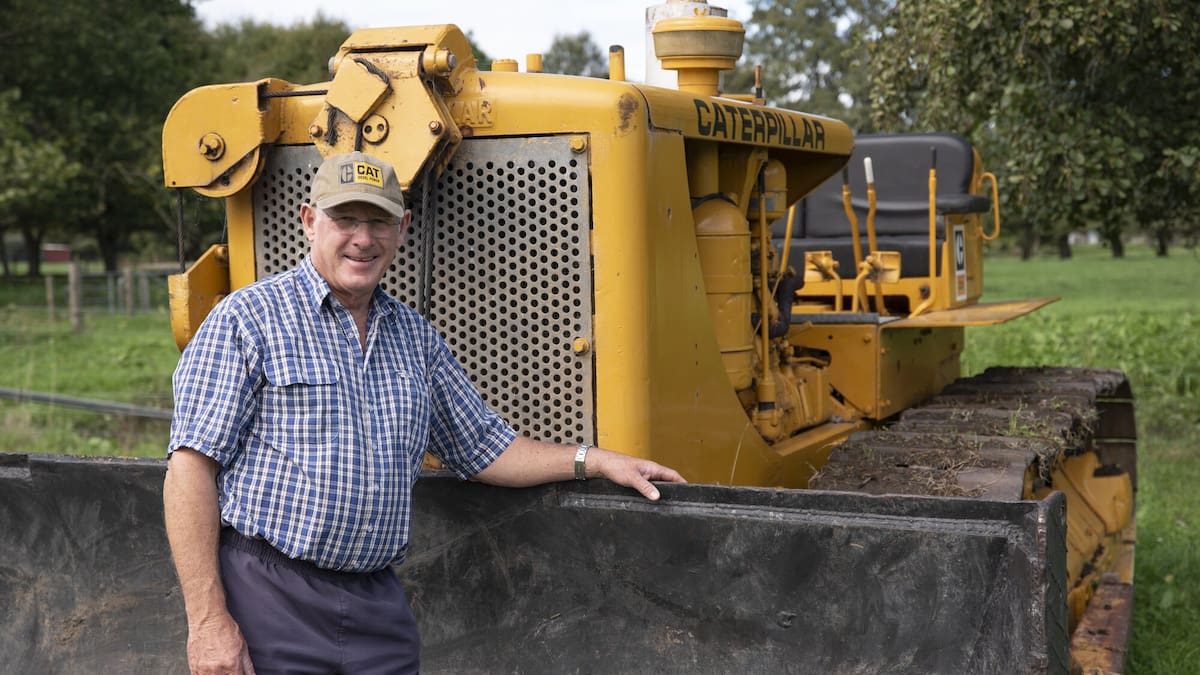
Vintage machinery collector Scott Bright with his 1953 Caterpillar D8 2U. Photo / Catherine Fry
The engine displacement is 1246 cubic inches.
The bore and stroke are 5.75in by 8in.
It has five forward and three reverse gears, and has a top speed of 7.2 miles per hour.
The Caterpillar D8 2U has no electronics to go wrong. Photo / Catherine Fry
“The steel blade weighs around 2.5 tonnes,” Bright said.
“It’s 3.5 metres wide and 1.1 metres high with a maximum draw bar pull of 44,840lb.”
The blade is operated by a wire-cable and pulley system (similar to a winch), which runs off the engine.
Driving the 23-tonne D8 2U was is a heavy manual job. Photo / Catherine Fry
The D8 2U maintains full power to the tracks during tight turns.
Bright uses the Caterpillar on his land, but he doesn’t want to overwork it, as he feels it’s deserving of retirement.