
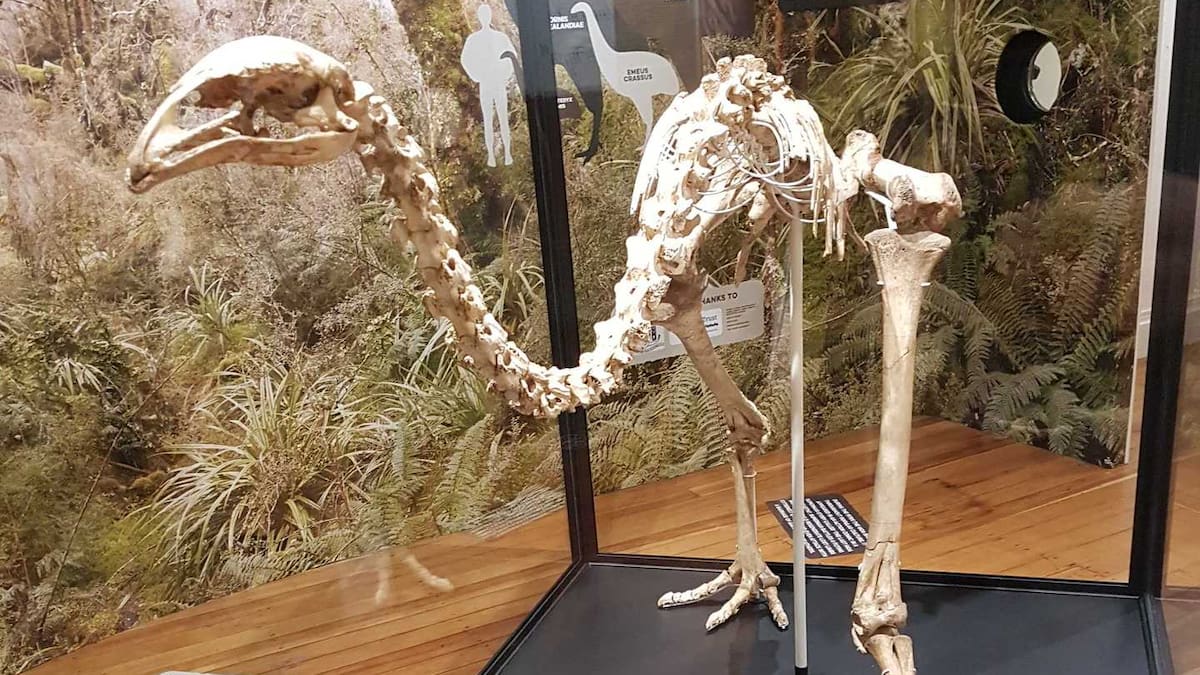
Moa were known to Māori long before Europeans arrived, but the first European discoveries of moa bones in New Zealand occurred in the 1830s.
When Europeans found these unusually large bones, scientists realised they belonged to a giant flightless bird that had become extinct.
Moa bones are still being discovered today in caves, swamps, dunes, and old river deposits around New Zealand.
Some of the most famous finds have come from places such as Pyramid Valley in Canterbury, and there have been many finds in Hawke’s Bay.
Below is a selection of historical stories from the New Zealand Herald (1913), the Central Hawke’s Bay Press (1939) and the Hawke’s Bay Herald-Tribune (1947).
Finds of moa bones
New Zealand Herald, January 31, 1913
Two finds of moa bones are reported from the South.
An almost perfect specimen of a moa, 10ft high, was recently unearthed on the Takaka Hills (Nelson) by Messrs L. Cook and R. J. Stevenson.
Portions of a moa egg were also discovered.
The find is a valuable one by reason of the size of the specimen and its completeness, although it is not the first occasions on which remains of the moa have been found on the Takaka Hills.
The prison workers who are quarrying at the foot of Coote Road, Napier, unearthed some moa bones a few days ago.
These, which belonged to a large specimen, were lying on the limestone under the surface soil on top of the face.
Not long ago another find was made in a cutting commenced at the north end of Shakespeare Road.
There, however, the bones were found at some distance from the surface and beneath a band of pumice sand.
Wellington resident finds moa bones under his house
Central Hawke’s Bay Press, April 28, 1939
(Per Press Association).
Wellington, Last Night.
Digging under his house in the suburb of Seatoun, Wellington, Mr. N. W. Thomas came across the bones of a moa buried in the sand.
They were in an excellent state of preservation and have been identified by Dr. W. R. B. Oliver, director of the Dominion Museum and an eminent authority on moa bones, as those of one of the larger species.
Mr. Thomas has presented them to the museum.
Mr. Thomas came across the bones at a depth of nine feet.
They comprised a complete skeleton of either leg of the bird, except the toe-bones and part of the pelvis and were in remarkably good order.
Within a few feet were found several vertebrae of a blackfish.
The bones were found on the site of an old pa, and the absence of the rest of the moa and the presence of the blackfish bones indicated that it had been used for food.
These are the first moa bones from the district, although moa bones were found formerly near Miramar golf links at a promontory consequently named Moa Point.
They form an interesting addition to the museum’s collection of moa bones, mostly from the East Coast, Martinborough, the Conoor Caves and the Te Aute swamp.
Finds of moa bones prove disappointing
Hawke’s Bay Herald-Tribune, September 17, 1947
A search party from the Hawke’s Bay Museum investigated the finds of moa bones at Taheke and Matapiro recently, but apart from digging up several leg bones, nothing of real moment was unearthed.
The party comprised Dr. K. E. Crompton, the Rev. F. H. Robertson and Mr J. D. H. Buchanan, Havelock North.
They were disappointed with their find at Taheke where they unearthed one whole leg bone and half of another leg of one of the largest types of moa, known as the giganteous moa.
The remainder of the bones had disappeared.
The party then transferred its operations to a reported find at Matapiro, but here they came across only portions of leg bones of the next largest type of moa, the ingens moa.
“What we really wanted is a complete skeleton of a moa,” stated one member of the party, who explained that finds of moa bones were fairly frequent, and the museum had many bones of various types but no complete set.
– Source: Papers Past