
Foy said a nationally funded, nationwide digital platform was essential if councils were to efficiently prepare and implement the new post-RMA planning framework.
A nationwide online geospatial mapping platform would form the universal digital backbone for regional spatial planning, allowing councils and agencies to combine data on growth, infrastructure, environmental, hazard and cultural aspects into a single interactive map.
Different versions of such platforms are already used by individual councils.
“But at the moment, different council plans use different digital mapping systems that don’t talk to each other,” Foy said.
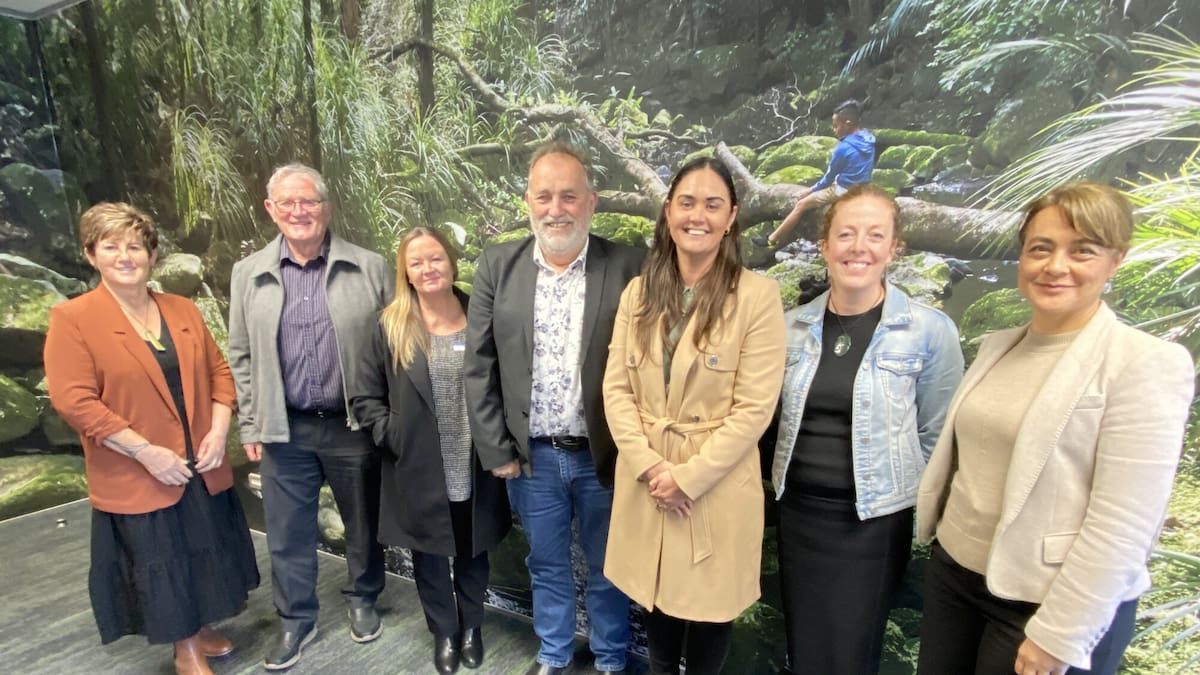
The first meeting of the Northland’s new governance-level Resource Management Joint Committee at the Northland Regional Council offices in Whangārei on June 29. Photo / Susan Botting
Failing to create a nationwide system risked recreating existing inefficiencies on a larger scale, she said.
RMA Reform Minister Chris Bishop said the Government was investing $41 million over the next two years for the first phase of a national digital foundation, including national data standards, an e-Plan viewer and core system architecture to support the future planning framework.
A further $61m would be spent over four years on environmental data to support the post-RMA planning system.
Government officials were developing common geospatial data standards and expected to provide local government with guidance and support for their adoption.
“Independent analysis has shown that investment in better data and digital systems could unlock up to $5.3 billion in economic growth over 30 years by making planning and decision making faster and easier,” Bishop said.
The Northland spatial plan will identify where housing, infrastructure, industry and environmental protection should be prioritised.
Foy said Government funding was needed to set up the universal platform supporting the plan, rather than expecting ratepayers and their councils in a rates-capped world to pay.
RMA Reform Minister Chris Bishop. Photo / NZME
Bishop said no decisions had been made on whether councils would be expected to contribute to implementation costs.
He did not reveal the total projected cost of developing the national digital infrastructure.
“The ultimate cost will depend on the precise scope of digital transformation of the new planning system,” Bishop said.
“While we have clearly signalled the intent to move towards a nationally consistent system, there are still a range of choices to be made by Cabinet about which elements of the system to digitise and on what timeframe.”
Foy, who is also a member of Northland’s Local Government Reform Elected Members’ Steering Group, said the development of a regional spatial plan overlapped with discussions about the future structure of local government.
The many plans across Northland’s four councils that currently underpin resource management use in the region. Photo / Susan Botting
At Monday’s meeting, Whangārei District Council District Plan manager Yvonne Masefield said looming council amalgamations and the new Northland Waters chief commercial officer could disrupt the required tight spatial plan delivery timeline.
She said the approach to Māori participation in developing the spatial plan needed to be agreed upon early, across all four participating councils.
The new Northland spatial plan will identify where housing, infrastructure, industry and environmental protection should be prioritised.
It is expected to align land use, transport, infrastructure, economic development and environmental management across the region – rather than the four councils having multiple, overlapping planning documents.
Kaipara Deputy Mayor Gordon Lambeth has been elected deputy chairwoman of the Resource Management Joint Committee.
The eight-member committee also includes Whangārei District councillors Tangiwai Baker and Crichton Christie, Northland Regional councillors Geoff Crawford and Amy Macdonald, Far North District Deputy Mayor Chicky Rudkin and Kaipara councillor Rachael Williams.
■ LDR is local body journalism co-funded by RNZ and NZ On Air.