
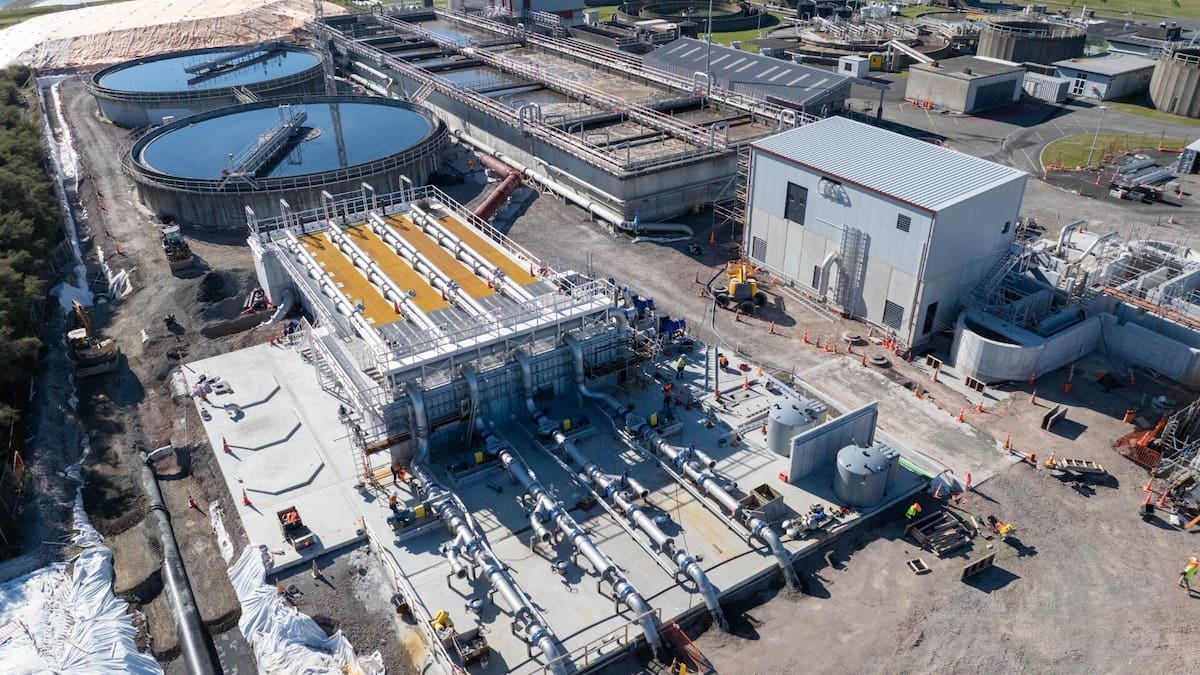
“On a peak day, during storm events, that can now go up to 72,000 once the upgrade is completed,” he said.
That represents a 64% increase in peak capacity.
The system screens, biologically processes and uses membrane filtration and UV disinfection to produce highly treated recovered water.
The initial stage includes filtering out foreign material such as wet wipes which, combined with other non-biodegradable products, can cause masses known as “fatbergs”, clogging the system and causing sewage overspills.
Wipes and other unwanted material is filtered out, to avoid blockages in the water system. Photo / Mathew Nash
In May, Rotorua Lakes Council said it had 48 “dry weather overflows” over the past 12 months, of which about half were caused by “fats and rags”.
The water that arrives at the plant is a smelly brown liquid made up mostly of water from showers, washing machines and toilets.
But the final output is a fairly odourless and clear fluid.
Wastewater treatment specialist Jason Ewart shows the new membranes that filter out materials from Rotorua’s wastewater. Photo / Mathew Nash
“There is a little bit of colour in there, almost a slight yellow tinge,” Ewart said.
“When you put it in a glass beaker, it looks like sauvignon blanc.”
The upgraded process is expected to significantly improve treatment levels, reducing nitrogen from about 5-6mg/L and phosphorus from around 3-4mg/L down to much lower levels – an overall reduction of about 94%.
E. coli counts are expected to drop from roughly 5400 per 100ml to less than one per 100ml, driven by UV disinfection.
The treated water, which the council calls recovered water, will still not be suitable for drinking despite its wine-like appearance.
Ewart said the upgraded facility had been designed with backup systems throughout the treatment process.
“We always have one spare item for redundancy.”
Wastewater at an early treatment stage. Photo / Mathew Nash
He said two standby diesel generators would automatically start if the mains power supply failed, allowing the plant to continue operating.
The project also aims to make it easier for treated wastewater to be reused.
“We really wanted to remove that barrier,” council environmental manager Alison Lowe said, with the higher standard of treatment now making that a possibility.
Lowe said the council could apply for consent to allow the treated water to be reused for non-drinking purposes.
The plant produces almost clear, yellow-tinted water at the end of the treatment process. Photo / Mathew Nash
Lowe said the project addressed several objectives, including capacity for growth and to deal with storms.
She said the upgrade would also improve phosphorus removal and add a disinfection stage.
As part of the upgrade, existing clarifier tanks will be converted into storage to help manage peak flows during heavy rain before the wastewater is fed back through the treatment process.
An older membrane plant, installed about 13 years ago to increase capacity, will be decommissioned once the new system is commissioned, with treatment consolidated into a single membrane facility.
The treated water is currently stored before being irrigated into the Whakarewarewa Forest. However, that arrangement will not continue in the long term.
Recovered water is irrigated into the Whakawerawera Forest – for now. Photo / Mathew Nash
A long-term solution for Rotorua’s recovered water is being investigated by the council and a specially formed working group.
Much of this discussion has remained behind closed doors because of “commercial sensitivity” but three options have been finalised.
Recovered water will either be applied to land, to constructed wetlands, or treated through advanced processes such as activated carbon systems.
Engagement was underway with landowners, with design work to follow any agreements.
How the new filtration system works
Step 1: Screening – Wastewater passes through coarse and fine screens, removing items such as wet wipes, sanitary products and grit.
Step 2: Biological treatment – It enters biological reactors, where naturally occurring bacteria remove nitrogen. Phosphorus is also removed at this stage before the water moves on.
Step 3: Membrane filtration – The water is pushed through hollow-fibre membrane filters, which act as a fine physical barrier, removing bacteria and other remaining contaminants.
Step 4: UV disinfection – Finally, the water is treated with ultraviolet (UV) light, which inactivates any remaining bacteria before the treated water is discharged.
Mathew Nash is a Local Democracy Reporting journalist based at the Rotorua Daily Post. He has previously written for SunLive, been a regular contributor to RNZ and was a football reporter in the UK for eight years.
– LDR is local body journalism co-funded by RNZ and NZ On Air.