
The parties said the collaboration would combine CarbonScape’s biographite technology with CATL’s extensive experience in industrialisation, manufacturing and large-scale deployment.
CATL will get board representation.
The companies said automakers and policymakers were seeking low-carbon, locally sourced and cost-competitive anode materials for the US and European graphite supply chain.
The rapid growth of electric mobility and energy storage is expected to drive significant demand for battery-grade graphite.
CarbonScape CEO Ivan Williams said the partnership would provide access to CATL’s global reach.
“It validates the strategic importance of biographite in the future of electrification and uniquely aligns technical de-risking with route-to-market readiness.
“Together, we aim to bring commercial biographite production online by the end of the decade.”
CATL executive president Oscar Luo said sustainable innovation across the battery value chain was essential to advancing the global energy transition.
“CarbonScape’s technology introduces a novel method for producing battery-grade graphite from renewable resources, embodying a true breakthrough in material science.”
CarbonScape chief commercial officer Vincent Ledoux-Pedailles said graphite was the forgotten giant of the battery supply chain.
“What we have built at CarbonScape is the only proven pathway to produce battery-grade graphite from forestry residues, at target cost parity with conventional graphite and with a carbon-negative footprint.”
Graphite is the single largest material component in lithium-ion batteries by weight, representing up to 50% of the anode mass.
Each electric vehicle contains roughly 50-100kg of graphite – more than lithium, nickel, and cobalt combined – making it one of the most critical materials for the energy transition.
CarbonScape said global demand for battery-grade graphite is expected to grow sixfold between 2025 and 2040, EVs and demand for energy storage.
Meeting this demand would require substantial new production capacity and the development of alternative, more sustainable supply sources that are less carbon-intensive than synthetic graphite but still cost-competitive.
As it stands, more than 75% of graphite used in batteries comes from an oil-based feedstock.
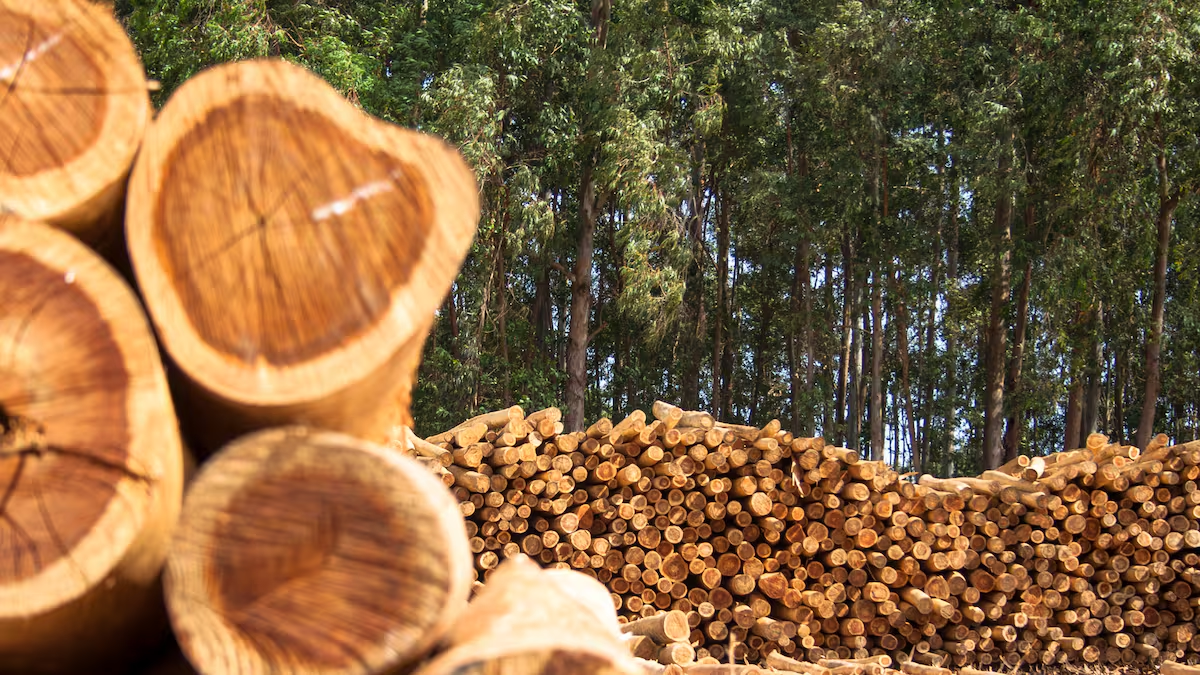
CarbonScape’s technology addresses both challenges by enabling the production of battery-grade graphite from widely available forestry byproducts.
“This approach supports the development of regional supply chains while helping battery and automotive manufacturers meet increasingly stringent sustainability and regulatory requirements,” the company said.
Jamie Gray is an Auckland-based journalist, covering the financial markets, the primary sector and energy. He joined the Herald in 2011.
Stay ahead with the latest market moves, corporate updates, and economic insights by subscribing to our Business newsletter – your essential weekly round-up of all the business news you need.