
Finally, the Queen has arrived. The origin of Akasha’s awakening is the high point of the season so far.
Photo: AMC/courtesy Everett Collection
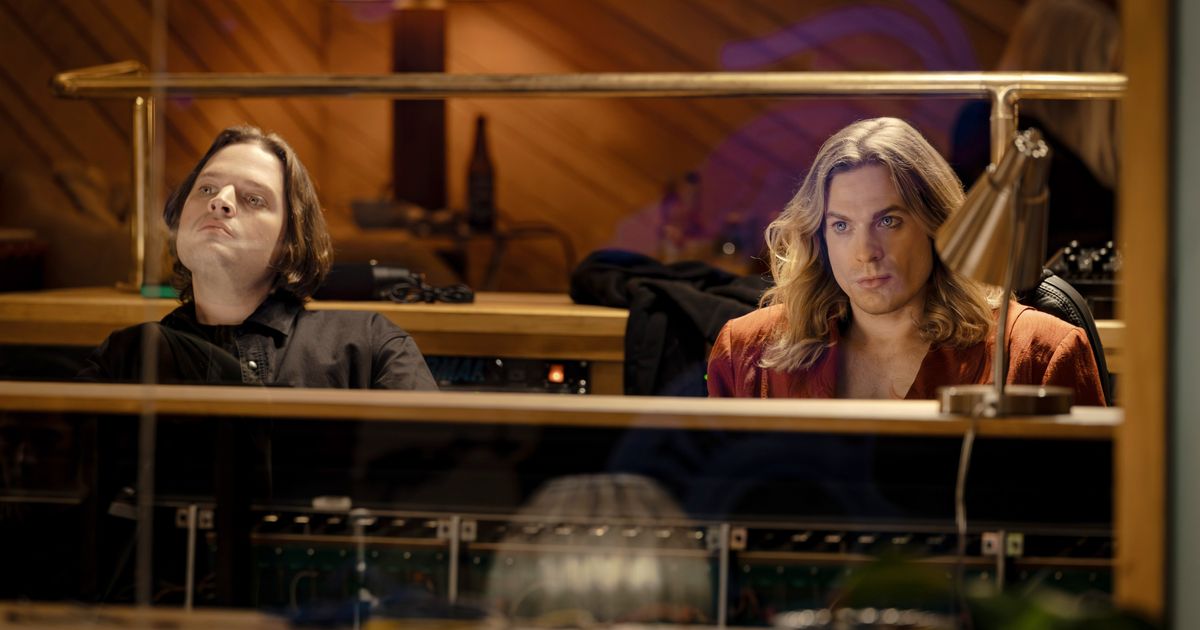
Finally: the Queen! All season long, this show has been writing checks that its ass couldn’t Akash-a, but Lestat promises to get into the biggest of the “Big Bad”s this episode. We open in the recording studio where Lestat has entombed himself with his band and Sam Barclay, making what will be released as a “posthumously produced” album. Gabriella paid off most of his entourage to leave him and the band alone and is now basically his own private Joe Jackson, pressuring him to record nonstop. He has the time, now that he’s faked his death. Lestat’s been in New York for four months but has only left the studio once, which is so sad because I think he would’ve really gotten a kick out of Oh, Mary!
Without the pleasures and distractions of tour life, Lestat is an insufferable bandleader, giving everyone directions like “Your drums are my heart. Your guitar is my hunger. Your bass, the night terrors that follow me to my coffin.” (Larry’s guitar symbolizes Lestat’s “frailty,” causing Lar to storm out.) This calls to mind how Rolin Jones said he originally wanted Lestat to be a conductor, and makes me so glad that they didn’t go in that direction; I would not be able to handle five more minutes of, “Your piccolo is my soul! Your trombone’s my dick!”
A flashback takes us to the 19th century, when the vampire Marius de Romanus (Christopher Heyerdahl) dug Lestat out of the ground and brought him to the utopian scholastic lair where he keeps Akasha (Sheila Atim, at long last). The viewer has to fill in the blanks about how Gabriella’s departure made Lestat so upset that he decided to just go bury himself in a hole for 80 years, but now here he is, in a basement with this quirky ancient vamp, painting and muttering to himself, and telling Lestat that he was commanded to uproot him like a hunky French carrot so that he can take over as the new keeper. By whose command? Keeper of who? Of the “mother and father” of them all, who appear like lying statues carved out of stone, but who are very much alive. He is instructed to be sort of a magpie for them, going into the chaos of society to bring back worldly “presents of the present.” He must also nourish them with ashes of his victims, because “blood overwhelms,” and to play music for Akasha, although he says he doesn’t play (solitary confinement will soon fix that). As for the “father,” Enkil, he has a giant chunk missing from the back of his skull, from a night in 1802 when Marius was transporting them from crypt to crypt and didn’t fully entomb them. That night, all vampires everywhere burned alive, under the moon (Lestat says he and Gabriella spent months recovering in a bog.) “If she burns, we will burn.”
This info dump would be a lot for anyone to take in, even if they didn’t just wake up from a decades-long dirt nap, and Lestat is overwhelmed. “I don’t like being alone,” Lestat says in a small, sad voice, worried about being thrust into this isolated stewardship against his will and this isolated existence. But Akasha chose him, out of the few remaining vampires on earth, and Marius is already halfway out the door, suitcase packed and Hawaiian shirt and Goofy hat on, saying ohyeah and bytheway she didn’t say a word to me for 22 years okbyeeeee. The second he leaves, though, she speaks without moving her lips to Lestat, to correct the record about just how long she chose not to talk to this guy: “tweeeeenty threeeeee.” Marius’s quick Keeper tutorial is rushed in a way that many of the season’s flashback plotlines have been, but at least here it effectively shows just how disoriented and lost Lestat would have been. It is so crushing to see how the majority of Lestat’s life, in his own recounting, was him being thrown around into situations against his will and beyond his understanding, but he has been burdened with all kinds of destiny.
Cast out of TVL’s entourage, Daniel is making like a Washington Square Park TikToker and filming interviews with many a “random Manhattanite” when Armand appears to him in disguise, telling the story of how he followed Daniel for 52 years, “interceding on his behalf” in his life. He was going to come clean at their first reunion, “but I felt you were not in a space to receive it,” because no one weaponizes therapy-speak better than Armie. Daniel wants Armand to prove that he meant what he said in Philly about being in love, so Armand rattles off all of the times that he stalked Daniel over the years, including a time that he memory-wiped a UMass Amherst student that Daniel assaulted. He says that love between vampires is love is love is love, and gives the very unhelpful example that “Lestat lays with his mother,” blowing Gabriella’s cover. He knows just the right things to say to get his favorite newshound to sit, stay, and roll over.
In the recording studio, Lestat tells Gabs she was a terrible mother but also kisses her in desperation, and directs the band in recording their bluntest Great Conversion anthem yet, to Gabs’s specification. Then, he tries to record “Big Boss” while the ghost of Nicky heckles him. In order to lay down the rawest of vocals, he brings a mic out into broad daylight and wails while his flesh turns to sand, and back in the booth, he looks like he got, well, a vampire facial.
In a flashback, all about being enamored with the human world but laying the groundwork for its destruction to please a Scary Mommy, Lestat comes back from the Monastiraki with gifts for Akasha. He has a spring in his step because our girl Lestat loves a shopping spree, but we see how, in his time in isolation as the Keeper, he has taken on Marius’s eccentric yammering. He is a far cry from the suave, powerful Lestat we saw in season one through Louis’s eyes; he’s still Little Mister Whimsy, getting giggly over the invention of the ice cream scoop and comparing the mouthfeel of the word to “an owl daydreaming he’s a kingfisher.” On the violin, he tries to recreate something he heard on bouzouki in the marketplace, but Akasha starts booing him. No, not boo. She’s saying scoooo… (“You have to put the p,” he corrects.) Then Akasha actually moves, flicking the scooooop to the ground, in a scene that wraps up all of the yearning theatricality and moments of creeping horror.
Meanwhile, Louis is paying Regina to do his very awkward and very sad Daddy Lou gestalt therapy, with a yellow dress and everything, and he’s folded a fake Madeleine into the mix. As someone pointed out in the comments last week, the arrangement is an echo of how he used to pay Lily, a sex worker under his employ, just to talk. He fills them in on his life, and they riff as though Claudia and Madeleine are alive and well and going to Cubbyhole. But the performance is just a performance, and any tears in the fabric of this little roleplay let too much pain in. Later, when it’s just the two of them in a paddleboat, she asks him to use his powers to freeze her in place. Louis acquiesces and cries.
Contrasted with Louis losing his grip in the present, past-tense Lestat is throwing the worst New Year’s Eve party ever for an assortment of objects sourced from his I Spy prison, gathered around a table like teddy bears at the proverbial picnic. There’s Nicky (a violin), Marie Antoinette (a slice of cake), Armand (moldy bread), Gabriella (a Tiffany lamp), his dad and brothers (cabbages, naturally), a random dead body, and an empty chair for Marius, who he blames for his state of dejected mania. He’s Lestatsplaining Schubert’s unfinished 8th to his intimate inanimates when Akasha’s voice pleads for him to shut the fuck up. He murmurs, “Are you affronted by these intimacies, Enkil? My hand on your Eve on the eve of a great century?” to her mangled groom and pricks his finger to rouge her lips, saying, “You would have been exquisite in your youth.” It’s all so grandly Gothic, and then Lestat scratches the record, the clock strikes midnight, and shit hits the fan, as Akasha shifts upright with extended hand, hissing, “Coooome to meeeeee.” That bit of blood he dabbed on her lips was enough to put her in Sicko Mode, and she seizes Lestat and drinks from him.
In the present, Louis reaches out to Lestat, and in his car parked outside the diner, he fills him in on the situation with Regina. “I know it’s not real. But … is it? Is it her, come back to me? I can’t tell, and whole nights go by where I don’t want to be able to tell.” He wants Lestat to go in there and tell him: Is it her, somehow? Lestat notes that Louis didn’t reach out when he was shot in the street, but yes, he’ll go in. In his little I am not the famously assassinated musician Lestat disguise of a black hoodie and sunglasses, he approaches the bar, and so much shock and sadness plays across his face just watching their dead daughter’s grown-up double go about her job, and so many calculations cross her face as she realizes who she’s talking to. He entreats her to stop playing this game with Louis, as it’s hurting him. He swallows his tears, and seeing how easy it would be to become totally undone by living out this strange fantasy with a fake Claudia, tells Louis at his car window that “it’s not anything like her” and not to see this person again. After that early sequence of Lestat in Montreal, this whole scene is my favorite of the modern-day parts this season, particularly for how Jacob Anderson plays his desperate grief and how Sam Reid plays his acute attunement to Louis’s moods, and the ways that he fronts atop his own pain. The show is at its best when it homes in on what made the show so compelling in the first place: these characters and their relationships. Also: more great work on the score from Hart.
But then the show spends a few more minutes on Lestat’s music, as he’s inspired to write a sort of adult contemporary Adele ballad about his grief over failing Claudia as a parent and maker. I found the focus on the recording studio in this episode rough. At least the concert sequences had that note of performative excess you had to appreciate on the level of gumption and glitter. But this reminded me of any number of stale recording studio sequences in bad musician biopics, or like if Ally Maine’s serious piano stuff did not ultimately eat down. The band does not see Lestat’s vision. TC correctly laughs out loud at Lestat insisting he’s redoing the entire album with “instruments played like metaphors.” “You need to be a vampire to hear it” is the type of explanation for the music that works in a pure genre way for the wailing monster-trash nu-metal of Queen of the Damned and works less for easy listening. That’s okay, though, because things take a turn for the delightful again when his bandmates ask to be turned and Lestat says, “Let me tell you something about this blood.” I’m locked the fuck in. “Long Face” might be cut from the album, but now we’re having fun. Tell us something about this blood!
Marius returns home in 1900 to find the clocks all spinning, Akasha wide-eyed and ranting, and Lestat suspended, twirling in mid-air, where he’s been for three whole days, after she told him to drink from her. Marius wrestles her back onto the slab and screams at Lestat: now she owns him, and her blood will run hot in his veins and imbue him with her powers but also her madness. Marius casts the wicked “son of Magnus” out while Akasha, with wide eyes, continues her breathless rant. Lestat explains to the band, “This is the metal sun inside my veins. This is the hell I unleash on all those near me. It cannot be restrained in the moment or drained over time. It will drag you into depravity and reward you with regret.” As he says this, we see a highlight reel of Lestat’s wickedest moments, including dropping Louis from space. Lestat, like a Spider-Man villain, was in the grips of Akasha’s mad queen’s blood in those moments, and he could do nothing to stop it. But the band is undeterred, and Gabriella bares her fangs to turn them. All of the flashback sequences, culminating in the awakening of Akasha, are an absolute high point of the season so far, and make the stakes of Lestat’s doom loom larger as we hurdle towards the end of the season.
Finally, there’s poor Larry, Lestat’s whipping boy, whose guitar playing has been worse than usual ever since his brother Alex returned and, in Armand’s grip, began drinking again. While the rest of the group swears their devotion to the band, Larry tries to run away, but is joined on a subway platform by the gremlin Armand, who gets to show off his favorite party trick: getting into Lestat’s musician friends’ heads and making them kill themselves. He says, “You do look tired,” which would have been enough of an excuse for me to end it all personally. But it’s the word “rest,” a hypnotically incepted command that he somehow had Alex say to Larry earlier, that makes Larry step in front of a train. The look on Armand’s face afterwards is blank and chilling. Mama, I’m so scared.
• “Inflate your lips, be it facial or labial” is maybe the worst line to come out of this entire series.
• Heyerdahl’s Marius is perfectly nutty. I love the way he yells, “She was on the slab for centuries!” He also looks like the Art Attack head.
• Lestat has never been more relatable than when he said, “Job? I want to die!”
• I love the focus on the ice cream scoop, an invention by an African American inventor, Alfred L. Cralle. It pegs the scene to 1897.
• Lestat was really in his Hamlet bag when he said, “Why do we exist? Why do we endure at all? And why did she leave me? Am I evil? Is my evil sanctioned by nature or divine error? Where is God?” to no one.
• Funny meta joke: Louis telling Regina she doesn’t have to do the accent because the accent’s hard, from one British actor to another.
Sign Up for the Vulture Newsletter
Entertainment news, for the pop-culture obsessed.
Vox Media, LLC Terms and Privacy Notice