
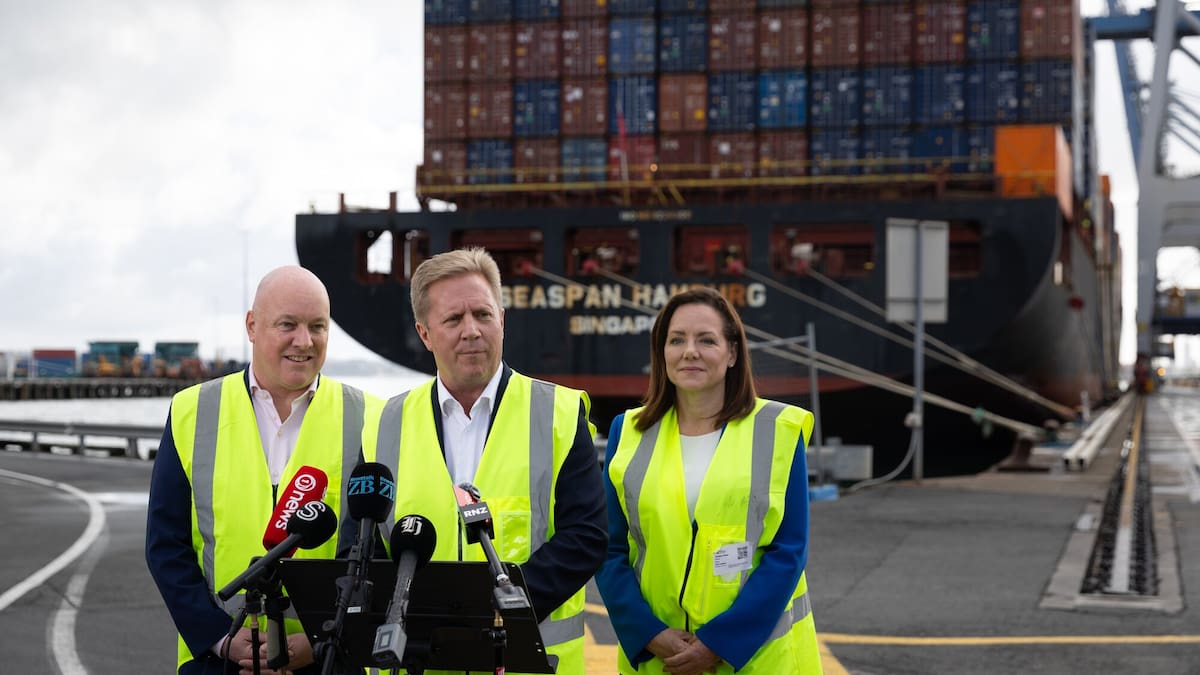
Supporters say that is the kind of ambition a small trading nation needs. Sceptics say the policy may be trying to do too much at once.
BusinessDesk senior correspondent Dileepa Fonseka told The Front Page that there are different reasons to include each place on the party’s wish list.
“They have all been identified as big markets. The total exports to them are not massive at the moment, about $1.8 billion. I think our exports to China are somewhere in the vicinity of $25 billion.
“But I guess they’re saying from a low base you could potentially grow it. These countries have come up for different reasons in the past.
“If you think of somewhere like Brazil, you know Sao Paulo is the biggest urban area outside of Asia in terms of population. New Zealand is at a unique kind of geographic point where we’re the shortest point between some of the big Chinese cities, if you’re talking about Shanghai or Beijing and Sao Paulo,” he said.
Together, the priority markets represent almost 700 million people and more than US$5 trillion ($8.8t) in combined GDP.
A re-elected National Government will prioritise commencing negotiations with each of these seven markets in the next five years. The next term would see at least 23 trade missions with a “sharper focus on sector-specific missions”.
“So rather than it being focused on a particular country, it’s gonna be focused on sectors. So it’d be a trade mission about fintech.
“We’ll have to wait and see how different this is in practice. Are they talking about having trade missions where it’s multiple countries and you’ve got people from one sector who are going to all those countries, and a politician is leading it, or is it some other model?” Fonseka said.
National’s trade policy is just as much about moving forward as it is about not falling behind, he said.
“One example where we’ve suffered already is India. When India signed a free trade agreement with Australia, we were a big exporter.
“We suddenly saw big reductions in the amount that we were exporting to India, and Australia suddenly saw big increases in what it exported.
“I think it’s interesting because trade policy’s diverging a little bit. There’s offence, and there’s defence, and you could argue that the India FTA is a little bit of both, but you could say that, to some extent, it is actually a defence because we’re just trying to get back to the position we were at after somebody else negotiated a better agreement,” he said.
Labour’s trade spokesman Damien O’Connor said putting time constraints on trade negotiations was not a recipe for securing the best trade agreements.
“The ability of MFAT [the Ministry of Foreign Affairs], MPI [the Ministry for Primary Industries], and other core agencies to negotiate all of these agreements is pretty unrealistic.
“Labour supports ambition, but it will be agreement by agreement as the resources are available,” he told BusinessDesk.
Listen to the full episode to hear more about:
Why these countries?Quantity versus qualityTrade missions and strategyPolicy as defence and offence.
The Front Page is a daily news podcast from the New Zealand Herald, available to listen to every weekday from 5pm. The podcast is presented by Chelsea Daniels, an Auckland-based journalist with a background in world news and crime/justice reporting who joined NZME in 2016.
You can follow the podcast at iHeartRadio, Apple Podcasts, Spotify or wherever you get your podcasts.