
The Bank House pub and museum on Whiddy Island, Co Cork. Photo / Thomas Bywater
A few paces back was my brother-in-law, with a plane still to pack for, looking increasingly uncomfortable.
Humid sun raked the country roads. Dark clouds kept raincoats in hand and everyone guessing. It was summer in Ireland.
Just behind was a dozen bovine eyes. Liver-brown poddy calves recently split from their herd. They trod the edge of their paddock, calling for their mums.
The only person delighted to be there was my daughter, Fiadh. She pushed long stems of grass through the five-bar gate at the cows. Uncomplicatedly happy in the way that only 2-year-olds can be, stopping to pull fists full of hedgerow flowers at every turn.
With an airport departure fast approaching, it looked increasingly unlikely we would ever find great-grandad and nanny O’s home. Though this was not the main reason for a family trip to Ireland.
We were in the Beara Peninsula to set a world record, with 2000 other O’Sullivans.
The ruins of Allihies Copper Mine on the Beara Peninsula. Photo / Thomas Bywater
A challenge for the ages
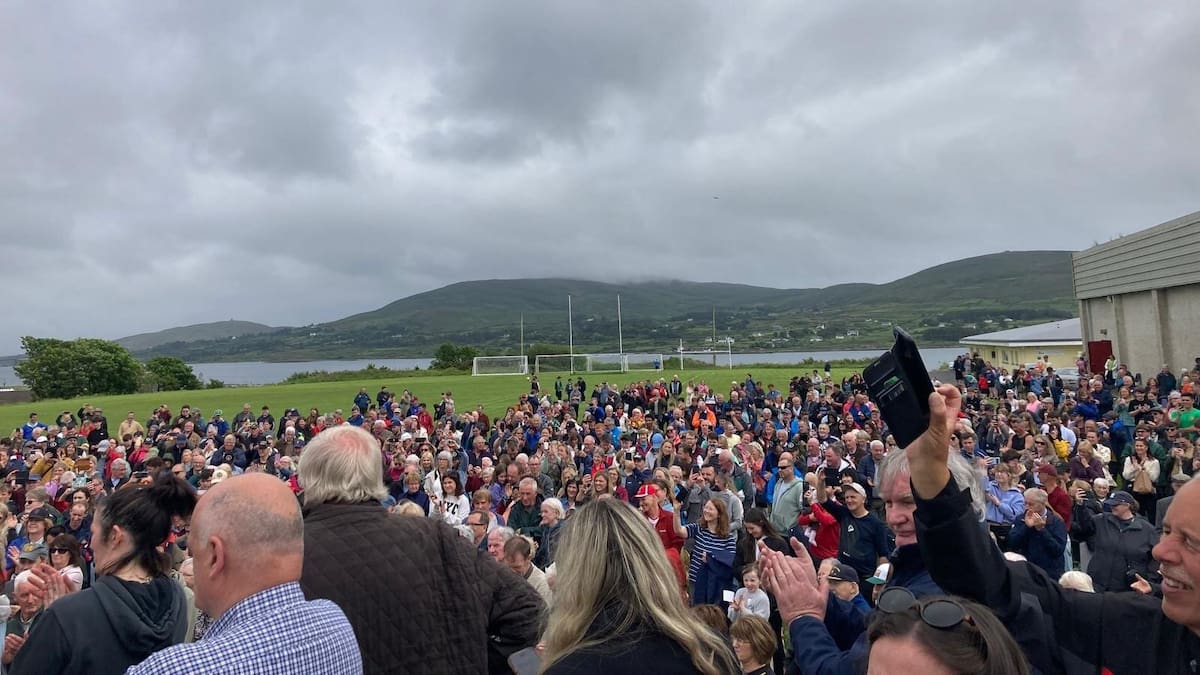
That weekend, the Clan O’Sullivan had set a challenge to claim the world record for most people gathered with a shared family name. O’Sullivans flocked in from Texas to Tauranga. The local tourism trade was delighted.
The aim was to gather all of them for 1pm on May 30 on the Castletownbere playing fields.
“Thousands descend on West Cork for world record,” headlines from RTE and Euronews reported breathlessly.
Already one of Ireland’s most popular names, nearly 5% of Cork Census are O’Sullivans. The further west you go – towards the peninsula – that’s more like one in ten. And Castletownbere is the epicentre of O’Sullivans. Particularly on this May weekend.
Crowds posed for selfies outside “O’Sullivan’s Garage”, “O’Sullivan’s Bar”… “O’Sullivan’s self-service petrol station”.
As a Bywater, I was gatecrashing the party.
Thomas Bywater and daughter Fiadh at the O’Sullivan gathering. Photo / Thomas Bywater
My wife – whose passport still proudly bears the name O’Sullivan – had not been well enough to travel. Ever pragmatic, she insisted Fiadh and I still go. It was a chance to see the grandparents. To see the “old country”. To avoid wasting an airfare.
It was also expedient as everything was booked in my name. (Presumably to avoid confusion with all the tens of hundreds of O’Sullivans filling every B&B and car rental this side of Cork.) My role was now surplus as a plus-one to the most intense family gathering in the world.
Castletownbere – with a high street containing a handful of pubs, an honorary Spanish fisherman’s consul, and not much else – hardly looked ready. Crowd control consisted of plastic cones and tape.
Nearing midday, the pubs were approaching full. The O’Sullivan diaspora had a different “Guinness World Record” in mind. Stout began to flow.
It was black pints, grey skies and half-remembered family stories.
Fiadh, in primary colours and sticker book in hand, was quite content. As the publican came over, I tried to peel a ripped flamingo off a barstool. I needn’t have worried. He gave me a smile and Fiadh a coin.
Not a Euro. A copper coin. Heads was the Irish clairseach harp and a mother hen on the tail. An old Irish penny.
This part of the country is famous for its copper. Or rather, this part of Ireland is famous for English copper mines.
Saying I was an interloper in the land of O’Sullivans was only half true. I had my own family connection: Anglo-Irish miners, expelled during the 1920s. Today, the only links were the Allihies mines at “Hungry Hill” and the derelict “Dunboy” Mansion – burned to a shell. The latter loomed large near the playing fields.
Dunboy Mansion’s ruined shell near the O’Sullivan gathering. Photo / Thomas Bywater
I half-recognised it from a family holiday, two decades prior. Though it now looked as if it had been exhumed by Trump Turnberry.
The mansion underwent a failed transformation into a luxury golf resort, abandoned again during the 2008 financial crash. It was now returning to a comfortable state of decay.
The weather had not let up by the time the blazers and clipboards arrived. The count had begun. There was to have been music and Irish dancing, but this had been washed off and instead of Riverdance, Fiadh and distant cousins stomped the boards impatiently in gumboots. O’Sullivans young and old waited for the result. It wasn’t until 3.30pm that clan chieftain Kelly O’Sullivan’s soft Iowa accent announced the count over a rainy sports field. We had broken the record: 1848 O’Sullivans passed through the turnstiles from Ireland, UK, Australia, New Zealand, and America. Not many had stuck around to find out.
Hungry Hill rises above the Blue Pools in Glengarriff. Photo / Thomas Bywater
The last hurrah
At last, there it was. Asking directions from a woman with a piebald pony, there on the shore was great-grandpa O’Sullivan’s house.
“Maybe it wasn’t a lake,” my mother-in-law said, watching waves break.
We stopped into the Bank House – Teach an Bhainc – the pub, post office and informal museum. On reflection, it is where we should have started our search. It was run by distant relatives of our branch of O’Sullivans – though discovering family members was beginning to lose its novelty. They were even able to produce an old school photo, circa 1926. Not a usual thing to have at the time. There in the rows were great grandpa O and several aunts – barefoot children as they were then.
Before we knew it, we were on the boat back from Whiddy Island, to the visible relief of my step-brother. Hearing there was a plane to catch, the Bank House had kindly put on an extra ferry for us.
Hey, what are family for?